UN to launch new Yemen peace roadmap within two months

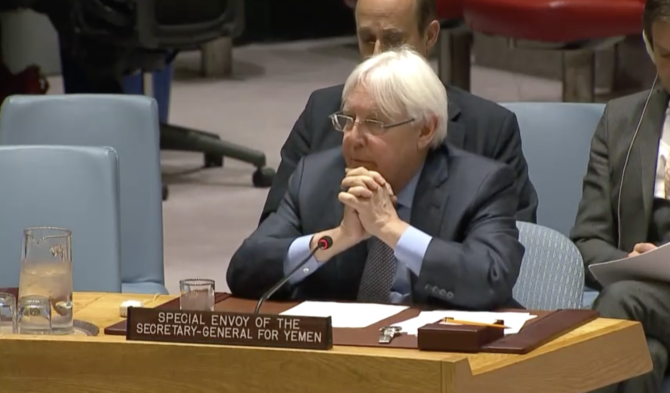
United Nations Yemen mediator Martin Griffiths submitted his first report on Yemen to the UN Security Council (Photo: Screengrab)
Updated 17 April 2018
Follow

UN to launch new Yemen peace roadmap within two months

  • UN Envoy to Yemen says plans to put a framework for negotiations to end the conflict to the UNSC within 2 months
  • Saudi-led Coalition and the Yemeni National Army downed two Iranian drones

UNITED NATIONS: The United Nations’ new peace envoy for Yemen said Tuesday he will present a plan within two months to re-launch negotiations to end the war but warned that missile strikes on Saudi Arabia risked derailing the effort.

Submitting his first report to the Security Council, Griffiths said there are no guarantees for the success of negotiations in Yemen without confidence and goodwill and the conflict will not be resolved without agreement between leaders.

Addressing the Security Council, Martin Griffiths said a possible sharp escalation from the missile attacks on Saudi Arabia and intensified fighting could “in a stroke, take peace off the table.”
“My plan is to put to the council within the next two months a framework for negotiations,” Griffiths said in his first council report since taking over as special envoy in February.

He added that the legitimate government in Yemen has expressed its readiness to help achieve peace, stressing that peace will not be achieved without listening to and involving Yemenis in the south.

"We will work to reach an agreement acceptable to all Yemeni parties," said Griffiths, noting that all parties must cooperate to reopen Sanaa airport.
He also warned that there were unconfirmed reports that “movements of forces in Yemen are on the increase” and that the prospect of intensive military operations around Hodeidah port might be forthcoming.

The Saudi-led coalition battling Yemen’s Houthi rebels on Monday warned it was ready to inflict a “painful” response if new attacks are carried out against Saudi Arabia.
Riyadh said last week it had shot down two Iran-supplied drones in the south of the kingdom as well as interceptws ballistic missiles fired from rebel-held parts of Yemen, the latest in a series of similar incidents.
Griffiths cited the increased number of ballistic missile launches, intensified military operations in northwest Saada governorate, ongoing air strikes and movements of forces in the Hodeidah region as worrisome developments.
“Our concern is that any of these developments may, in a stroke, take peace off the table. I am convinced that there is a real danger of this,” said the envoy.
War-wracked Yemen is the world’s worst humanitarian crisis, according to the United Nations, with 75 percent of the population — 22 million people — in need of aid, seven million of whom are at risk of famine.
A severe cholera outbreak has also killed 2,000 people and infected one million, the International Committee of the Red Cross said.Griffiths also expressed concern over the rockets launched from Yemen towards Saudi Arabia.
Meanwhile, the Saudi-led Coalition and the Yemeni National Army on Tuesday downed two Iranian drones, as reported by Al-Arabiya. 


Syria’s leader set to visit Berlin with deportations in focus

Updated 2 sec ago
Follow

Syria’s leader set to visit Berlin with deportations in focus

BERLIN: Syrian President Ahmed Al-Sharaa is expected in Berlin on Tuesday for talks, as German officials seek to step up deportations of Syrians, despite unease about continued instability in their homeland.
Sharaa is scheduled to meet his counterpart Frank-Walter Steinmeier, the German president’s office said.
Chancellor Friedrich Merz’s office has yet to announce whether he would also hold talks with Sharaa during the visit.
Since ousting Syria’s longtime leader Bashar Assad in late 2024, Sharaa has made frequent overseas trips as the former Islamist rebel chief undergoes a rapid reinvention.
He has made official visits to the United States and France, and a series of international sanctions on Syria have been lifted.
The focus of next week’s visit for the German government will be on stepping up repatriations of Syrians, a priority for Merz’s conservative-led coalition since Assad was toppled.
Roughly one million Syrians fled to Germany in recent years, many of them arriving in 2015-16 to escape the civil war.
In November Merz, who fears being outflanked by the far-right AfD party on immigration, insisted there was “no longer any reason” for Syrians who fled the war to seek asylum in Germany.
“For those who refuse to return to their country, we can of course expel them,” he said.

- ‘Dramatic situation’ -

In December, Germany carried out its first deportation of a Syrian since the civil war erupted in 2011, flying a man convicted of crimes to Damascus.
But rights groups have criticized such efforts, citing continued instability in Syria and evidence of rights abuses.
Violence between the government and minority groups has repeatedly flared in multi-confessional Syria since Sharaa came to power, including recent clashes between the army and Kurdish forces.
Several NGOs, including those representing the Kurdish and Alawite Syrian communities in Germany, have urged Berlin to axe Sharaa’s planned visit, labelling it “totally unacceptable.”
“The situation in Syria is dramatic. Civilians are being persecuted solely on the basis of their ethnic or religious affiliation,” they said in a joint statement.
“It is incomprehensible to us and legally and morally unacceptable that the German government knowingly intends to receive a person suspected of being responsible for these acts at the chancellery.”
The Kurdish Community of Germany, among the signatories of that statement, also filed a complaint with German prosecutors in November, accusing Sharaa of war crimes, genocide and crimes against humanity.
There have also been voices urging caution within government.
On a trip to Damascus in October, Foreign Minister Johann Wadephul said that the potential for Syrians to return was “very limited” since the war had destroyed much of the country’s infrastructure.
But his comments triggered a backlash from his own conservative Christian Democratic Union party.