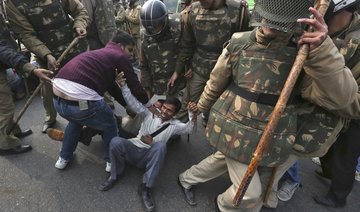
NEW DELHI: India’s women’s minister on Friday called for the death penalty for child rapists as nationwide outrage mounted over the brutal gang rape and murder of an eight-year-old girl.
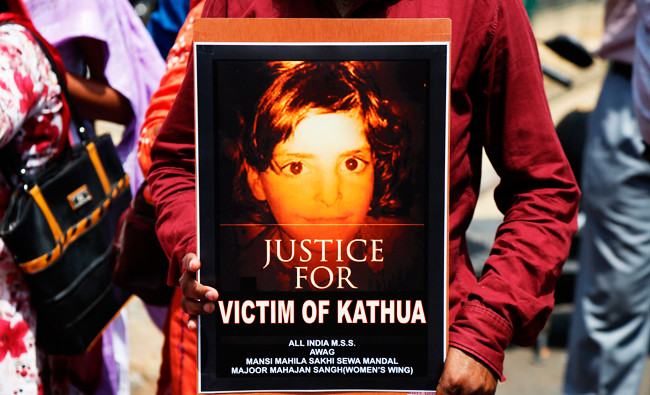
Demonstrations were held in New Delhi and other cities as horrific details emerged of the murder of the Muslim girl, who was repeatedly raped while being held for five days in the city of Kathua in Jammu, including at a Hindu temple.
“I have been deeply, deeply disturbed by the rape case in Kathua and all the recent rape cases that have happened on children,” the women and children’s minister Maneka Gandhi said in a Twitter video message.
Gandhi said her ministry would seek an amendment to India’s Protection of Children from Sexual Offences Act, “asking for the death penalty for rape on children below 12 years.”
The killing has shaken the country in a way reminiscent of the fatal gang rape of a Delhi student on a bus in 2012 that made headlines around the world.
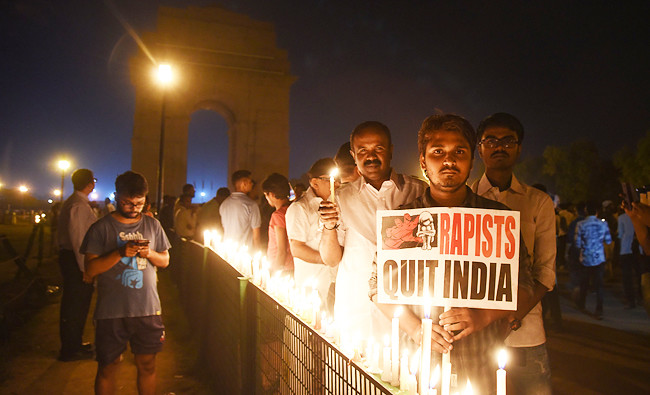
Rahul Gandhi, Congress Party President, led a candlelight march late Thursday to the India Gate monument in Delhi — the site of mass protests after the 2012 attack — to highlight the “unimaginable brutality” of the latest killing.
“Like millions of Indians my heart hurts,” Gandhi said at the midnight rally. “India simply cannot continue to treat its women the way it does.”
Vikramaditya Singh, who joined protesters at India Gate later Friday, said deep reforms were needed to improve women’s rights in India.
“The women in this country are the victims of these crimes. Besides taking action in this case, we need to look at the... upbringing and education of men in our society,” Singh told AFP.
Eight people have been arrested over the killing, including four police officers and a minor. All are Hindus.
The girl, whose identity was protected by a court order Friday, was murdered in January in the northern state of Jammu and Kashmir.
According to the charge sheet, she was abducted by the minor and an accomplice. The girl was forced to take sedatives and during five days in a shed and then a Hindu temple, she was repeatedly raped by the juvenile and different men, including a police constable.
She was finally strangled and beaten with a stone. According to the charge sheet, one of the attackers raped her just before she died.
Jammu and Kashmir is India’s only Muslim-majority state, but the Jammu region in the south, where the rape and murder took place, is Hindu-dominated.
The case has heightened fears of communal tensions in the region. Muslim activists have demanded action against what they see as a crime against their community.
This week, a crowd of Hindu lawyers tried to stop police from entering a court to file charges against the accused men.
Prime Minister Narendra Modi, head of the Hindu nationalist government, has yet to comment on the case, but the Jammu and Kashmir chief minister, whose party is aligned with Modi’s Bharatiya Janata Party, said the murder had “shamed humanity.”
Separately, a senior BJP lawmaker in Uttar Pradesh state faces arrest over the rape of a 17-year-old woman. The alleged attack occurred last year but only started making headlines again after the woman tried to set herself on fire outside the state chief minister’s residence last weekend.
High-profile names from the world of cinema and cricket joined the outrage over the Jammu crime in a country were nearly 40,000 rape cases are reported every year, according to official figures.
“What is happening to the world we live in???” Bollywood star Anushka Sharma, who is married to Indian cricket captain Virat Kohli, wrote on Twitter.
“These people should be given the most severe punishment there is! Where are we heading as humanity? Shaken to my core.”
Cricketer Gautam Gambhir blamed India’s “stinking systems” for what some have described as a rape epidemic.
“Come on ‘Mr System’, show us if you have the balls to punish the perpetrators, I challenge you,” he tweeted.

India outrage mounts over gang rape, murder of 8-year-old
- A crowd of Hindu lawyers tried to stop police from entering a court to file charges against the accused men
- Jammu and Kashmir is India’s only Muslim-majority state
Deadly militant offensive sweeps northern and eastern Burkina Faso
- Burkina Faso, ruled by a military junta since September 2022, has faced more than 10 years of raids by groups linked to Al-Qaeda and the Daesh
ABIDJAN: Al-Qaeda-affiliated JNIM has in recent days claimed to have inflicted heavy losses in Burkina Faso as a surge in deadly militant attacks sweeps across the Sahelian state.
Burkina Faso, ruled by a military junta since September 2022, has faced more than 10 years of raids by groups linked to Al-Qaeda and the Daesh, including the Group for the Support of Islam and Muslims (JNIM).
A February UN Security Council report noted that the “pace of JNIM attacks” had slowed in September as fighters were diverted to Mali to back an attempted fuel blockade.
“The group’s efforts in Mali have been the primary focus since early September last year,” said Heni Nsaibia, analyst at conflict monitor ACLED.
But attacks never fully stopped, and JNIM has launched a string of large-scale assaults in northern and eastern Burkina Faso since mid-February, killing dozens, including civilians.
“Since February 14, JNIM has claimed responsibility for 10 attacks across different regions of Burkina Faso,” said Hasret Kargin, an Africa studies researcher at intelligence firm Mintel World.
Deadly assaults
The deadliest incidents targeted Titao’s military base on February 15 in the northwest, where the group says it killed dozens of soldiers.
A separate ambush on the same day left around 50 forestry officers dead in Tandjari in the east.
Around 10 civilians were also killed in Titao, including seven Ghanaian traders.
“This latest round demonstrated a high degree of coordination, given the number of large-scale attacks that occurred between 12 and 22 February,” Nsaibia said.
“Over 130 people” — Burkinabe soldiers, civilian auxiliaries and JNIM fighters — “were killed in this series of battles.”
Kargin noted that JNIM has issued no formal statement explaining the recent uptick after several months of reduced activity.
But militant groups often strike “right before and during” the Muslim holy month of Ramadan, he said, adding current dry-season conditions had helped them on the ground.
‘Smuggling zones’
Recent attacks have gripped the country’s north and east, areas seen as financial hubs for Al-Qaeda’s Sahel branch.
“These are zones with numerous gold sites and key routes that fuel the group’s smuggling activities,” a Burkinabe security analyst said, requesting anonymity.
The north “acts as a bridge” to JNIM’s “main central command” in Mali, Kargin said, while he east — home to a vast nature reserve straddling Niger, Benin and Burkina Faso — allows the group to push into neighboring countries.
The forests, he added, both shield fighters from airstrikes and generate income through illegal timber sales and control of artisanal gold mining.
The Tandjari attack near regional capital Fada N’Gourma highlights JNIM’s growing freedom of movement after having “gained a lot of ground in recent years,” Nsaibia said.
“The question is not the frequency of attacks — they never stopped — but how these groups are able to inflict such heavy losses” when the army claims to be better equipped and better organized, said a Burkinabe political scientist.
The army, which rarely comments on attacks, said in mid-February it now controls 74 percent of national territory, with some “600 villages retaken.”
According to the UN report, JNIM recently appointed a senior leader in eastern Burkina Faso tasked with expanding into Benin, Ivory Coast, Ghana, Niger and Togo.
Burkina Faso, ruled by a military junta since September 2022, has faced more than 10 years of raids by groups linked to Al-Qaeda and the Daesh, including the Group for the Support of Islam and Muslims (JNIM).
A February UN Security Council report noted that the “pace of JNIM attacks” had slowed in September as fighters were diverted to Mali to back an attempted fuel blockade.
“The group’s efforts in Mali have been the primary focus since early September last year,” said Heni Nsaibia, analyst at conflict monitor ACLED.
But attacks never fully stopped, and JNIM has launched a string of large-scale assaults in northern and eastern Burkina Faso since mid-February, killing dozens, including civilians.
“Since February 14, JNIM has claimed responsibility for 10 attacks across different regions of Burkina Faso,” said Hasret Kargin, an Africa studies researcher at intelligence firm Mintel World.
Deadly assaults
The deadliest incidents targeted Titao’s military base on February 15 in the northwest, where the group says it killed dozens of soldiers.
A separate ambush on the same day left around 50 forestry officers dead in Tandjari in the east.
Around 10 civilians were also killed in Titao, including seven Ghanaian traders.
“This latest round demonstrated a high degree of coordination, given the number of large-scale attacks that occurred between 12 and 22 February,” Nsaibia said.
“Over 130 people” — Burkinabe soldiers, civilian auxiliaries and JNIM fighters — “were killed in this series of battles.”
Kargin noted that JNIM has issued no formal statement explaining the recent uptick after several months of reduced activity.
But militant groups often strike “right before and during” the Muslim holy month of Ramadan, he said, adding current dry-season conditions had helped them on the ground.
‘Smuggling zones’
Recent attacks have gripped the country’s north and east, areas seen as financial hubs for Al-Qaeda’s Sahel branch.
“These are zones with numerous gold sites and key routes that fuel the group’s smuggling activities,” a Burkinabe security analyst said, requesting anonymity.
The north “acts as a bridge” to JNIM’s “main central command” in Mali, Kargin said, while he east — home to a vast nature reserve straddling Niger, Benin and Burkina Faso — allows the group to push into neighboring countries.
The forests, he added, both shield fighters from airstrikes and generate income through illegal timber sales and control of artisanal gold mining.
The Tandjari attack near regional capital Fada N’Gourma highlights JNIM’s growing freedom of movement after having “gained a lot of ground in recent years,” Nsaibia said.
“The question is not the frequency of attacks — they never stopped — but how these groups are able to inflict such heavy losses” when the army claims to be better equipped and better organized, said a Burkinabe political scientist.
The army, which rarely comments on attacks, said in mid-February it now controls 74 percent of national territory, with some “600 villages retaken.”
According to the UN report, JNIM recently appointed a senior leader in eastern Burkina Faso tasked with expanding into Benin, Ivory Coast, Ghana, Niger and Togo.
© 2026 SAUDI RESEARCH & PUBLISHING COMPANY, All Rights Reserved And subject to Terms of Use Agreement.