

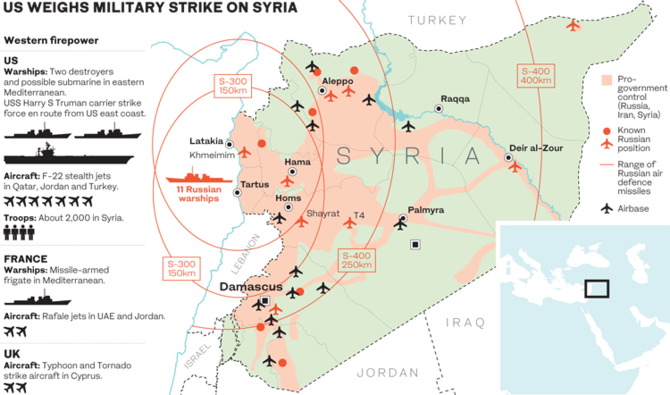


WASHINGTON/LONDON/MOSCOW: US President Donald Trump said yesterday he was holding meetings to discuss the crisis in Syria and that a decision would be taken “fairly soon” on threatened missile strikes in response to the suspected poison gas attack on a rebel stronghold.
Fears of a confrontation between Russia, Syria’s strongest ally, and the West have been running high since Trump said on Wednesday that missiles “will be coming” after the attack in the Syrian town of Douma on April 7. The US leader criticized Moscow for standing by Syrian President Bashar Assad.
“Never said when an attack on Syria would take place. Could be very soon or not so soon at all,” Trump said in an early morning tweet on Thursday.
Later, he said: “We’re having a number of meetings today, we’ll see what happens. Now we have to make some ... decisions, so they’ll be made fairly soon.”
Earlier, French President Emmanuel Macron said France had proof the Syrian government carried out the attack, which aid groups have said killed dozens of people, and will decide whether to strike back when all the necessary information has been gathered.
“We have proof that last week ... chemical weapons were used, at least with chlorine, and that they were used by the regime of (President) Bashar Assad,” Macron said, without offering details of any evidence.
“We will need to take decisions in due course, when we judge it most useful and effective,” he told broadcaster TF1.
Meanwhile, British Prime Minister Theresa May held a special cabinet meeting to consider whether Britain should join the US and France in possible military action. She has described the attack in Douma, just east of the capital Damascus, as barbaric.
Syria and its backers, Russia and Iran, say reports of the attack were fabricated by rebels, and rescue workers in Douma have accused the US of seeking to use it as a pretext to attack the government.
US Defense Secretary Jim Mattis, told Congress on Thursday that he believed there was a chemical attack in Syria, but added a short while later that the US had not made any decision to launch military action against the Syrian regime.
He accused Russia of being complicit in Syria’s retention of chemical weapons, despite a 2013 deal that Moscow helped broker requiring Syria to abandon them.
A team of experts from a global chemical weapons watchdog, the Organization for the Prohibition of Chemical Weapons, was traveling to Syria and will start its investigations on Saturday, the Netherlands-based agency said.
Despite the tension, there were signs of a global effort to head off a direct confrontation between Russia and the West. The Kremlin said a crisis communications link with the US, created to avoid an accidental clash over Syria, was in use.
There was no direct word from Russian President Vladimir Putin on the crisis, though he discussed the situation with Turkish President Tayyip Erdogan by phone on Thursday, Interfax news agency said.
The Russian foreign ministry said Moscow sought no escalation of the situation, but that it could not support “dishonest accusations” and had found no evidence of a chemical weapons attack in Douma.
Statements from Washington have been militaristic, ministry spokeswoman Maria Zakharova said, and threats by the US and France were a violation of the UN charter.
Syria’s military has repositioned some air assets to avoid missile strikes, US officials told Reuters. Locating Syrian aircraft alongside Russian military hardware might make Washington reluctant to target them.
Russian ships had left the Tartus naval base in Syria, Interfax news agency quoted a Russian lawmaker as saying.
Vladimir Shamanov, who chairs the defense committee of the lower house, said the vessels had departed the Mediterranean base for their own safety — “normal practice” when there were threats of attack.
For its part, the Russian military said it had observed movements of US Navy forces in the Gulf. Any US strike would probably involve the navy, given the risk to aircraft from Russian and Syrian air defenses.
A US guided-missile destroyer, the USS Donald Cook, is in the Mediterranean.
Assad said any Western action “will contribute nothing but an increase in instability in the region, threatening international peace and security,” Syrian state TV reported.


