Myanmar court refuses to drop case against Reuters journalists

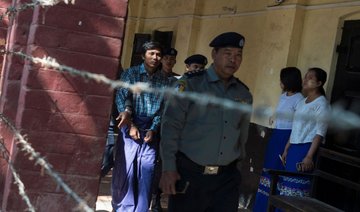
Detained Reuters journalist Wa Lone is escorted by police after a court hearing in Yangon on April 4. A Myanmar court is pushing ahead with hearings that have sparked global outrage and fears of shrinking press freedoms. (Reuters)
Updated 11 April 2018
Follow

Myanmar court refuses to drop case against Reuters journalists

YANGON: A Myanmar court on Wednesday rejected a motion to drop a case against two Reuters journalists arrested months ago while reporting on the Rohingya crisis, pushing ahead with hearings that have sparked global outrage and fears of shrinking press freedoms.
“The court decided that the proposal from the defendants’ lawyer to release the defendants ... has been rejected,” judge Ye Lwin told a courtroom in the commercial capital Yangon packed with supporters, family and media.
Reuters reporters Wa Lone, 32 and Kyaw Soe Oo, 27 were arrested in December and accused of violating the country’s Official Secrets Act for possessing material relating to security operations in conflict-hit Rakhine state.
Myanmar has faced global condemnation and accusations of extrajudicial killings, ethnic cleansing and genocide as some 700,000 Rohingya Muslims have fled Rakhine to Bangladesh following a military crackdown on insurgents.
The government rejects the allegations and says it was defending itself against attacks from the Arakan Rohingya Salvation Army, which occurred on August 25.
The Reuters pair had been investigating a massacre of 10 Rohingya men on September 2 in the Rakhine village of Inn Din that was carried out by security forces and local villagers.
Seven Myanmar soldiers have been sentenced to jail with hard labor for their part in the killings, according to a Facebook post by the army chief late Tuesday.
The case against the journalists has proceeded despite international calls for their release. Last month Reuters announced that prominent rights attorney Amal Clooney had joined the legal team.


BBC slammed for ‘shameful’ cut to ‘free Palestine’ comment at BAFTA Awards

Updated 23 February 2026
Follow

BBC slammed for ‘shameful’ cut to ‘free Palestine’ comment at BAFTA Awards

  • Broadcaster removes from broadcast part of filmmaker Akinola Davies Jr.’s acceptance speech at the British Academy Film Awards
  • Amnesty UK praises filmmaker for speaking up for those ‘facing and fleeing from persecution and mass atrocities’

LONDON: The BBC was accused on Monday of a “shameful” decision after it cut part of an acceptance speech at the previous night’s British Academy Film Awards in which a filmmaker uttered the phrase “free Palestine.”

British-Nigerian director and co-writer Akinola Davies Jr. and his brother, co-writer Wale Davies were collecting the award for outstanding debut by a British writer, director or producer for their film “My Father’s Shadow” when the former made the comment.

The BBC chose not to include the final part of his speech when it broadcast the BAFTAs ceremony later in the evening. However, the corporation did broadcast an inadvertent racist slur shouted by a person with Tourette syndrome while Black actors Michael B. Jordan and Delroy Lindo were presenting an award.

Akinola thanked industry figures and family for their support as he accepted the award, before dedicating it to “all those whose parents migrated to obtain a better life for their children.”

In the final part of his speech, cut by the BBC, he said: “To the economic migrant, the conflict migrant, those under occupation, dictatorship, persecution and those experiencing genocide, you matter and your stories matter more than ever.

“Your dreams are an act of resistance. To those watching at home, archive your loved ones, archive your stories yesterday, today and forever. For Nigeria, for London, Congo, Sudan, free Palestine. Thank you.”

The BBC, which broadcast the ceremony with a two-hour time delay, said the cut was made for timing reasons.

A spokesperson told Deadline: “The live event is three hours, and it has to be reduced to two hours for its on-air slot. The same happened to other speeches made during the night, and all edits were made to ensure the program was delivered to time. All winners’ speeches will be available to watch via BAFTA’s YouTube Channel.”

Human rights campaign group Amnesty UK described the decision by the BBC to cut part of the speech as “shameful.”

It added: “Thank you Akinola Davies Jr. for using your platform to speak out for the rights of migrants and people facing and fleeing from persecution and mass atrocities, from the Congo to Sudan to Palestine.”

In June last year, the BBC was at the center of a row after it broadcast a Glastonbury Festival performance by the duo Bob Vylan, during which the lead singer chanted “death to the IDF” in protest against the Israeli Defense Forces’ assault on Gaza.