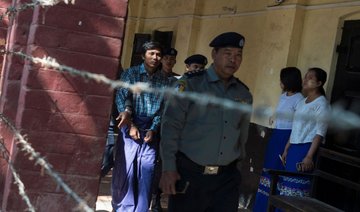
YANGON: A Myanmar court on Wednesday rejected a motion to drop a case against two Reuters journalists arrested months ago while reporting on the Rohingya crisis, pushing ahead with hearings that have sparked global outrage and fears of shrinking press freedoms.
“The court decided that the proposal from the defendants’ lawyer to release the defendants ... has been rejected,” judge Ye Lwin told a courtroom in the commercial capital Yangon packed with supporters, family and media.
Reuters reporters Wa Lone, 32 and Kyaw Soe Oo, 27 were arrested in December and accused of violating the country’s Official Secrets Act for possessing material relating to security operations in conflict-hit Rakhine state.
Myanmar has faced global condemnation and accusations of extrajudicial killings, ethnic cleansing and genocide as some 700,000 Rohingya Muslims have fled Rakhine to Bangladesh following a military crackdown on insurgents.
The government rejects the allegations and says it was defending itself against attacks from the Arakan Rohingya Salvation Army, which occurred on August 25.
The Reuters pair had been investigating a massacre of 10 Rohingya men on September 2 in the Rakhine village of Inn Din that was carried out by security forces and local villagers.
Seven Myanmar soldiers have been sentenced to jail with hard labor for their part in the killings, according to a Facebook post by the army chief late Tuesday.
The case against the journalists has proceeded despite international calls for their release. Last month Reuters announced that prominent rights attorney Amal Clooney had joined the legal team.

Myanmar court refuses to drop case against Reuters journalists
DCO and Arab News partner to combat digital misinformation, explore AI’s impact on media
KUWAIT CITY: The Digital Cooperation Organization (DCO) and the international Saudi newspaper Arab News have signed a Letter of Engagement aimed at strengthening knowledge and expertise exchange on the impact of artificial intelligence in the media sector, as well as leveraging expert insights to develop best practices to combat online misinformation amid accelerating technological advancements.
DCO said this step aligned with its efforts to strengthen collaboration with international media institutions to support responsible dialogue around digital transformation and contribute to building a more reliable, inclusive, and sustainable digital media environment.
Commenting on the agreement, Deemah AlYahya, Secretary-General of the Digital Cooperation Organization, said: “At a moment when AI is reshaping how truth is produced, distributed, and trusted, partnership with credible media institutions is essential.”
She added that “working with Arab News allows us to bridge technology and journalism in a way that protects integrity, strengthens public trust, and elevates responsible innovation. This collaboration is about equipping media ecosystems with the tools, insight, and ethical grounding needed to navigate AI’s impact, while ensuring digital transformation serves people and their prosperity.”
Faisal J. Abbas, Editor-in-Chief of Arab News, emphasized that the partnership enhances media institutions’ ability to keep pace with technological shifts, noting that engagement with representatives of DCO Member States enables deeper understanding of emerging technologies and regulatory developments in the digital space.
He added: “DCO’s commitment to initiatives addressing online content integrity reflects a clear dedication to supporting a responsible digital environment that serves societies and strengthens trust in the digital ecosystem.”
The Letter of agreement was signed on the sidelines of the Fifth DCO General Assembly held in Kuwait City under the theme “Inclusive Prosperity in the Age of AI”, alongside the second edition of the International Digital Cooperation Forum, held from 4–5 February, which brought together ministers, policymakers, business leaders, entrepreneurs, and civil society representatives from more than 60 countries to strengthen international cooperation toward a human-centric, inclusive, and sustainable digital economy.