

Saudi Aramco takes step to integrating petrochems into United States’ biggest refinery

A Saudi Aramco employee sits in the area of its stand at the Middle East Petrotech 2016, an exhibition and conference for the refining and petrochemical industries, in Manama, Bahrain, September 27, 2016. (Reuters)
Updated 08 April 2018
Follow

Saudi Aramco takes step to integrating petrochems into United States’ biggest refinery

HOUSTON: Saudi Aramco took the first steps to integrating a petrochemicals business into the United States’ biggest oil refinery, which is operated by its subsidiary Motiva Enterprises.
Aramco’s Chief Executive Amin Nasser signed memoranda of understanding (MoUs) worth $8 billion-$10 billion with Honeywell UOP and Technip FMC to study petrochemical production technology for use in a chemical plant the company is considering building at the Port Arthur refinery.
Saudi Arabia’s Crown Prince Mohammed bin Salman, who was winding up a two-week visit to the United States, was present at the signing in Houston, Texas, on Saturday along with Saudi Energy Minister Khalid Al-Falih and US Energy Secretary Rick Perry.
“These agreements signal our plans for expansion into petrochemicals,” Motiva’s Chief Executive Brian Coffman said.
Aramco, which wants to develop its downstream business as the government prepares to sell up to 5 percent of the world’s largest oil firm in an initial public offering (IPO) this year, wants to use oil as a major petrochemicals feedstock.
Coffman also said Motiva was evaluating boosting the 603,000 barrel-per-day (bpd) Port Arthur refinery’s capacity to 1 million or 1.5 million bpd, which would make it the largest in the world.


The aromatics unit for which Honeywell UOP’s technology is being considered under one of the MoUs, would convert benzene and paraxylene, byproducts of gasoline production, into 2 million tons annually of feedstocks for chemicals and plastics.
The other MoU would allow Aramco to use Technip FMC’s mixed-feed ethylene production technologies in the United States. The technology would produce 2 million tons a year of ethylene, which is used to make plastics, Motiva said.
The final investment decision on setting up a multi-billion-dollar petrochemical plant at Port Arthur is not expected until 2019, and is “dependent on strong economics, competitive incentives, and regulatory support,” Aramco said in a statement.
Coffman did not provide a timeline for the possible expansion of the Port Arthur refinery’s crude oil processing capacity.
“That’s something we’re evaluating, we’re studying for in the future,” he said.
The 1.2-million bpd Reliance Industries refinery in Jamnagar, India, has the world’s largest crude oil processing capacity.
Aramco said last year that it would invest $18 billion in Motiva to expand the refinery and move into petrochemical production.
Other US companies, including Chevron Phillips Chemical Co. — a joint venture of Chevron Corp. and Phillips 66 — and Exxon Mobil Corp, have recently opened plants, like the one Motiva is considering, to process ethane into ethylene.
Chevron Phillips is considering building a second ethane cracker on the Gulf Coast of Texas.
The price tag for a large ethane cracker is typically over $6 billion, according to analysts. In addition to taking refining byproducts, ethane crackers provide hydrogen for refineries to use in making motor fuels.
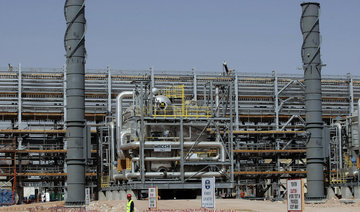
FASTFACTS

Motiva

Aramco-subsidiary Motiva is evaluating raising the Port Arthur refinery's capacity to up to 1.5 million bpd, which would make it the largest in the world.


Real Estate Registry signs 10 agreements at forum in Riyadh

Updated 29 January 2026
Follow

Real Estate Registry signs 10 agreements at forum in Riyadh

RIYADH: The Real Estate Registry concluded its participation in the Real Estate Future 2026, as a partner of the forum, with a distinguished presence that included the launch of its business portal, the signing of 10 agreements and memoranda of understanding with entities from the public and private sectors, the organization of specialized workshops, and the awarding of the Gold Award at the Real Estate Excellence Awards.

During his participation in the forum, the CEO of the firm, Mohammed Al-Sulaiman, reviewed the latest developments in real estate registration in the Kingdom in a keynote speech, highlighting the pivotal role of the Real Estate Registry in building a unified and reliable system for data. He also announced the launch of the national blockchain infrastructure, which aims to enable the microcoding of real estate assets, enhance transparency, expand investment opportunities, and support innovative ownership models within a reliable regulatory framework.

On the sidelines of the forum, Al-Sulaiman met with Nigeria’s Minister of Housing and Urban Development, Ahmed Dangiwa. During the meeting, they discussed areas of joint cooperation, exchanged experiences and advice on shaping the future of the real estate sector, and reviewed best practices in implementing real estate registration systems that enhance reliability and improve the efficiency of property registration.
efficiency of property registration systems.

The Real Estate Registry’s participation included organizing three specialized workshops that focused on the role of geospatial technologies in identifying ownership, enhancing transparency, and improving the quality of real estate data. 

The workshop “Empowering the Real Estate Registry for the Business Sector” reviewed digital solutions that enable the business sector to manage its real estate assets more efficiently and enhance governance and technical integration. The workshop “From Off-Plan Sales to Title Deed” focused on the journey of documenting real estate ownership and the role of the registry in linking the stages of development and documentation within an integrated digital system.

On the sidelines of the forum, the Real Estate Registry signed 10 agreements and memorandums of understanding, including a deal with Yasmina Information Technology Co. to utilize real estate data in developing smarter insurance solutions that support the real estate sector and enhance service reliability. 

Partnerships were also signed with Haseel, NewTech, and Sahl, as well as HissaTech and Droub, to develop innovative digital solutions in property ownership, fractional ownership, and asset tokenization, as well as real estate finance and investment within a trusted regulatory framework.

Further collaborations included an MoU with ROSHN Group, an agreement with the Saudi Water Authority to enable data integration and quality enhancement, an agreement with the Saudi National Bank, and a partnership with Saudi Post to link the national address with the property registry as a unified geospatial identifier supporting data accuracy and integration.

The registry’s participation was crowned with the Golden Award at the Real Estate Excellence Awards in the category of Excellence in Property Documentation, in recognition of its role in building a model based on transparency, accuracy, and speed, as well as advanced digital technologies and specialized legal expertise, contributing to rights protection and increasing the sector’s attractiveness.

The Real Estate Registry emphasized that its participation reflects its continued role as a key enabler of the real estate sector, a trusted data source, and an active partner in driving digital transformation, enhancing market efficiency, and building investor and financier confidence, in line with Saudi Arabia’s Vision 2030 objectives for a fully integrated and sustainable digital real estate ecosystem.