

The second phase of ‘Gulf Shield 1’ concluded in the east of Saudi Arabia on Saturday

1 / 5
Photo showing special forces units in sweeping manoeuvre as part of ‘Gulf Shield 1’ phase two training in the Eastern Province of Saudi Arabia. (SPA)
2 / 5
Photo showing units from Saudi Arabia and 23 other countries complete ‘Gulf Shield 1’ phase two training in the Eastern Province. (SPA)
3 / 5
Photo showing units from Saudi Arabia and 23 other countries complete ‘Gulf Shield 1’ phase two training in the Eastern Province. (SPA)
4 / 5
Photo showing F-16 fighter taxying in an air field in the Eastern Province of Saudi Arabia as part of ‘Gulf Shield 1’. (SPA)
5 / 5
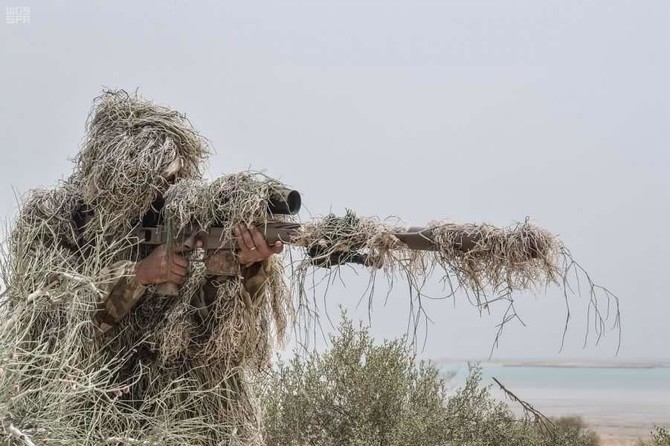
Photo showing a camouflaged sniper in Saudi Arabia's Eastern Province as part of ‘Gulf Shield 1 exercise. (SPA)
Updated 07 April 2018
Follow

The second phase of ‘Gulf Shield 1’ concluded in the east of Saudi Arabia on Saturday

London: 24 countries participated in the exercise, which included air, land and navy units in addition to air defense systems and special forces unit carrying out mock scenarios to attack and control huge areas of alleged enemy territory.

The aim of the maneuver was to ensure effective coordination between multi-national units from the 24 countries to maintain peace and security against modern adversaries — be it classic warfare or war operations against a non-state threat.

The exercise is considered one of the biggest in the region for the number of troops taking part in it. And is similar to operations like ‘Desert Storm’ in 1990-1991, and ‘Northern Thunder’ that took place in ‘Hafr Al Batin’ region in Saudi Arabia in 2016.

The Saudi Arabian-led exercise aimed to show the capability of Kingdom forces to plan and execute intricate military planing to manage seamless operation in various theaters of conflictusing the most developed communication and mapping technology to operate modern weapon systems.

Four of the participating armies are classified part of the ten most important armed forces in the world. The exercise demonstrated the 24 armed forces’ ability to liaise and operate in real time to attack missile launching sites, naval coastal control and protection, in addition to special forces’ lightning attacks, village door-to-door sweeps as well as clearing vital installations after an unconventional munitions attack.


Saudi Arabia says recent STC military movements in Hadramout, Al-Mahra were unilateral, uncoordinated

Updated 25 min 54 sec ago
Follow

Saudi Arabia says recent STC military movements in Hadramout, Al-Mahra were unilateral, uncoordinated

  • Saudi Arabia said the moves harmed the interests of the Yemeni people, as well as the southern cause and the coalition’s efforts.
  • The Kingdom said it coordinated with the United Arab Emirates, the president of the Presidential Leadership Council, and the Yemeni government to contain the situation.

RIYADH: Saudi Arabia on Thursday said that recent military movements in the Yemeni governorates of Hadramout and Al-Mahra carried out by the Southern Transitional Council (STC) were conducted unilaterally and without coordination with the Presidential Leadership Council or the coalition leadership.

“These movements resulted in an unjustified escalation that harmed the interests of all segments of Yemeni people, as well as the Southern cause and the coalition’s efforts,” read a statement published by the Saudi Press Agency.

The statement said Saudi Arabia has always prioritized preserving the unity of Yemen throughout recent developments, and that the Kingdom has spared no effort to reach peaceful solutions to resolve the situation in both governorates.

In this context, “the Kingdom worked with the brotherly United Arab Emirates, the president of the Presidential Leadership Council and the brotherly Yemeni government to contain the situation.

“A joint military team was sent from the Kingdom of Saudi Arabia and the United Arab Emirates to put the necessary arrangements in place with the Southern Transitional Council in Aden. These arrangements were made to ensure the return of the Southern Transitional Council forces to their previous positions outside the two governorates and hand over the camps in those areas to the Nation Shield Forces and the local authorities, in accordance with organized procedures under the supervision of the coalition forces.”

The statement said that “these efforts remain in progress to restore the situation to its previous state.”

Saudi Arabia also said it “hopes public interest will prevail through ending the escalation by the Southern Transitional Council and the withdrawal of its forces from the two governorates in an urgent and orderly manner.”

It added: “The kingdom stresses the importance of cooperation among all Yemeni factions and components to exercise restraint and avoid any measures that could destabilize security and stability, which may result in undesirable consequences.”