JEDDAH: Ever since the royal decree lifting the ban on women driving was issued on Sept. 26 last year, Saudis have received the historic news in many different ways.
Perhaps the best reaction was fathers and daughters hitting the streets to learn how to steer the wheel.
In preparation for the long-awaited date of June 24, when the royal order will come into force, two Saudi universities, Princess Norah and Effat, announced the opening of driving schools for females.
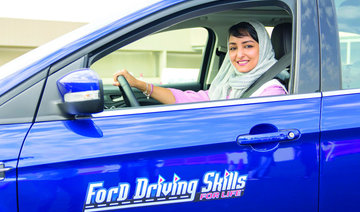
Effat University recently teamed up with Ford Motor Company by hosting a special Driving Skills for Life program with Effat University.
On the more private and intimate side, some fathers chose to be part of their daughters’ first time behind the wheel.
A number of videos of fathers giving driving lessons to their daughters circulated on social media sites and apps, especially Snapchat, which has millions of users in the Kingdom.
A duty and a special experience
“For me, this decision was expected a long time ago and was just a matter of time,” Baleegh Basharaheel told Arab News on the royal decree. “We have a lot of our daughters and wives who are studying outside the Kingdom and they are driving in Europe, in the US, in Australia. I think it was a decision made to change our culture in Saudi Arabia, and the change is coming too fast.”
The 50-year-old father said that he is neither against nor totally with the decision. “I think there should be some rules, some actions that need to be taken to make the driving of women in Saudi Arabia safe and also practical.”
Speaking of how driving lessons came about, Basharaheel, a resident of Jeddah and a father of four daughters and one son, said: “At the beginning, there was an interest from my daughter is being taught how to drive. I tried with all of my daughters to drive outside Jeddah in some open areas.”
He said he wanted to see for himself which of his daughters has “some caution and is a little bit focused on driving alone, not on any other (distracting) things.
“When I tested all my daughters’ driving skills, I felt that (only) one of them, in the future, can drive easily but still needs more practice and needs to go to driving school to thoroughly learn about the signals, traffic rules and some basic driving tips,” he added.
Basharaheel believes it is a duty to teach his daughters how to be “careful and respectful” on the road. “It’s my duty to remind them about some the tips that they should follow if they are interested in driving in the future.”
Remembering his daughters’ first steps as babies, Basharaheel said there is little comparison between the two situations, but it was more difficult when they were babies.
“Of course, I was more worried about them when they were babies than now behind the wheel.”
First times and first experiences are always special, particularly with one’s own children. “Teaching my daughters to drive was something I felt was better coming from me. However, that doesn’t mean it is a must. There are some alternatives. Currently, we have drivers and companies that ease the task for fathers, but for me, it was a special experience to have to with my daughters,” Basharaheel said.
He concluded with a piece of advice to all fathers: “It’s a good practice and I advise each and every father to start practicing with their daughters. It should be conducted on a frequent basis to feel and see the progress.”
Basharaheel’s middle daughter said it was a great honor to have her father as her personal driving instructor. “Father is the best instructor ever, because you have a different dynamic with your father from the one that you can get with any other instructor,” said 24-year-old daughter Waad Baleegh.
Apart from the fun they have, Waad said with her father she has access to a massive amount of experience.
Waad, who had taken four or five classes over the past years with her father, said it is a totally different experience: “I never thought this day would come, but here it is! I’m very excited because my dad has always been supportive from the beginning.”
Since her father witnessed everything from the beginning, Waad said he will be the first person to get a ride when she officially hits the streets.
“Of course he will be there to see how I do it all by myself. It’s mandatory for him to be there for my first time. It will have some sentimental meaning to it and will be special.”
A lovely bonding time
Batoul Al-Jabri and her twin sister Rawan, 26, experienced the thrill with their father for only a few minutes behind the wheel and were still able to feel the strong connection this unique experience gives.
“This maybe doesn’t count. Dad is probably too afraid of us wrecking his car!” said Batoul, laughing.
On whether she would rather have her father as her driving instructor, Batoul thinks that the idea has its pros and cons.”
“Yes and no. Yes, because I have fun and regardless of what they might think of girls driving, they themselves have fun (teaching us how to drive).”
“They remember when they first started learning to drive and when they first bought their new car, and they tell you all kinds of stories,” added Batoul. “It is a really lovely bonding time.”
Batoul said that some fathers, in their heads, cannot wait to give their sons their first driving lesson. “To them, it’s a moment they have long been waiting for since the baby was born. They didn’t imagine it would be a girl (who will be receiving those driving lessons).”
She said she has always hoped her father would teach her his “amazing” driving skills. “Dad is an amazing driver, but he is a horrible teacher,” Batoul said jokingly.
“I’m not dissing my father, I’m just saying that he makes me nervous when I drive. You will hear him screaming ‘Watch out, watch out!’ and the car is a mile away. So for this very reason, I said ‘no’ earlier as I’m afraid I would get nervous (if I had my father as an instructor) and then give up driving for good.”
Ads promoting the motion
A couple of world-famous companies took part in the “father and daughter” motion and invested in successful advertisements to further promote it.
Coca-Cola released their ad on Nov. 2 last year under the title “Change is an opportunity, special moment” with the hashtag #ChangeHasATaste. The ad shows a father and his daughter practicing driving in the desert, with the drink as a motivation to master the task.
In another ad by Nissan a number of women were invited to a special driving lesson with an unprecedented instructor. The company brought the fathers, brothers and husbands of these women to give them their first driving lesson.
“I was a bit nervous at first. This was the first time I drove, but knowing my dad was with me I felt safe and comfortable,” said Bayan Ashor from the ad.
Nissan used the hashtag #SheDrives in their ad.