Syria rebels given ultimatum

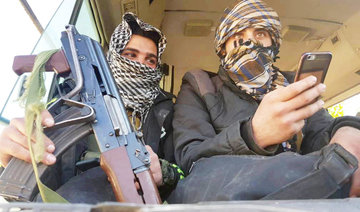
The civilians who met the Russian and Syrian military officers had expressed concern that a departure of rebel fighters would leave them vulnerable to attack by terrorists from Nusra Front or Daesh. (AFP)
Updated 04 April 2018
Follow

Syria rebels given ultimatum

BEIRTU, AMMAN: Syrian opposition fighters in a besieged area northeast of Damascus have been told they must accept state rule or leave, a rebel group said on Tuesday.
The regime and its Russian ally seek to wipe out the last pockets of opposition territory near the capital.
The ultimatum to the rebels of Eastern Qalamoun was served to civilians from the area during a meeting with a Russian colonel and an officer from Syrian Air Force Intelligence, rebel spokesman Said Saif of the Martyr Ahmad Abdo forces told Reuters.
The area is 40 km from Damascus and separate from Eastern Ghouta — an area right next to the capital where regime forces have routed rebels in recent weeks, forcing thousands to accept safe passage out toward the Turkish border.
An opposition source said talks over the densely populated town of Douma, the last rebel pocket of Eastern Ghouta, had yet to be concluded.
President Bashar Assad, his military position secure thanks to Russia and Iran, is seeking to crush the last pockets of opposition to his rule near the main cities of western Syria.
The rebel enclave in eastern Qalamoun includes several towns and a barren expanse of mountainous territory.
“A clear message was sent to the Free Syrian Army (FSA) groups in the area: Either reconciliation and disarmament — handing weapons to the Syrian regime as the Russians describe it — or departing eastern Qalamoun,” Saif said in separate comments to Al-Hadath TV.


Saif said rebels had made a proposal under which they would withdraw from the towns into the mountains and civilians would stay, and Russia’s response was awaited. He said the aim was to avoid the “forced displacement” of people that had occurred in other areas recovered by the Syrian regime.
The Syrian military could not immediately be reached for comment.
Saif told Reuters the civilians who met the Russian and Syrian military officers had expressed concern that a departure of rebel fighters would leave them vulnerable to attack by terrorists from Nusra Front or Daesh.
The Syrian war last month entered its eighth year having killed hundreds of thousands of people and forced 11 million from their homes, including nearly 6 million who have fled abroad in one of the worst refugee crises of modern times.
While Assad now controls the single largest chunk of Syria, it may prove difficult for him to regain much more territory without colliding with the interests of foreign states, notably Turkey and the US which have forces in the country.
Russian-backed regime forces have recovered nearly all of eastern Ghouta in a ferocious assault that began in February.

Bombardment kills 1,600
The Syrian Observatory for Human Rights says bombardment of the rebel enclave killed more than 1,600 civilians in Ghouta.
It marks Assad’s most significant victory over the rebellion against his rule since rebels were driven from eastern Aleppo in 2016.
State media has said Jaish Al-Islam had accepted a deal giving its fighters safe passage to towns at the border with Turkey that are located in a buffer zone controlled by the Turkish military and allied Syrian rebel groups.
But while Russia’s Defense Ministry said 2,000 had left since April 1, the opposition source familiar with the negotiations said no final deal had been reached with Jaish Al-Islam.
The group, which is estimated to have many thousands of fighters, has previously insisted it will not leave Douma or accept “forced displacement” to another part of Syria.
The source said that while Jaish Al-Islam wanted to stay in the town, it was not seeking its own “independent canton.”
People in Douma wanted a reconciliation deal with the state that keeps out its feared security services, the source added.
A military source told Reuters on Monday that some elements of Jaish Al-Islam were still rejecting a deal and that military force would be used if they refused to strike one.
The source said on Tuesday the regime had set a deadline for militants to leave Douma, without saying how long.
“The Syrian government has taken a decision to clear militants from the areas,” the source told Reuters.

FASTFACTS

Iran, Russia and Turkey aim to forge accord in spite of differences over Damascus.


Iran government stages mass rallies as alarm grows over protest toll

Updated 5 sec ago
Follow

Iran government stages mass rallies as alarm grows over protest toll

PARIS: Iranian authorities on Monday sought to regain control of the streets with mass nationwide rallies in the wake of protests on a scale unprecedented in recent years, as alarm grew over a deadly crackdown.
The foreign minister said Iran was ready for both war and talks after repeated threats from Washington to intervene militarily over the crackdown on protests, which activists fear has left at least hundreds dead.
Over two weeks of demonstrations initially sparked by economic grievances have turned into one of the biggest challenges yet to the theocratic system that has ruled Iran since the 1979 Islamic revolution ousted the shah.
In a sign of the severity of the crisis, the authorities have imposed an Internet blackout lasting more than three-and-a-half days that activists say is aimed at masking the extent of the crackdown.
Seeking to regain the initiative, the government called for rallies nationwide backing the Islamic republic on Monday.
Thousands of people filled the capital’s Enghelab (Revolution) Square brandishing the national flag as prayers were read for victims of what the government has termed “riots,” state TV showed.
Addressing the crowds, parliament speaker Mohammad Bagher Ghalibaf said Iran is fighting a “four-front war,” listing economic war, psychological war, “military war” with the United States and Israel and “today a war against terrorists,” referring to the protests.
Flanked by the slogans “Death to Israel, Death to America” in Persian, he vowed the Iranian military would teach US President Donald Trump “an unforgettable lesson” if Iran were attacked.
Trump said Sunday that Iran’s leadership under Ayatollah Ali Khamenei, in power since 1989 and now 86, had called him seeking “to negotiate” after he repeatedly threatened to intervene militarily if Tehran killed protesters.
“The Islamic Republic of Iran is not seeking war but is fully prepared for war,” Foreign Minister Abbas Araghchi told a conference of foreign ambassadors in Tehran broadcast by state television.
“We are also ready for negotiations but these negotiations should be fair, with equal rights and based on mutual respect.”
Foreign ministry spokesman Esmaeil Baghaei said a channel of communication is open between Araghchi and Trump’s special envoy for the Middle East Steve Witkoff despite the lack of diplomatic relations.
Meanwhile, the foreign minister of Oman, which has on occasion acted as a mediator, met Araghchi in Tehran on Saturday.
Soaring toll
The European Union has voiced support for the protesters and on Monday said it was “looking into” imposing additional sanctions on Iran over the repression of demonstrations.
Iran’s shutdown of the Internet has now lasted more than 84 hours, said monitor Netblocks. The blackout has severely affected the ability of Iranians to post videos of the protests that have rocked big cities since Thursday.
A video circulating on Sunday showed dozens of bodies outside a morgue south of Tehran.
The footage, geolocated by AFP to the district of Kahrizak, showed bodies wrapped in black bags, with what appeared to be grieving relatives searching for loved ones.
The Norway-based NGO Iran Human Rights (IHR) said it confirmed the killing of at least 192 protesters but that the actual toll could be much higher.
“Unverified reports indicate that at least several hundreds, and according to some sources, more than 2,000 people, may have been killed,” said IHR.
More than 2,600 protesters have been arrested, IHR estimated.
The US-based Human Rights Activists News Agency said it had confirmed the deaths of 544 people.
Iranian state media has said dozens of members of the security forces have been killed, with their funerals turning into large pro-government rallies. The government has declared three days of national mourning for those killed.
State outlets were at pains to present a picture of calm returning, broadcasting images of smooth-flowing traffic.
Tehran Governor Mohammad-Sadegh Motamedian insisted in televised comments that “the number of protests is decreasing.”
’Stand with the people’
Reza Pahlavi, the US-based son of Iran’s ousted shah, urged Iran’s security forces and government workers to join the protests against the authorities.
“Employees of state institutions, as well as members of the armed and security forces, have a choice: stand with the people and become allies of the nation, or choose complicity with the murderers of the people,” he said in a social media post.
He also urged protesters to replace the flags outside Iranian embassies.
“The time has come for them to be adorned with Iran’s national flag,” he said.
The ceremonial, pre-revolution flag has become an emblem of the global rallies that have mushroomed in support of Iran’s demonstrators.