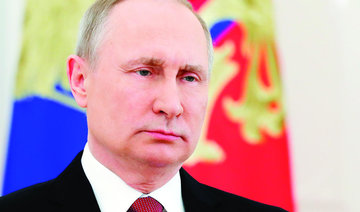
Putin arrives in Turkey for talks on Syria, economic ties

Turkish President Tayyip Erdogan (R) welcoming his Russian counterpart Vladimir Putin at the Presidential Palace in Ankara. (AFP via Turkish Presidential Press Service)
Updated 04 April 2018
Follow

Putin arrives in Turkey for talks on Syria, economic ties

  • Russian President Vladimir Putin is on his first foreign visit since being re-elected
  • Turkey's first nuclear power plant to be built by Rosatom at cost of $20 billion

ANKARA: Vladimir Putin, Russia’s president, was in Ankara on Tuesday for talks with Recep Tayyip Erdogan, his Turkish counterpart, over moving forward on Syria, as well as how to boost economic and energy ties.
The two leaders will hold a tripartite summit devoted to Syria with Hassan Rouhani, Iran’s president, on Wednesday. The three countries are sponsoring a series of peace efforts to end the conflict amid increasing confrontation with the West.
They were expected to discuss setting up a constitutional committee, humanitarian issues and developments in Syria’s northern Idlib region, which is under the control of rival rebel factions and jihadi groups, Reuters reported.
Turkey and Russia have put aside traditional rivalries to forge closer links. Putin and Erdogan have met several times in the past year and speak regularly on the phone. Ankara’s relations with Moscow collapsed in 2015 when Turkey shot down a Russian warplane, but have rallied since.
Putin’s visit to Turkey is his first trip abroad since he won a fourth presidential mandate in elections on March 18. His relations with the West have slumped since the March poisoning of Sergei Skripal, a former Russian double agent, and his daughter, in the UK.
EU powers supported Britain in condemning Russia and expelling diplomats following the attack. Turkey, however, has said that Ankara will not act against Moscow “based on an allegation.”

Akkuyu nuclear plant
Putin and Erdogan watched via video conferencing as work commenced at the first unit of the Akkuyu nuclear power plant — a $20 billion (SR75 billion), 4,800-megawatt plant in Turkey’s southern province of Mersin, which Turkey is about to start building with Russia.
The project is part of Erdogan’s “2023 vision,” marking 100 years since the founding of modern Turkey. It aims to reduce Turkey’s dependence on energy imports — the plant is expected to meet around 10 percent of Turkey’s electricity needs once it is up and running in around 2023.
Turkey is also negotiating the purchase of S-400 missile defense systems from Russia, a move that has been criticized by Ankara’s NATO allies.
Russia and Turkey are also building the TurkStream gas pipeline under the Black Sea that will allow Moscow to pump gas to Europe, avoiding Ukraine, increasing Turkey’s importance as a transit hub.


Hamas to elect first leader since Sinwar killed by Israel

Updated 3 sec ago
Follow

Hamas to elect first leader since Sinwar killed by Israel

  • Role left vacant since Israel killed Yahya Sinwar in 2024
  • Khalil Al-Hayya and Khaled Meshaal are seen as frontrunners
CAIRO: Hamas is expected to elect a new leader this month, two sources in the group told Reuters, filling the role left vacant since Israel killed Yahya Sinwar in 2024 despite ​concerns that a successor could suffer the same fate.
Khalil Al-Hayya and Khaled Meshaal are seen as frontrunners for the helm at a vital moment for the militant Islamist group, battered by two years of war ignited by its October 7, 2023 attack on Israel and facing international demands to disarm.
Both men reside in Qatar and sit on a five-man council that has run Hamas since Israel killed Sinwar, a mastermind of the October 7 attack. His predecessor, Ismail Haniyeh, was assassinated by Israel while on a visit to Iran in 2024.
The election process has already begun, the sources said. The leader is chosen in a secret ballot by Hamas’ Shoura Council, a 50-member body that includes Hamas ‌members in the Israeli-occupied ‌West Bank, the Gaza Strip, and exile.
A Hamas spokesperson declined to ‌comment.

Tough challenges

The ‌sources said a deputy leader will also be elected to replace Saleh Al-Arouri, who was killed by an Israeli airstrike in Lebanon in 2024.
Sources close to Hamas said it was determined to conclude the vote, though some preferred an extension of collective leadership.
Hamas watchers regard Meshaal as part of a pragmatic wing with good ties to Sunni Muslim countries, and Hayya, the group’s lead negotiator, as part of a camp that deepened its relations with Iran.
Hamas faces some of the toughest challenges since it was founded in 1987. While fighting has largely abated in Gaza since the US-brokered ceasefire in October, Israel still holds almost half ⁠the coastal enclave, attacks continue, and conditions for Gaza’s 2 million people remain dire.
Hamas has also drawn criticism within Gaza because of the heavy toll inflicted ‌by the war, with much of the enclave reduced to ruins and ‍more than 71,000 people killed, according to Gaza health authorities.
Hamas-led ‍militants killed some 1,200 people and abducted 251 others in the October 7 cross-border assault on Israel.
US President ‍Donald Trump’s ceasefire plan for Gaza demands Hamas disarm and foresees the enclave being run by a technocratic Palestinian administration overseen by an international body called the Board of Peace.

Targeted by Israel

Hamas has so far refused to disarm, saying the question of armed resistance is a matter for wider debate among Palestinian factions and that it would be ready to ​surrender its weapons to a future Palestinian state, an outcome Israel has ruled out.
Hamas is designated as a terrorist organization by Western powers including the United States.
Born in Gaza, Hayya was among ⁠Hamas leaders targeted by an Israeli airstrike on Qatar in September.
Israeli Prime Minister Benjamin Netanyahu later expressed regret to the emir of Qatar — a US ally — in a three-way call with Trump and affirmed Israel would not conduct such an attack again in the future, the White House said at the time.
Meshaal previously led Hamas for almost two decades. Israeli agents tried to assassinate him in Jordan in 1997 by injecting him with poison.
His relations with Iran were strained in 2012 when he distanced Hamas from Tehran’s Syrian ally, the now-ousted President Bashar Assad, early in the Arab Spring uprisings.
Hamas was founded as the Palestinian branch of the Muslim Brotherhood and is the main rival to the Palestinians’ Fatah national movement led by 90-year-old President Mahmoud Abbas.
Hamas’ founding charter called for the destruction of Israel, although its leaders have at times offered a long-term truce with Israel in return for a viable Palestinian state on all Palestinian territory occupied by Israel in the 1967 war.
Israel ‌regards this approach as a ruse.
Analyst Reham Owda said there were limited differences between Hayya and Meshaal over the conflict with Israel but believed Meshaal had better chances as he could “market (Hamas) internationally and help rebuild its capabilities.”