

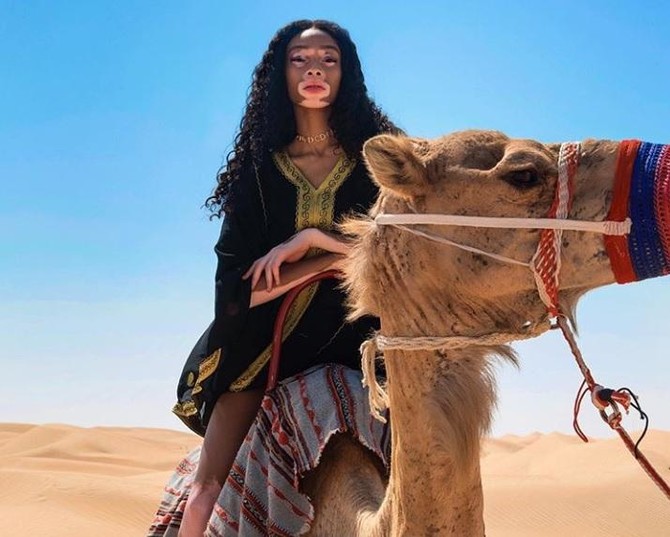
Where’s Winnie? Model makes a mark in Dubai

Winnie Harlow took Dubai by storm. (@winnieharlow)
Updated 01 April 2018
Follow

Where’s Winnie? Model makes a mark in Dubai

DUBAI: The UAE’s most glamorous city is no stranger to jet-setting celebrities and it certainly seems to have impressed Canadian model Winnie Harlow who recently shared a flurry of photos from Dubai.
Harlow shot to fame on America’s Next Top Model in 2014 and has since worked with the who’s who of the fashion industry’s elite, including Marc Jacobs and Tommy Hilfiger.
Harlow made waves due to her modeling prowess and vitiligo, a disease in which the pigment cells of the skin are destroyed in some areas.

My Son

A post shared by Winnie Harlow (@winnieharlow) on

She took tabloid newspapers to task, however, in a post on Instagram, saying that she should not be defined by her skin condition.

Habibi

A post shared by Winnie Harlow (@winnieharlow) on

“I’m not a ‘vitiligo sufferer.’ I’m not a ‘vitiligo model.’ I am Winnie. I am a model. And I happen to have vitiligo,” she posted alongside a snap of her standing on Dubai’s shoreline.


Makkah museum displays world’s largest Qur’an

Updated 04 February 2026
Follow

Makkah museum displays world’s largest Qur’an

MAKKAH: The Holy Qur’an Museum at the Hira Cultural District in Makkah is showcasing a monumental handwritten copy of the Holy Qur’an, recognized as the largest Qur’an of its kind in the world.

The manuscript measures 312 cm by 220 cm and comprises 700 pages, earning the museum recognition from Guinness World Records for displaying the world’s largest Qur’an, the Saudi Press Agency reported.

The manuscript is a magnified reproduction of a historic Qur’an dating back to the 16th century, the SPA stated.

The original copy measures 45 cm by 30 cm, with the chapters written primarily in Thuluth script, while Surah Al-Fatiha was penned in Naskh, reflecting the refined artistic choices and calligraphic diversity of the era.

The Qur’an is a unique example of Arabic calligraphy, gilding and bookbinding, showcasing Islamic art through intricate decorations, sun-shaped motifs on the opening folio, and elaborately designed frontispiece and title pages that reflect a high level of artistic mastery.

The manuscript was endowed as a waqf in 1883. Its original version is currently preserved at the King Abdulaziz Complex for Endowment Libraries, serving as a lasting testament to Muslims’ enduring reverence for the Qur’an and the richness of Islamic arts across the centuries.