Los Angeles museum celebrates the art of the selfie

1 / 6
Visitor Nina Crowe takes a "rooftop" selfie - simulating the perspective of being on top of the tallest building in Los Angeles - at the Museum of Selfies, in Glendale, California, March 29, 2018. (AFP)
2 / 6
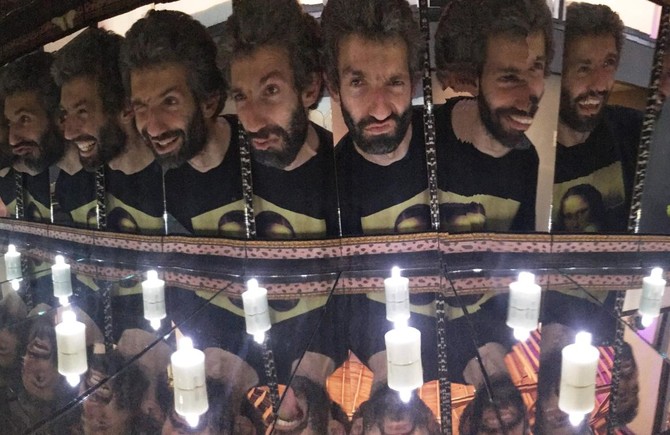
Museum co-creator Tair Mamedov is photographed using cellphone panorama format inside artist Matt Elson's infinity box called "You And Me Together," at the Museum of Selfies, in Glendale, California, March 29, 2018. (AFP)
3 / 6
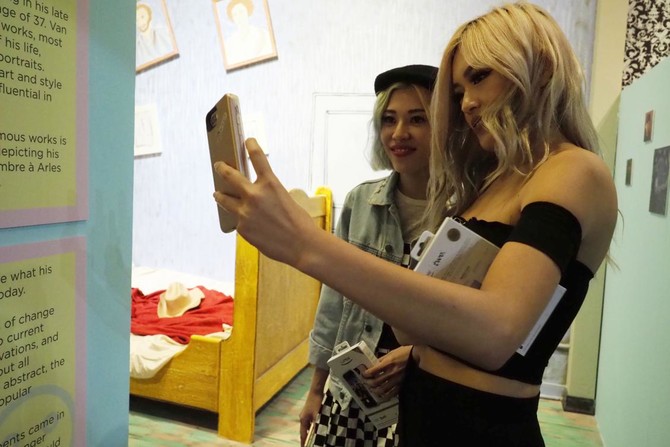
Visitors take selfies at the Museum of Selfies, in Glendale, California, March 29, 2018. (AFP)
4 / 6
Visitors take selfies at the Museum of Selfies, in Glendale, California, March 29, 2018. (AFP)
5 / 6
Museum co-creator Tair Mamedov hangs a display of various "No Selfie" warnings found across Russia, at the Museum of Selfies, in Glendale, California, March 29, 2018. (AFP)
6 / 6
Visitors take a selfie at the Museum of Selfies, in Glendale, California, March 29, 2018. (AFP)
Updated 01 April 2018
Follow

Los Angeles museum celebrates the art of the selfie

GLENDALE, United States: There’s an art to taking the perfect selfie — from the angle, to the focus, cropping out that pesky outstretched arm and above all, the smile.
In a celebration of self-portraits in the social media age Tommy Honton and Tair Mamedov are set to open the Museum of Selfies in Los Angeles this Sunday — an interactive exhibition exploring the history and cultural phenomenon of snapping a photo of yourself.
And for those who think if a moment wasn’t photographed, it might as well have not happened — the good news is that at the Museum of Selfies, selfies are compulsory.
Event planner Lori Nguyen, 45, said she doesn’t take selfies very often because “I’m not, like, super young.”
But another visitor, Nina Crowe, said she takes “one a day.”
Neither missed the chance to snap several at the Museum of Selfies, including at an exhibit mimicking the rooftop of Los Angeles’ tallest building.
In reality there’s a backdrop photograph of the “ground below” printed on a small platform, from which sprouts a tube that looks like the building’s antenna complete with a red signaling beacon.
Add a selfie stick, an “I’m afraid of heights” grimace and a click — and the result is very realistic.
The exhibition begins with mirrors, perhaps the most basic kind of selfie. But Honton and Mamedov view the concept as something more than just a simple photo.
“The selfies have a surprisingly rich history, and go back as far as people have been making art,” Honton explains.
“Rembrandt did hundreds of self-portraits, Albrecht Durer five, Van Gogh dozens. I mean they did their portraits too, what’s the difference?” he said.
“Yes, artistic technique and scale is one thing, but in reality, if cell phones and cameras had existed, everyone would have taken them.”
Another selfie museum opened in the Philippines in 2015, but there’s no sign it stayed open. Meanwhile in Glendale, a Los Angeles suburb, the exhibition is just the latest in the city’s stream of quirky museums focusing on everything from rabbits and death to neon and velvet.
The show is full of fun facts about the trend: women take pictures of themselves more than men, for example.
In Sao Paulo, 65.4 percent of selfies are taken by women — in New York, 61.6 percent. In Moscow, the divide is even more extreme, at 82 percent.
There aren’t statistics for Los Angeles, but Ally Bertik admits she is a frequent selfie-snapper.
“It shows off my good side. And I get to show people like ‘hey, this is where I am, maybe you guys should check it out too, this is what I’m doing.’ It’s just a fun way to like spread you know what I’m doing, show people where I’m at,” she explained.
Wandering through the museum, guests will be able to pose with Colette Miller’s “Angel Wings” and a work by Darel Carey, who creates multi-dimensional rooms using plastic tape — a concept the museum describes as a “selfie magnet.”
There are pieces by Brazil’s Rob Vital, German-Canadian Joseph Nowak, Italy’s Michele Durazzi — and a copy of the Russian government’s recommendations for taking a selfie safely, created following several accidents and as many as 12 selfie-related deaths in the country.
Also featured is David Slater’s controversial monkey selfie — which became embroiled in a legal battle over who has the copyright to photos taken by monkeys using his camera.
In a corner, meanwhile, are three statues resembling Michelangelo’s “David” — painted blue with a pink cell phone — and a Game of Thrones-esque throne created using selfie sticks.
You just “can’t avoid” taking a selfie there, says Mamedov, a Russian actor who arrived in the US four years ago.
The Museum of Selfies will be open in Glendale initially for two months. Its founders are open to extending its LA run and taking the exhibition to other places around the US, if not the world.


Egypt reveals restored colossal statues of pharaoh in Luxor

Updated 14 December 2025
Follow

Egypt reveals restored colossal statues of pharaoh in Luxor

  • Amenhotep III, one of the most prominent pharaohs, ruled during the 500 years of the New Kingdom, which was the most prosperous time for ancient Egypt

LUXOR: Egypt on Sunday revealed the revamp of two colossal statues of a prominent pharaoh in the southern city of Luxor, the latest in the government’s archeological events that aim at drawing more tourists to the country.
The giant alabaster statues, known as the Colossi of Memnon, were reassembled in a renovation project that lasted about two decades. They represent Amenhotep III, who ruled ancient Egypt about 3,400 years ago.
“Today we are celebrating, actually, the finishing and the erecting of these two colossal statues,” Mohamed Ismail, secretary-general of the Supreme Council of Antiquities, said ahead of the ceremony.
Ismail said the colossi are of great significance to Luxor, a city known for its ancient temples and other antiquities. They’re also an attempt to “revive how this funerary temple of King Amenhotep III looked like a long time ago,” Ismail said.
Amenhotep III, one of the most prominent pharaohs, ruled during the 500 years of the New Kingdom, which was the most prosperous time for ancient Egypt. The pharaoh, whose mummy is showcased at a Cairo museum, ruled between 1390–1353 BC, a peaceful period known for its prosperity and great construction, including his mortuary temple, where the Colossi of Memnon are located, and another temple, Soleb, in Nubia.
The colossi were toppled by a strong earthquake in about 1200 BC that also destroyed Amenhotep III’s funerary temple, said Ismail.
They were fragmented and partly quarried away, with their pedestals dispersed. Some of their blocks were reused in the Karnak temple, but archeologists brought them back to rebuild the colossi, according to the Antiquities Ministry.
In late 1990s, an Egyptian German mission, chaired by German Egyptologist Hourig Sourouzian, began working in the temple area, including the assembly and renovation of the colossi.
“This project has in mind … to save the last remains of a once-prestigious temple,” she said.
The statues show Amenhotep III seated with hands resting on his thighs, with their faces looking eastward toward the Nile and the rising sun. They wear the nemes headdress surmounted by the double crowns and the pleated royal kilt, which symbolizes the pharaoh’s rule.
Two other small statues on the pharaoh’s feet depict his wife, Tiye.
The colossi — 14.5 meters and 13.6 meters respectively — preside over the entrance of the king’s temple on the western bank of the Nile. The 35-hectare complex is believed to be the largest and richest temple in Egypt and is usually compared to the temple of Karnak, also in Luxor.
The colossi were hewn in Egyptian alabaster from the quarries of Hatnub, in Middle Egypt. They were fixed on large pedestals with inscriptions showing the name of the temple, as well as the quarry.
Unlike other monumental sculptures of ancient Egypt, the colossi were partly compiled with pieces sculpted separately, which were fixed into each statue’s main monolithic alabaster core, the ministry said.
Sunday’s unveiling in Luxor came just six weeks after the inauguration of the long-delayed Grand Egyptian Museum, the centerpiece of the government’s bid to boost the country’s tourism industry. The mega project is located near the famed Giza Pyramids and the Sphinx.
In recent years, the sector has started to recover after the coronavirus pandemic and amid Russia’s war on Ukraine — both countries are major sources of tourists visiting Egypt.
“This site is going to be a point of interest for years to come,” said Tourism and Antiquities Minister Sherif Fathy, who attended the unveiling ceremony. “There are always new things happening in Luxor.”
A record number of about 15.7 million tourists visited Egypt in 2024, contributing about 8 percent of the country’s GDP, according to official figures.
Fathy, the minister, has said about 18 million tourists are expected to visit the country this year, with authorities hoping for 30 million visitors annually by 2032.