Tesla says crashed vehicle had been on autopilot prior to accident

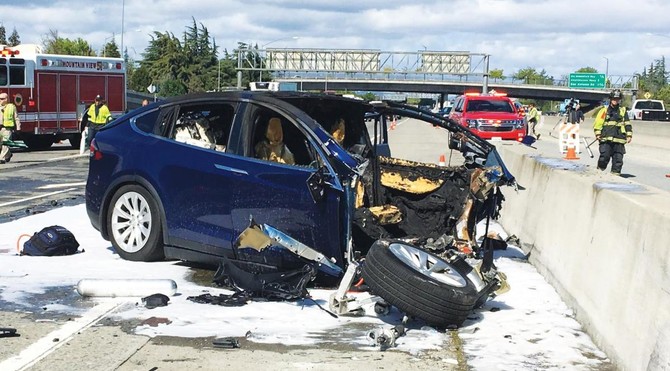
Rescue workers attend the scene where a Tesla electric SUV crashed into a barrier on US Highway 101 in Mountain View, California, last week. (Reuters)
Updated 31 March 2018
Follow

Tesla says crashed vehicle had been on autopilot prior to accident

LONDON: Tesla Inc. said that a Tesla Model X involved a fatal crash in California last week had activated its Autopilot system, raising new questions about the semi-autonomous system that handles some driving tasks.
Tesla also said vehicle logs from the accident showed no action had been taken by the driver soon before the crash and that he had received earlier warnings to put his hands on the wheel.
“The driver had about five seconds and 150 meters of unobstructed view of the concrete divider with the crushed crash attenuator, but the vehicle logs show that no action was taken,” Tesla said.
The statement did not say why the Autopilot system apparently did not detect the concrete divider.
The fatal crash and vehicle fire of the Tesla near Mountain View, California, involved two other cars and delayed traffic for hours. The 38-year-old Tesla driver died at a nearby hospital shortly after the crash.
The National Highway Traffic Safety Administration, which launched an investigation into the crash earlier this week, did not immediately comment late Friday. The National Transportation Safety Board (NTSB) is also investigating the fatal crash.
Autopilot allows drivers to take their hands off the wheel for extended periods under certain conditions. Tesla requires users to agree to keep their hands on the wheel “at all times” before they can use autopilot, but users routinely tout the fact they can use the system to drive hands-free.
The NTSB faulted Tesla in a prior fatal autopilot crash.
In September, NTSB Chairman Robert Sumwalt said operational limitations in the Tesla Model S played a major role in a May 2016 crash that killed a driver using autopilot.
That death — the first fatality in a Tesla vehicle operating in Autopilot mode — raised questions about the safety of systems that can perform driving tasks for long stretches with little or no human intervention, but which cannot completely replace human drivers.
The NTSB said Tesla could have taken further steps to prevent the system’s misuse, and faulted the driver for not paying attention and for “overreliance on vehicle automation.”
In January, NHTSA and NTSB launched investigations into a Tesla vehicle, apparently traveling in semi-autonomous mode, that struck a fire truck in California. Neither agency nor Tesla has offered any update.
The government probes raise the risk for Tesla and automakers at a time when the industry is seeking federal legislation that would ease deployment of self driving cars.
The crash comes soon after an Uber vehicle in Arizona in self-driving mode struck and killed a pedestrian in the first death linked to an autonomous vehicle.
Tesla said late Friday that “Autopilot does not prevent all accidents – such a standard would be impossible – but it makes them much less likely to occur. It unequivocally makes the world safer for the vehicle occupants, pedestrians and cyclists.”
Tesla said that in the US “there is one automotive fatality every 86 million miles across all vehicles from all manufacturers. For Tesla, there is one fatality, including known pedestrian fatalities, every 320 million miles in vehicles equipped with Autopilot hardware.”
Tesla in September 2016 unveiled improvements to Autopilot, adding new limits on hands-off driving.
On Thursday, Tesla said it was recalling 123,000 Model S sedans built before April 2016 in order to replace bolts in the power steering component that can begin to corrode after contact in cold temperatures with road salt. No accidents or injuries were reported.


Saudi Maaden reports 156% profit surge to $2bn on strong commodity prices, record production

Updated 05 March 2026
Follow

Saudi Maaden reports 156% profit surge to $2bn on strong commodity prices, record production

RIYADH: Saudi mining and metals company Maaden has reported a 156 percent jump in its net profit attributable to shareholders for 2025, driven by higher commodity prices, record production volumes, and a one-off bargain purchase gain.

The state-backed giant posted a net profit of SR7.35 billion ($1.95 billion) for the full year 2025, an increase from SR2.87 billion in the previous year. The firm’s revenue surged by 19 percent to SR38.58 billion, up from SR32.55 billion in 2024.

This comes as Saudi Arabia steps up efforts to expand its mining sector as a pillar of economic diversification, encouraging international participation and private investment to unlock the Kingdom’s estimated $2.5 trillion in untapped mineral resources under Vision 2030.    

In a statement on Tadawul, the company said: “Performance was led by record phosphate production, near record aluminum production, an increase in all three of Maaden’s main output commodity prices.”

The performance was also fueled by a 60 percent increase in gross profit, which reached SR14.79 billion. In its annual results announcement, Maaden attributed the top-line growth to “higher commodity market prices for phosphate, aluminum and gold business units,” as well as increased sales volumes in its phosphate and aluminum segments. This was partially offset by slightly lower sales volume in the gold unit.

Maaden’s CEO, Bob Wilt, hailed 2025 as a transformative year for the company, marked by strategic growth and operational excellence. “This was a great year for Maaden’s strategic growth. We delivered strong financial results and sustained operational excellence across the business,” he said in a statement.

“This was driven by growth in production across all businesses, including record-breaking DAP (di-ammonium phosphatevolumes), disciplined cost control across and a clear commitment to our role as a cornerstone of the Saudi economy,” Wilt added.

Profitability was further bolstered by an increased share of net profit from joint ventures and an associate. This included a one-off bargain purchase gain of SR768 million related to Maaden’s investment in Aluminium Bahrain B.S.C. The company also benefited from lower finance costs.

The fourth quarter of 2025 was strong, with Maaden swinging to a net profit of SR1.67 billion, compared to a loss of SR106 million in the same period of the prior year. Quarterly revenue rose 7 percent to SR10.64 billion.

The firm achieved record production of di-ammonium phosphate, reaching 6.72 million tonnes for the year, a 9 percent increase. Aluminum production remained near-record levels, while the company added a net 7.8 million ounces to its reportable gold mineral resources through discovery and resource development.

The phosphate division saw sales jump 17 percent to SR20.77 billion, with the earnings before interest, taxes, depreciation, and amortization margin expanding to 47 percent. The aluminum business reported a 9 percent increase in sales to SR10.99 billion, with EBITDA more than doubling in the fourth quarter.

Looking ahead, Wilt emphasized that the pace of growth will accelerate as the company advances key initiatives, including the Phosphate 3 Phase 1 and Ar Rjum projects, which remain on budget and schedule. Maaden has also secured a gas supply for its future Phosphate 4 project.

“This pace of growth will only accelerate. Not only as we advance projects and increase the scale of our exploration program, but as we continue to grow production and implement technology that will further modernize, streamline and unlock value,” Wilt added.

Earnings per share for the year rose sharply to SR1.91, up from SR0.78 in 2024. Total shareholders’ equity increased by 18.7 percent to SR61.59 billion.