

A wave of Israeli-Palestinian clashes since 2015

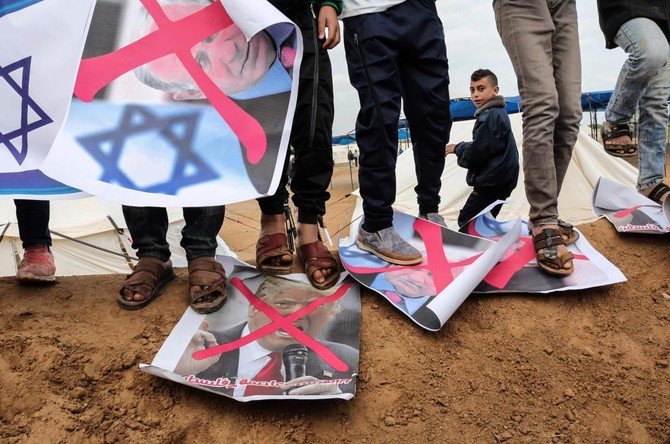
Palestinians step on crossed-out posters depicting Israeli Prime Minister Benjamin Netanyahu and US President Donald Trump during a tent city protest near Khan Yunis in the southern Gaza Strip. (AFP)
Updated 31 March 2018
Follow

A wave of Israeli-Palestinian clashes since 2015

JERUSALEM: Clashes erupt between Israeli police and Palestinians in September 2015 the flashpoint Al-Aqsa Mosque compound in Jerusalem’s Old City. They last three days and the unrest spreads across Jerusalem and the occupied West Bank.

• On Oct. 1, a settler couple are killed when Palestinians fire on their vehicle in the West Bank. The violence spirals as young Palestinians clash with Israeli troops and Jewish settlers, followed by a series of knife attacks targeting Israelis.

• On Oct. 9, seven young Palestinians are killed by Israeli fire during clashes at the Gaza border. Days later, following a rocket attack, Israel carries out a retaliatory raid on Gaza, killing a pregnant Palestinian woman and her daughter.

• In January, a Palestinian stabs a nurse to death in front of her children in an Israeli settlement. On Jan. 1, an Israeli Arab fires on shopfronts in Tel Aviv, killing two before being shot down.

• In June, two Palestinians fire on customers in a bustling area of the city, killing four before being arrested. Over a few days in June and July, four Palestinian attacks leave two Israelis and three attackers are killed.

• Jerusalem, bitterly disputed between Israelis and Palestinians, is the scene of frequent attacks throughout 2017.

• In January, four Israeli soldiers are killed when a Palestinian rams his truck into a group of soldiers visiting the city. The driver is killed on the spot.

• In July, three Israeli Arabs shoot dead two Israeli police officers in Jerusalem’s Old City before being shot themselves in Al-Aqsa Mosque compound. Israel, saying weapons were hidden inside the compound, bars access for two days and imposes stringent security measures, including metal detectors and surveillance cameras.
Tensions spiral into clashes between Palestinians and Israeli security forces in East Jerusalem and the West Bank. Worshippers gather for protest prayers outside the compound.
Under international pressure, Israel withdraws its metal detectors, later removing the remaining new security measures.

• On Oct. 12, members of the militant groups Islamic Jihad and Hamas are killed when Israel blows up a tunnel from Gaza into its territory.

• In December, US President Donald Trump recognizes Jerusalem as Israel’s capital in defiance of advice from world leaders, sparking outrage from Palestinians. Trump orders the transfer of the US Embassy from Tel Aviv to Jerusalem, set to take place in May 2018.

• In January, a rabbi, Raziel Shevah, is shot dead near the settlement where he lived. Three Palestinian suspects are killed. Two days later, Israeli fire kills two Palestinians in the Gaza Strip and the West Bank.

• In February, a Palestinian fatally stabs an Israeli in the West Bank and two weeks after that, two Palestinians are killed near Rafah.

• On March 16, two Israeli soldiers are killed in the West Bank in a Palestinian truck attack. A Palestinian later stabs an Israeli officer in Jerusalem’s old town, seriously injuring him before being killed.

Fledgling radio station aims to be ‘voice of the people’ in Gaza

Updated 15 February 2026
Follow

Fledgling radio station aims to be ‘voice of the people’ in Gaza

  • The electricity crisis is one of the most serious and difficult problems in the Gaza Strip, says Shereen Khalifa Broadcaster

DEIR EL-BALAH: From a small studio in the central city of Deir El-Balah, Sylvia Hassan’s voice echoes across the Gaza Strip, broadcast on one of the Palestinian territory’s first radio stations to hit the airwaves after two years of war.

Hassan, a radio host on fledgling station “Here Gaza,” delivers her broadcast from a well-lit room, as members of the technical team check levels and mix backing tracks on a sound deck. “This radio station was a dream we worked to achieve for many long months and sometimes without sleep,” Hassan said.

“It was a challenge for us, and a story of resilience.”

Hassan said the station would focus on social issues and the humanitarian situation in Gaza, which remains grave in the territory despite a US-brokered ceasefire between Israel and Hamas since October.

“The radio station’s goal is to be the voice of the people in the Gaza Strip and to express their problems and suffering, especially after the war,” said Shereen Khalifa, part of the broadcasting team.

“There are many issues that people need to voice.” Most of Gaza’s population of more than 2 million people were displaced at least once during the gruelling war.

Many still live in tents with little or no sanitation.

The war also decimated Gaza’s telecommunications and electricity infrastructure, compounding the challenges in reviving the territory’s local media landscape. “The electricity problem is one of the most serious and difficult problems in the Gaza Strip,” said Khalifa.

“We have solar power, but sometimes it doesn’t work well, so we have to rely on an external generator,” she added.

The station’s launch is funded by the EU and overseen by Filastiniyat, an organization that supports Palestinian women journalists, and the media center at the An-Najah National University in Nablus, in the occupied West Bank.

The station plans to broadcast for two hours per day from Gaza and for longer from Nablus. It is available on FM and online.

Khalifa said that stable internet access had been one of the biggest obstacles in setting up the station, but that it was now broadcasting uninterrupted audio.

The Gaza Strip, a tiny territory surrounded by Israel, Egypt, and the Mediterranean Sea, has been under Israeli blockade even before the attack on Oct. 7, 2023, which sparked the war. Despite the ceasefire, Israel continues to strictly control the entry of all goods and people to the territory.

“Under the siege, it is natural that modern equipment necessary for radio broadcasting cannot enter, so we have made the most of what is available,” she said.
