Superjumbo flight to Lebanon brings hopes of tourism revival

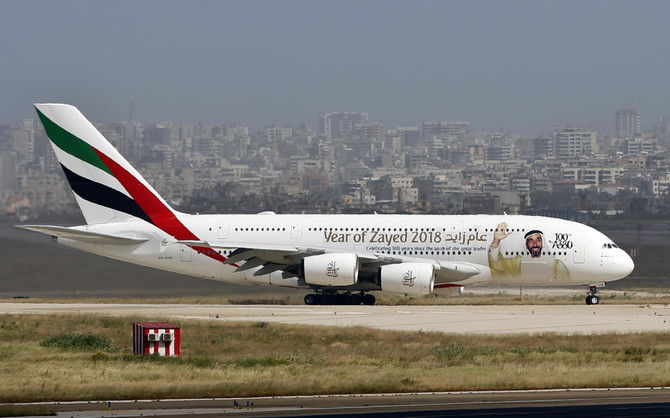
An Emirates superjumbo has made the first paying A380 flight to Lebanon. (AP Photo)
Updated 30 March 2018
Follow

Superjumbo flight to Lebanon brings hopes of tourism revival

BEIRUT: The world’s largest passenger jet landed at Beirut’s international airport on Thursday, bringing with it hopes of a sustained revival to Lebanon’s tourism and travel sectors.

The one-off Emirates Airbus A380 flight from Dubai was a nod to the substantial passenger traffic between Lebanon and Gulf nations, where many Lebanese nationals work, and many more pass through on the way to destinations farther afield.

Emirates said it scheduled the flight, the first of its kind to carry paying passengers to Beirut to see if the airport was ready to handle regular A380 service.
Lebanese officials will hope the results return positive, as tourism arrivals climb to levels last seen in 2010.

Lebanon welcomed 1.85 million tourists in 2017, according to the Tourism Ministry, the most since 2.16 million came in 2010, after which civil strife in Syria and political uncertainty in Lebanon sent the industry into a protracted depression.

There are nine flights daily from Dubai to Beirut, on three different carriers.

Tourism is one of the key pillars of Lebanon’s economy, contributing to 19 percent of the country’s GDP, according to the UK-based World Travel and Tourism Council.

However, Beirut’s Rafik Hariri International Airport, Lebanon’s only commercial airfield, is sorely out-of-date and lines at security can stretch for hours in the summer months, when throngs of expatriates visit the country for business and pleasure.

The airport, renovated in 1992 after the civil war, is designed to handle 6 million passengers annually. In 2017, it saw over 8 million, according to the airport’s research department. Its gate areas are grimy and gloomy — a poor reflection of politicians’ outsized ambitions for the national tourism industry.

Lebanon’s cabinet and the country’s flagship airline, Middle East Airlines, are considering two plans to expand and improve the airport’s facilities, one costing $88 million and the other $200 million. Their aim is to expand capacity to 10 million passengers annually by 2020 and then support continued growth beyond that.

Saudi Maaden reports 156% profit surge to $2bn on strong commodity prices, record production

Updated 05 March 2026
Follow

Saudi Maaden reports 156% profit surge to $2bn on strong commodity prices, record production

RIYADH: Saudi mining and metals company Maaden has reported a 156 percent jump in its net profit attributable to shareholders for 2025, driven by higher commodity prices, record production volumes, and a one-off bargain purchase gain.

The state-backed giant posted a net profit of SR7.35 billion ($1.95 billion) for the full year 2025, an increase from SR2.87 billion in the previous year. The firm’s revenue surged by 19 percent to SR38.58 billion, up from SR32.55 billion in 2024.

This comes as Saudi Arabia steps up efforts to expand its mining sector as a pillar of economic diversification, encouraging international participation and private investment to unlock the Kingdom’s estimated $2.5 trillion in untapped mineral resources under Vision 2030.    

In a statement on Tadawul, the company said: “Performance was led by record phosphate production, near record aluminum production, an increase in all three of Maaden’s main output commodity prices.”

The performance was also fueled by a 60 percent increase in gross profit, which reached SR14.79 billion. In its annual results announcement, Maaden attributed the top-line growth to “higher commodity market prices for phosphate, aluminum and gold business units,” as well as increased sales volumes in its phosphate and aluminum segments. This was partially offset by slightly lower sales volume in the gold unit.

Maaden’s CEO, Bob Wilt, hailed 2025 as a transformative year for the company, marked by strategic growth and operational excellence. “This was a great year for Maaden’s strategic growth. We delivered strong financial results and sustained operational excellence across the business,” he said in a statement.

“This was driven by growth in production across all businesses, including record-breaking DAP (di-ammonium phosphatevolumes), disciplined cost control across and a clear commitment to our role as a cornerstone of the Saudi economy,” Wilt added.

Profitability was further bolstered by an increased share of net profit from joint ventures and an associate. This included a one-off bargain purchase gain of SR768 million related to Maaden’s investment in Aluminium Bahrain B.S.C. The company also benefited from lower finance costs.

The fourth quarter of 2025 was strong, with Maaden swinging to a net profit of SR1.67 billion, compared to a loss of SR106 million in the same period of the prior year. Quarterly revenue rose 7 percent to SR10.64 billion.

The firm achieved record production of di-ammonium phosphate, reaching 6.72 million tonnes for the year, a 9 percent increase. Aluminum production remained near-record levels, while the company added a net 7.8 million ounces to its reportable gold mineral resources through discovery and resource development.

The phosphate division saw sales jump 17 percent to SR20.77 billion, with the earnings before interest, taxes, depreciation, and amortization margin expanding to 47 percent. The aluminum business reported a 9 percent increase in sales to SR10.99 billion, with EBITDA more than doubling in the fourth quarter.

Looking ahead, Wilt emphasized that the pace of growth will accelerate as the company advances key initiatives, including the Phosphate 3 Phase 1 and Ar Rjum projects, which remain on budget and schedule. Maaden has also secured a gas supply for its future Phosphate 4 project.

“This pace of growth will only accelerate. Not only as we advance projects and increase the scale of our exploration program, but as we continue to grow production and implement technology that will further modernize, streamline and unlock value,” Wilt added.

Earnings per share for the year rose sharply to SR1.91, up from SR0.78 in 2024. Total shareholders’ equity increased by 18.7 percent to SR61.59 billion.