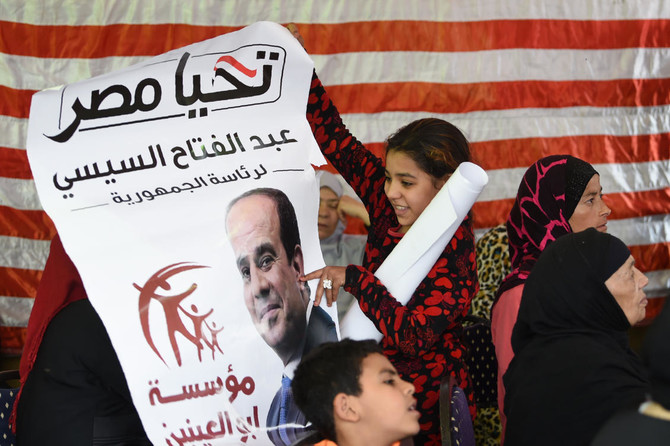
CAIRO: Egyptian President Abdel Fattah El-Sisi has been re-elected for a second term with about 92 percent of the vote, preliminary results showed on Thursday, with just over 40 percent of voters casting ballots.
Twenty-five million of the 60 million registered voters, or some 41.5 percent, turned out during the three days of polling that ended Wednesday, state-owned newspaper Al-Ahram reported. Twenty-three million voted for El-Sisi.
The Akhbar El-Youm newspaper did not report the full turnout but said El-Sisi won 21.4 million votes, and his rival Moussa Mostafa Moussa 721,000 votes, without mentioning the number of spoiled ballots.
According to Al-Ahram, in addition to 23 million who cast valid votes, two million spoiled their ballot papers.
El-Sisi’s sole challenger was the little-known Moussa, himself a supporter of the president, who registered immediately before the close date for applications, saving the election from being a one-horse race.
Moussa conceded his loss on Wednesday night, telling a television station he had hoped for 10 percent of the vote.
“But I know the immense popularity of President El-Sisi,” he said.
Opposition groups had called for a boycott of this week’s vote which they labeled a facade.
Critics see him as an autocrat. The poor and middle class criticize his economic reforms. But one community of Egyptians — big business — is much happier with El-Sisi’s win.
Businessmen say tough economic reforms, political stability and new infrastructure over the past four years have helped their companies recover from a slump caused by a 2011 uprising.
“He has taken bold and difficult decisions and needs the second term to conclude these steps,” said billionaire Naguib Sawiris, with interests from telecommunications to gold mining. He cited stability and security provided by the El-Sisi administration as factors that have helped boost growth.
Egypt’s economic growth slowed after the 2011 uprising that toppled Hosni Mubarak as tourists and investors fled, but sweeping reforms tied to a $12 billion International Monetary Fund deal signed in 2016 have paved the way toward more growth.
Foreign reserves have more than doubled and investors are returning. Reforms included a currency devaluation, subsidy cuts and tax hikes to reduce the budget deficit.
“Floating the pound has been the best thing that happened in the company’s history,” said Wael Hamdy, vice president of ELSEWEDY ELECTRIC, the Middle East’s biggest cable maker. Hamdy said development in infrastructure had also helped attract investment and create thousands of jobs.
“Until 2014, foreign companies were pulling out of Egypt because of poor infrastructure, but every day now we’re meeting lots of investors who are interested in doing business in Egypt,” he said.
Mohab Ghali, Hilton vice president for Egypt and North Africa, said stability provided by the El-Sisi administration was behind the recovery in tourism, which suffered badly after the Russian airliner was downed.
“We’re seeing new hotels pop up every day which means there’s stability,” said Ghali. “We’re seeing it in the increased numbers of tourists too.”
The number of foreigners visiting Egypt jumped 54 percent to 8.3 million in 2017, and receipts more than doubled to $7.6 billion.

El-Sisi wins with 92% of vote; 41.5% turnout in 3-day poll
Israel says carrying out ‘large-scale strikes’ on Tehran
JERUSALEM: The Israeli military said it launched “large-scale strikes” on Tehran on Monday, two days since the start of a US-Israeli campaign against Iran.
“The Israeli Air Force... has begun an additional wave of strikes against the Iranian terror regime at the heart of Tehran,” the military said in a statement.
Israei's new “large-scale” strikes followed mile fire from Iran that injured three people in Jerusalem late on Sunday.
“A direct impact of a munition was identified on one of the main roads in Jerusalem,” police said in a statement, sharing footage showing officers at a highway section littered with rubble.
Israel’s emergency medical service Magen David Adom said three people were injured, including a 46-year-old man with moderate shrapnel wounds.
The medical organization earlier said several others were treated for light injuries at the site.
AFP journalists heard a series of loud blasts above the city, after the Israeli military said it had detected missiles launched from Iran.
Israel’s Kan public television and Channel 12 broadcast footage showing police officers and rescuers deployed in areas where visible damage could be seen, one “in the center of the country” and the other in the Jerusalem area.
In the Jerusalem area, the footage showed a road strewn with debris and rocks.
In the center of the country, damaged cars could be seen.
Military censorship prohibits the media from disclosing the exact locations of the impact sites.
In other developments:
• The European Union has warned of the cost to the Middle East of a long war, and said it was reinforcing its naval mission in the Red Sea with additional vessels as Iran’s retaliation to US-Israeli strikes threatens maritime traffic, a European diplomat said.
Two new French ships will join the EU’s Aspides mission, bringing to five the number of warships taking part, the diplomat told AFP.
• Gulf states vowed to defend themselves against Iranian attacks, including by “responding to the aggression” if need be, after the Gulf Cooperation Council convened via video-link to formulate a unified response.
• Top US officials including Secretary of State Marco Rubio will make the case Tuesday to Congress for the attack on Iran. Rubio, Defense Secretary Pete Hegseth, CIA Director John Ratcliffe and military chief General Dan Caine “will brief the full membership of both chambers of Congress,” White House spokesman Dylan Johnson said.
• Container shipping company Maersk said it was halting passage through the Suez Canal and the Strait of Hormuz for “safety” reasons.
The Danish group was the latest of several shipping groups to make similar announcements after Iran’s Revolutionary Guards declared the strait closed on Saturday.
• Seven people were injured in the Jerusalem area following the latest salvo of missiles fired from Iran, Israeli firefighters said.
• British Prime Minister Keir Starmer said he had agreed to let the United States use UK bases to fire “defensive” strikes aimed at destroying Iranian missiles and their launchers. But in a video address posted to social media, he added: “We were not involved in the initial strikes on Iran and we will not join offensive action now.
• Iranian media reported that a police station in a city on the outskirts of Tehran had been hit, killing an unspecified number of people, with others reportedly trapped under debris. “According to initial reports, a number of citizens were martyred and some were trapped under the rubble,” the Tasnim news agency reported.
• Iranian news agency ISNA reported that Gandhi hospital in northern Tehran had been targeted by strikes. The Fars and Mizan agencies published a video, presented as being from inside the facility, showing debris on the floor among wheelchairs.