

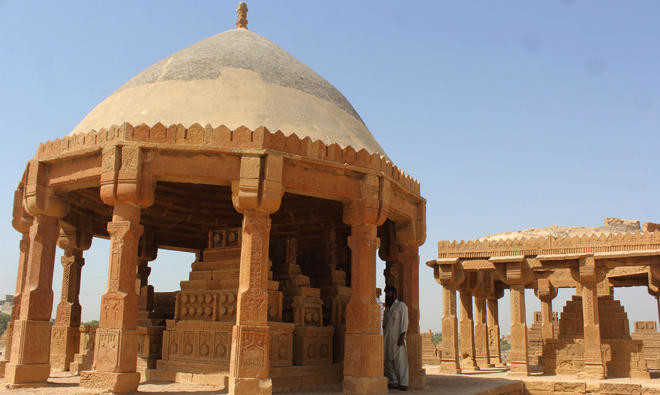
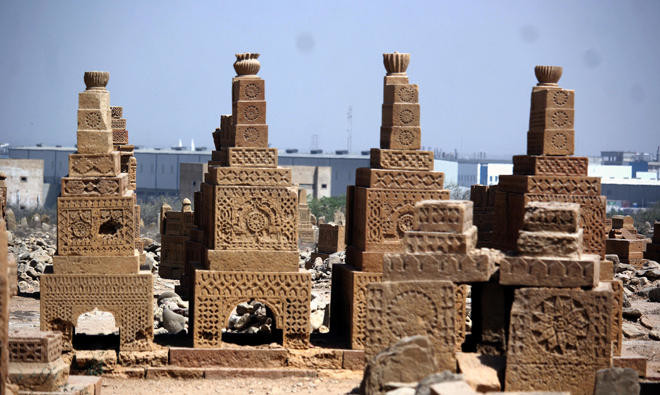

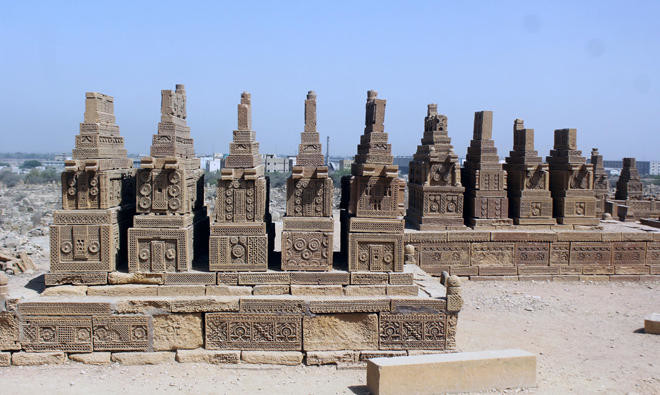
Some 29 kilometers east of Karachi, more than 600 graves of yellow sandstone, popularly known as Chaukhandi tombs, tell a story of Jokhio and Baloch tribes whose men were fond of horse riding and animal hunting, and whose women would wear beautiful jewelry. The tombs also reveal how skillful the architects of that time were.
“Chaukhandi tombs are generally attributed to the Jokhio, Jam and Baloch tribes and were built between the 15th and 18th centuries,” reads a board at the entrance of the historic Islamic cemetery, which has now been declared a national heritage.
Chaukhandi literally means “the four corners.” The tombs are built of yellow sandstone that was carried from Jung Shahi, a railway station near Thatha.
The most impressive tombs have the pyramidal structure, under which lay four chieftains of the time. “One tomb has an inscription, indicating that it belongs to Jam Mureed bin Hajji, who was one of the famous chieftains of the Jam tribe,” said Jamshed, a caretaker of Chaukhandi graveyard, while talking to Arab News.
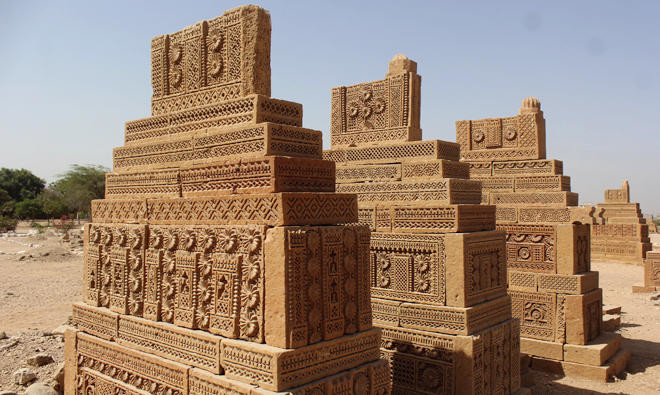
The tombs are rectangular in shape and generally two and half feet wide, five to eight feet long and four to 14 feet high. The geometric designs that cover the entire surface of the tombs are quite extraordinary.
The intricate carving in geometric design is unique and its delicacy gives the impression of a woodcarving. “The same designs are found in the textiles, pottery, jewelry and wood carvings in Sindh and Balochistan today,” says Muhammad Farooq, a caretaker, who has been with Chaukhandi for more than 35 years.
The tombs of men are capped and stylized in turban and occasionally carved with horses, arms and weapons. The tombs of women are decorated with anklets, bracelets, necklace, rings and ear pendants, etc. On one tomb there is a horse and a man with a lantern.
“The more influential the man, the higher his grave,” said Farooq. Among the curved tombs, one can also find normal graves that depict the difference between the haves and have-nots. Not everyone could afford to buy the stone and provide a month’s ration to the architect, which back then was the cost of labor.
Some of the graves have been recently carved out. These include the tombs of chieftain Jam Bijar Khan Jokhio and his son, which were built in 2008 and 2018. These tombs resemble the old ones, paying tribute to the architects of the past. “Although the stone is still available at Jung Shahi, the skillful architect no longer exists and the work in these stones is all done by machines,” said Farooq, pointing to the new tombs.
“There is one tomb belonging to Jamal Bin Bijar, who was fond of hunting, and one can also see that by taking a look at his grave,” said the caretaker, adding that people back then wanted carvings on their graves that reflected their particular skills and hobbies. “There are 1,160 different designs on more than 600 graves,” he added.
Although the graves have names of the deceased embedded on them, two graves of an unmade?? mother and her daughter being built at a single platform has name of the architect, Ustad Enyatullah.
Till the early 1990s, it was the highest tourist attraction for people belonging to European countries, which gradually decreased and almost came to an end when violence hit the seaside metropolis.
“Recently, however, there has been a rise again in the number of tourists. But most of them are Chinese, whereas the Japanese stand at number two,” said Farooq.
— Watch more photos Click here


