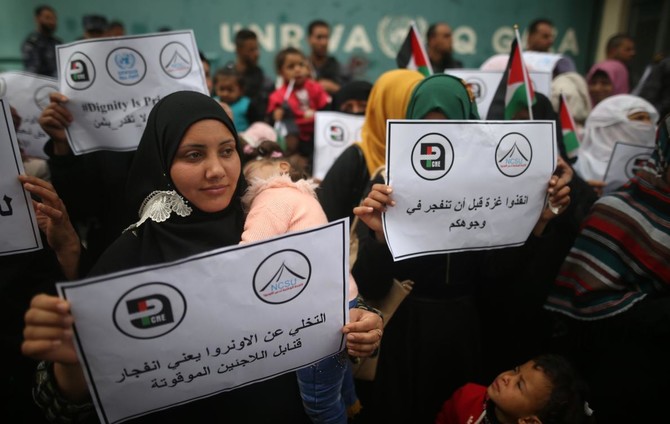
GAZA CITY, Gaza Strip: Gaza’s embattled Hamas rulers are imploring people to march along the border with Israel in the coming weeks in a risky gambit meant to shore up their shaky rule, but with potentially deadly consequences.
Beginning Friday, Hamas hopes it can mobilize large crowds to set up tent camps near the border. It plans a series of demonstrations culminating with a march to the border fence on May 15, the anniversary of Israel’s establishment, known to Palestinians as “the Nakba,” or catastrophe.
The group aims to mobilize hundreds of thousands of people for the effort, though it hasn’t been able to get such turnouts at past rallies. Nonetheless, a jittery Israel is closely watching and vowing a tough response if the border is breached.
“When we march to the border, the organizers will decide then what to do,” said Ismail Radwan, a Hamas official. Warning Israel against targeting the protesters, he said “the occupation should not commit any stupidity in confronting the Palestinian crowds.”
Hamas says the demonstration is meant to draw attention to the plight of hundreds of thousands of Gazans whose relatives fled or were expelled from their homes in what is now Israel during the 1948 war surrounding Israel’s creation.
But the first-of-its-kind protest also comes at a low point for the Islamic militant group and the 2 million residents of Gaza, where conditions have deteriorated since Hamas seized control of the territory from the internationally-backed Palestinian Authority in 2007.
An Israeli-Egyptian blockade, along with three wars with Israel and a series of sanctions by Palestinian President Mahmoud Abbas, have left Gaza’s economy in tatters. Unemployment is well over 40 percent, tap water is undrinkable and Gazans receive just a few hours of electricity a day.
An Egyptian-led attempt to broker a reconciliation deal between Hamas and Abbas’ Fatah movement took a major downturn earlier this month after a bombing targeted a convoy carrying Abbas’ prime minister and security chief shortly after they entered Gaza. Abbas has blamed Hamas and threatened more financial pressure, such as cutting civil servant salaries or fuel purchases, to force the group to cede control.
“Hamas has realized it’s besieged from three sides; Israel, Egypt and the Palestinian Authority,” said Mkhaimar Abusada, political science professor at Gaza’s Al-Azhar University. “It feels the crisis is suffocating.”
He said that for Hamas, the protests can divert attention from their domestic woes while avoiding renewed war with Israel. “They think busying Israel with this issue may put it under pressure,” he said.
As Gaza’s woes have mounted, Hamas’ popularity has plummeted, and it remains unclear whether the group will be able to mobilize the crowds it envisions. Still, a combination of social pressure and curiosity in a territory with few options for recreation could help attract people.
On Tuesday, bulldozers were busy leveling the five camp locations from north to south. Trucks unloaded portable toilet stalls, and the Palestinian Scholars Union, which represents Islamic clerics, declared participation in the protests a religious obligation.
The demonstrations will begin after the Muslim noon prayer on Friday. Buses will carry people from all over Gaza to the five tent camps, situated hundreds of meters (yards) from the border fence.
Hamas and Hamas-allied organizers of the “Great Return March” say the sit-in will remain peaceful through May. But the ultimate plan is to move to the border in mid-May.
Organizers say they are trying to realize the “right of return,” a Palestinian demand that descendants of refugees who lost their homes in 1948 should be able to return to lost family properties in what is now Israel.
Israel opposes any large-scale return of refugees, saying it would destroy the country’s Jewish character. The fate of refugees and their descendants has been a core issue in past rounds of peace talks.
Israeli Cabinet Minister Yoav Galant, a retired general and member of Prime Minister Benjamin Netanyahu’s inner Security Cabinet, said that Israel had set clear red lines.
“Hamas is in distress,” he said. “They are using in a cruel and cynical way their own population in order to hurt them and to hurt Israel.”
He said the military was well-prepared to prevent any infiltrations. “We will try to use the minimum force that is needed in order to avoid Palestinians wounded and casualties. But the red line is very clear. They stay on the Gazan side and we stay in Israel.”
Violent skirmishes are expected even before May 15. Clashes have erupted along the border every Friday since Dec. 6, when President Donald Trump recognized contested Jerusalem as Israel’s capital and announced plans to move the US Embassy from Tel Aviv.
There have been a series of recent incidents along the border, including a bombing that wounded four Israeli soldiers last month. On Tuesday, three Gazans armed with hand grenades managed to cross into Israel and travel some 30 kilometers (20 miles) before they were caught.
The upcoming Jewish holiday of Passover, Israeli Independence Day celebrations in April and the planned move of the embassy in May could lead to additional clashes.
Israel’s Foreign Ministry called the planned marches “a dangerous, premeditated provocation meant to fan the flames of the conflict and increase tension.”

Palestinians prepare mass demonstrations along Gaza border

Israel attacks southern Lebanon, Bekaa Valley
- Lebanon insists on return of residents to border villages as a prerequisite for discussing any economic zone
BEIRUT: Two people, including a Hezbollah member, were killed, and more than five others injured on Sunday in Israeli airstrikes carried out without warning on towns in southern Lebanon and the northern Bekaa Valley.
The attacks came while the Mechanism Committee, monitoring the implementation of the ceasefire agreement between Lebanon and Israel, is experiencing “temporary paralysis.”
The date of its next meeting has yet to be confirmed, following the postponement of a session scheduled for Jan. 14 without a clear explanation.
Israeli airstrikes targeted the towns of Bir Al-Salasel, Khirbet Selm, Kfar Dunin, Barish, and Bazouriye, as well as the vicinity of the Nabi Sheet and Janta towns in the northern Bekaa.
The Lebanese Ministry of Health confirmed the fatality and injuries, while an Israeli military spokesperson said that the army attacked Hezbollah members working at a site used for producing weapons.
The strikes targeted a building where Hezbollah members were operating in the Bir Al-Salasel area in southern Lebanon. The building was being used to produce weapons, the spokesman said.
The Israeli army claimed that its airstrikes on the northern Bekaa targeted “Hezbollah military infrastructure,” adding that the “Hezbollah members’ activity at the targeted sites constitutes a violation of the agreements between Israel and Lebanon and poses a threat to Israel.”
The Mechanism Committee, headed by US Gen. Joseph Clearfield and tasked with monitoring the implementation of the cessation-of-hostilities agreement between Israel and Lebanon, is expected to resume its meetings on Feb. 25.
The committee leadership has not officially confirmed the date, which remains under discussion among its members.
An official Lebanese source told Arab News: “The failure of the Mechanism Committee to convene on Jan. 14, following two meetings that were held on Dec. 3 and 19 in Ras Al-Naqoura, indicates the existence of a crisis.”
The source said that “during the two previous meetings, Lebanon insisted on its two demands for the return of residents to border villages from which they were displaced and where their homes were destroyed, as well as the reconstruction of these villages. These two clauses constitute the foundation upon which negotiations must be built.”
The same source, who is involved in the Mechanism Committee’s meetings, said that “Lebanon’s only gateway for addressing the Israeli envoy’s proposition regarding the establishment of a border economic zone similar to a buffer zone is that the border villages must be inhabited by their residents from the Lebanese perspective. This condition cannot be overlooked under any circumstances.”
The source said that “this was discussed with the US side, in particular, and the statement issued by the US on Dec. 19 regarding the negotiations and the progress made by the Lebanese army south of the Litani River presented acceptable evidence that Lebanon is now at the heart of the negotiations.”
The source added: “Lebanon called on the Mechanism Committee to issue a statement endorsing the Lebanese army’s success in extending its control south of the Litani River, including acknowledgment from the Israeli side.
“However, through the office of Prime Minister Benjamin Netanyahu, Israel only issued a statement referring to positives and negatives."
Last week, Lebanese Finance Minister Yassine Jaber confirmed to Arab News, in a special interview from Davos on the sidelines of the World Economic Forum, that “the proposal to transform the Lebanese border area into an economic zone was immediately rejected.”
The official Lebanese source attributed the reasons for the postponement of the latest Mechanism meeting to “a structural flaw within the committee, and to a crisis affecting the American delegation related to regional and international developments, in addition to an American-Israeli desire to exclude the French representative.”
The official source spoke of two dilemmas: “There is an Israeli enemy persisting in its violations of the agreement and in its attacks on Lebanon.
“On the other hand, the Israeli side submits evidence to the Mechanism Committee, including documents, photos, and videos, regarding Hezbollah’s restoration of its capabilities, at a time when its Secretary-General, Sheikh Naim Qassem, threatens civil war if Hezbollah’s weapons north of the Litani River are touched.”
The source added: “For its part, the Lebanese Army presents evidence and documentation of what it has accomplished south of the Litani. This means that the Lebanese Army is achieving what it is capable of achieving with flesh and blood. It is aware of the existence of remaining Hezbollah weapons depots and is pursuing them.”
The official source fears “a lack of progress in negotiations in light of all these documents, high-pitched statements, and the American complaint about the slow pace of negotiations.”
He added: “The positions of Hezbollah officials do not help Lebanon’s stance within the Mechanism Committee, particularly with regard to capacity building.”
The source said that “the adherence of the Hezbollah–Amal Movement duo to the Mechanism Committee does not mean their approval of any progress in negotiations.
“When Lebanon proposes expanding the Lebanese delegation to include, for example, a former minister, this constitutes horizontal expansion rather than the vertical expansion that would serve the negotiation process, which should involve specialized experts and technicians. Consequently, any collapse of the ‘Mechanism’ meetings would mean that Lebanon would be facing a very difficult moment.
“It appears that the history of Lebanese–Israeli negotiations is passing through its most dangerous phase today. The world is no longer negotiating with Lebanon solely over its rights, but over its ability to prevent war.”
The official source also stressed that the “Mechanism” constituted a fundamental point of intersection among the participating states despite the difficulties affecting its work.
He said: “The suspension of the committee’s work could be reflected in the issue of the exclusivity of weapons north of the Litani, as its absence would mean leaving matters without controls, pushing Lebanon into an even worse phase.”
The official source said that “raising the level of representation of the Lebanese delegation is not currently on the table, but it is an inevitable end that Lebanon may reach according to the logic of events.”
Lebanon is counting on the anticipated visit of Army Commander Gen. Rodolphe Haykal to Washington early next month, and on the Paris conference scheduled for March 5, to secure further support for the plan to confine weapons north of the Litani River.