Saudi finance minister outlines ‘challenging and multidimensional’ strategy for change

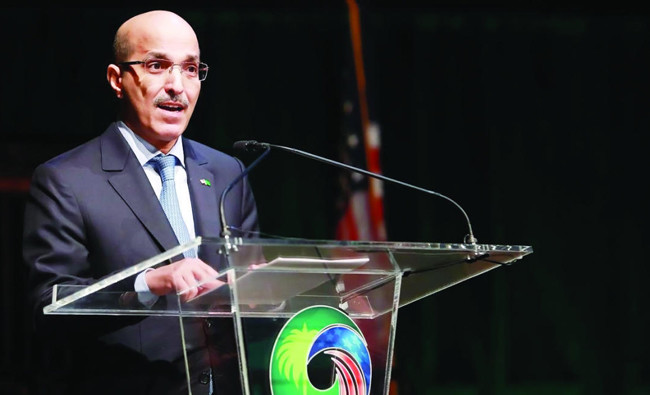
Saudi Finance Minister Mohammed Al-Jadaan told the Saudi-US CEO Forum that the main strategies driving Vision 2030 were the National Transformation Program, the fiscal balance program, the national industrial development program and the financial sectors development program. (SPA)
Updated 28 March 2018
Follow

Saudi finance minister outlines ‘challenging and multidimensional’ strategy for change

NEW YORK: Saudi Finance Minister Mohammed Al-Jadaan told the Saudi-US CEO Forum on Tuesday that the strategy for transformation was “challenging and multi-dimensional” but that if achieved, it will help robust economic growth and improve living standards in the Kingdom.
Al-Jadaan was delivering the keynote address to a packed audience at the Gotham Hall in New York, where 200 chief executives and other senior business people had gathered.
“We are here to build upon the success and the program launched in Riyadh during the first foreign visit by US President Trump last year.
“Our path forward is challenging and multidimensional, but we have programs underway that can make it successful,” he said.
He said that the main strategies driving Vision 2030 were the National Transformation Program, the fiscal balance program, the national industrial development program and the financial sectors development program.
He told the Americans in the audience: “You believe in the promises and the opportunities Saudi Arabia will provide.”
Al-Jadaan underlined the government’s commitment to reduce budget deficits and eliminate them completely by 2023. He added that the aim was to increase non-oil gross domestic product (GDP) by 3 percent per year, and that this would be helped by the changing import policy and by new bankruptcy laws.
On the possible initial public offering of Saudi Aramco, he said: “There is no decision on a listing yet, but what is sure is that we’ll list on the local market, the Tadawul.”
The forum had been welcomed by Lubna Olayan, CEO of the Olayan group and co-chair of the forum, who told the gathering that the economic diversification plan had a broad strategic vision.
“We all know about defense, security and hydrocarbons, but we want to go way beyond that,” she said.
The strategy was to accelerate growth through public-private partnerships, women’s empowerment, new sectors of the economy and the “giga projects” such as Neom and the Red Sea Resort.
“This cannot be achieved without the support of strong partners. The US-Saudi relationship goes back to the foundation of the Kingdom, and Saudis see the US as a source of knowledge that we can bring back home. Many of our youth are trained here in the US, and our youth are an even greater resource than our oil,” she added.
Andrew Liveris, the CEO of Dow Chemical Company and the other co-chair of the forum, said the reform program underway in the Kingdom was “profound and game-changing.”


Is sourdough Saudi Arabia’s latest craft food?

Updated 07 February 2026
Follow

Is sourdough Saudi Arabia’s latest craft food?

  • Saudi home bakers point to a practice that was once routine, not artisanal
  • Naturally fermented bread reflects a broader shift toward process-driven, premium food culture

ALKHOBAR: Sourdough has started to shift from a niche interest into a mainstream feature of home kitchens, cafes and specialty bakeries across the Kingdom.

The rise of sourdough is part of a wider shift in Saudi Arabia’s food landscape, where artisanal production and slower preparation methods are gaining traction.

Specialty coffee seems to have set the early template for this transition, normalizing premium pricing, craftsmanship and an interest in process.

The rise of sourdough is part of a wider shift in Saudi Arabia’s food landscape, where artisanal production and slower preparation methods are gaining traction. (Supplied/creativecommons)

Bread is now undergoing a similar shift, with fermentation replacing extraction and roasting as the central point of differentiation.

In both cases, the appeal is rooted in the product’s perceived authenticity, reduced additives, and a clearer link between raw ingredients and final consumption.

Home bakers in Riyadh, Jeddah and the Eastern Province have adapted natural yeast cultures to the Saudi environment, adjusting feeding schedules, hydration ratios, and fermentation times to accommodate higher temperatures and lower humidity in the summer months.

HIGHLIGHTS

• Home bakers in Riyadh, Jeddah and the Eastern Province have adapted natural yeast cultures to the Saudi environment.

• They adjust feeding schedules, hydration ratios, and fermentation times to accommodate higher temperatures and lower humidity in the summer months.

Cafes and specialty bakeries have responded by adding sourdough loaves, baguettes and focaccia to their menus, often positioned as premium alternatives to conventional commercial bread.

For younger home bakers, the appeal lies in the craft and the learning curve rather than nostalgia. “It feels more real and more intentional,” home baker Sarah Al-Almaei told Arab News. She began experimenting with natural yeast at home after watching starter tutorials online.

The technical aspect — hydration percentages, fermentation control and starter maintenance — has become content in its own right, with TikTok and Instagram compressing trial-and-error learning into short videos and recipe cards.

But the practice of maintaining a natural yeast culture is not new in Saudi Arabia. Long before sourdough became a global trend, Saudi households kept what was commonly referred to as the “mother dough,” a natural yeast starter fed and used daily.

“We used to maintain it every day and bake with it,” said Hessa Al-Otaibi, 56, a Saudi home baker with more than four decades’ experience. “People today call it sourdough. For us, it was simply bread.”

Her comment highlights a cultural continuity that has remained largely unrecognized, partly because the practice was not framed as artisanal or health-oriented, but as a routine household function.

The modern sourdough trend differs in its market positioning. While the older model was practical and domestic, the current model is commercial, aesthetic and often health-coded. Bakeries justify higher pricing through longer fermentation times, higher ingredient costs and smaller batch production.

Consumers justify their purchases through digestibility, perceived health benefits, flavor and product integrity.

“Once you get used to it, it’s hard to go back,” said Amina Al-Zahrani, a regular buyer of sourdough from specialty bakeries in Alkhobar.

Digestibility and texture are often cited as reasons for substitution, especially among buyers who report discomfort from standard commercial bread.

Another consumer, Majda Al-Ansari, says sourdough has become part of her weekly routine, noting that availability and quality have improved significantly in the past year.

The social media component has played an outsized role in accelerating adoption. Home bakers document starter feeding cycles, cold proofing and first bakes, turning a once-private domestic process into visible public content.

This has also created micro-markets of home-based sellers, where individual bakers offer loaves to local buyers, often fulfilling orders through direct messaging.

What remains to be seen is how far the trend will scale. If specialty bakeries continue to expand and consumers maintain willingness to pay premium prices, sourdough could establish a long-term place in Saudi food culture.

If not, it may revert to a smaller niche of committed home bakers and specialty cafes. For now, however, sourdough occupies an unusual position: both a newly fashionable trend and a quiet continuation of an older Saudi baking practice.