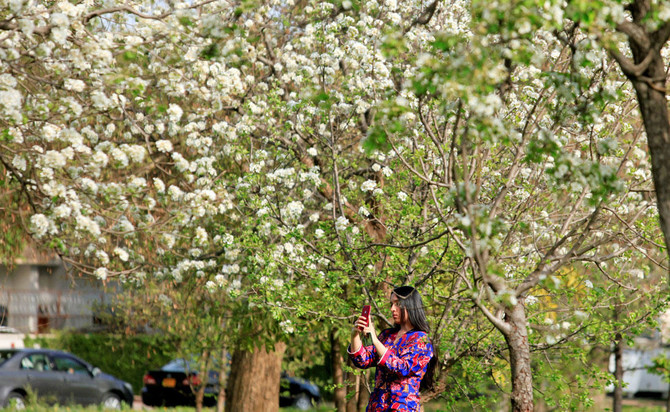
ISLAMABAD: Upset by the felling of many of Islamabad’s trees – victims of rapid urbanization — the city’s children are fighting back with a tree planting drive.
Children, accompanied by their parents, are now a common sight at tree nurseries in Pakistan’s capital, buying saplings to plant at home – some after receiving school assignments to do just that.
“They will get awards and certificates of appreciation as ‘green’ students if they succeed in growing healthy trees for at least the next two years,” said Aneela Karim, whose 5-year-old daughter and 8-year-old son recently picked out saplings of magnolia, pine and silver oak at a tree nursery in Islamabad.
Karim, 41, said her children had been assigned at school to plant at least one sapling each at home and to care for them for the next three years.
“This was really inspiring to see our children sensitised… and talking about the value of trees with us,” she said, noting that she’d learned little about the environmental and health benefits of trees while she was in school.
In recent years there has been more tree felling than tree planting in the capital, as new roads and other construction projects require the clearing of trees in formerly green areas.
The changes have triggered anger and protests among many residents.
AIR POLLUTION RISK
Karim said she was outraged that the government was chopping down mature trees, something she believes is worsening air pollution in the capital, particularly as the number of vehicles on the roads grows.
The Islamabad Municipal Corporation and Capital Development Authority could not provide official figures for the numbers of trees felled.
However, Sanaullah Aman, until recently executive director general for environment at the Capital Development Authority, estimated that over the last five years the city had lost around a third of its green cover to road expansion and the construction of housing and shopping malls.
Asif Shuja Khan, a former director general of Pakistan’s Environmental Protection Agency, said that just 10 years ago most of Pakistan’s towns and cities still had significant green areas.
But in recent years green areas have quickly disappeared or deteriorated, he said, often as a result of urbanization. Pakistan’s population has swelled from 132 million in 1998 to 210 million today, according to the Pakistan Bureau of Statistics.
According to the Pakistan Forest Institute and Pakistan Institute of Development Economics, 39,000 hectares (96,000 acres) of forest are cleared every year across the country.
Pakistan lost one-third of its forest area between 1990 and 2010, according to the UN Food and Agriculture Organization
In Islamabad, tree-planting initiatives have the backing of non-governmental organizations, the municipal corporation and the Capital Development Authority, which is planting 300,000 tree saplings in the city this spring.
PASS IT ON
Rukhsana Gul, Karim’s daughter, said she had planted trees with her classmates at school, and was now using her own pocket money to buy four small trees for the front of her family’s home, after persuading her parents to bring her to the nursery.
Tasneem Sher Mohammad, her school’s principal, said the school had organized spring and monsoon time tree-planting programs for the past three years, involving pupils, parents, teachers and administrative staff.
Nearly 60 percent of the city’s schools are organizing tree-planting drives or sending their students to tree-planting events at nearby schools or colleges, government officials say.
“We highlight with the participants, particularly children and parents, to play a part in tackling environmental pollution and protecting human health with planting more trees in their houses and neighborhoods,” said Mohammad, who noted the response from the children has been enthusiastic.
The lessons are particularly effective because children “pass on the messages about the value of trees to their homes and neighborhood and talk about it with their parents and neighborhood friends”, he said.
The surging interest in tree planting has led to a growth in the number of tree nurseries in Islamabad, industry officials said.
“Four years ago there were only 10 to 15 tree nurseries. But their number has soared beyond 250,” said Mohammad Siddique, chairman of the Islamabad Nurseries Welfare Association.
Most buyers of saplings are families, with children coming with their parents to buy trees for their houses, according to city officials and nursery owners.
Zafeer Saqib, an environment professor at the International Islamic University in Islamabad, said he believes the younger generation will be more serious about environmental protection than their parents.
Sanaullah Aman, a former city government environmental official, agreed.
“In the past, we used to engage various government and non-governmental organizations, corporate sectors, trade associations, and the industrial sector to boost the city’s tree cover,” he said.
“But the response from schoolchildren of the educational institutions has been amazing.” (Reporting by Saleem Shaikh and Sughra Tunio ; editing by James Baer and Laurie Goering : (Please credit the Thomson Reuters Foundation, the charitable arm of Thomson Reuters, that covers humanitarian news, climate change, resilience, women’s rights, trafficking and property rights. Visit http://news.trust.org/climate)


![]()
As Islamabad’s trees disappear, its children lead a green offensive
As Islamabad’s trees disappear, its children lead a green offensive
Related
Latest updates


© 2026 SAUDI RESEARCH & PUBLISHING COMPANY, All Rights Reserved And subject to Terms of Use Agreement.