ISLAMABAD: Hundreds of fully-grown trees have been chopped down in Pakistan’s capital to make way for a series of development projects in recent years, resulting in an aggravation of the adverse impacts of climate change and pollution.
The authorities are believed to have cut down more than 1,500 trees in Islamabad over the last four years in order to build a metro bus project and expand major roads.
The falling of about 245 mature trees on Embassy Road near Parliament House last October, in particular, did not go unnoticed, as scores of eco-activists took to the streets in protest.
Mome Gul has launched a “Reclaiming Green Islamabad” campaign in a bid to force the local administration to abandon its plans to sacrifice more trees during road expansion works.
“The deforestation in Islamabad is resulting in the fast depletion of groundwater, increasing carbon emissions and pollution,” she said.
Mome fears that Islamabad’s residents might soon have to grapple with smog like in Lahore and other major cities if deforestation continues at the current pace.
“Our political leaders do not honor their pledges made in international conferences for sustainable development,” she said, suggesting that people should take the political leadership to task for destroying urban ecology in the name of development.
Forest covers 4.4 million hectares (5 percent) of Pakistan’s land area, while the current rate of deforestation is 27,000 hectares per year, one of the highest in the world, according to government data.
Environmental experts say the main drivers behind deforestation in Pakistan are weak governance, land encroachments, and the growing population with its associated demand for firewood.
Ali Tauqeer Sheikh, CEO of LEAD Pakistan and Asia director for the Climate and Development Knowledge Network (CDKN), said trees are considered to be the “lungs of the cities.”
“We need to develop carbon-neutral cities and ensure sustainable development to offset the increasing pressure of urbanization,” he said.
A 2016 report on urbanization by the United Nations estimates that nearly 40 percent of Pakistan’s population lives in urban areas, as compared to 34 percent in Bangladesh, and 33 percent in India.
Malik Amin Aslam, global vice president of the International Union for Conservation of Nature (IUCN), told Arab News that increasing urban forest cover across Pakistan is vital in order to deal with issues like smog, respiratory diseases and cutting greenhouse gas emissions.
“Trees are the biggest defense against pollution and climate change,” he said, adding that deforestation in Pakistan is contributing to the melting of glaciers and increasing flood risk.
Aslam urged all provincial governments to initiate afforestation and reforestation programs similar to those carried out in Khyber Pakhtunkhwa, where the Pakistan Tehreek-e-Insaf (PTI) government has restored more than 350,000 hectares of forest in the last four years through its $123 million “Billion Tree Tsunami” project.
According to the latest Global Climate Risk Index, Pakistan ranks seventh among the countries most adversely affected by climate change. Its current annual expected urban damage due to floods is $378 million, but that could reach $3.4 billion by 2030 if no additional flood protection is introduced, says a report released by US-based think-tank the World Resources Institute.
In the face of all these challenges and threats, the country does not even have a national forest inventory (NFI) to monitor its forest cover and curb deforestation, which is a major cause of flash flooding and the subsequent losses to life and property.
Syed Mahmood Nasir, Inspector General of Forests, told Arab News that Finnish company Arbonaut is preparing an NFI for Pakistan with the help of World Bank funding. This is due to be completed by June this year.
Nasir said that climate change is a provincial subject, but the federal government is helping by designing projects aimed at mitigating the environmental degradation caused by deforestation.
In 2010, Pakistan faced its worst-ever floods, which destroyed agricultural land, infrastructure and affected more than 20 million people.
Federal Minister for Climate Change, Senator Mushahid Ullah Khan, recently urged the global community to make speedy progress on taking decisive action, saying “climate change is an issue determining our destiny as humankind and the wellbeing of all of us and our future generations to have a better, loveable future.”


![]()
![]()
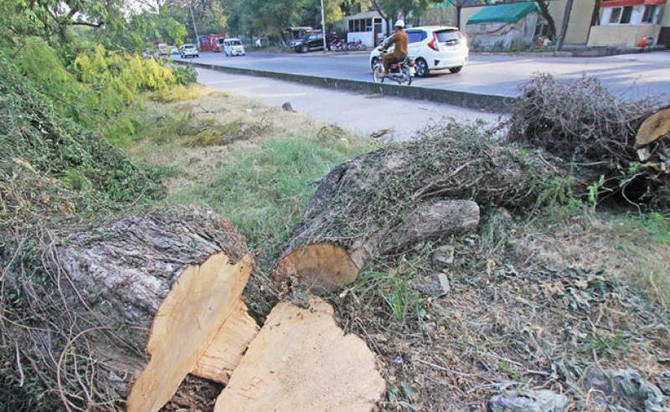
Smog fears as Islamabad’s trees are sacrificed
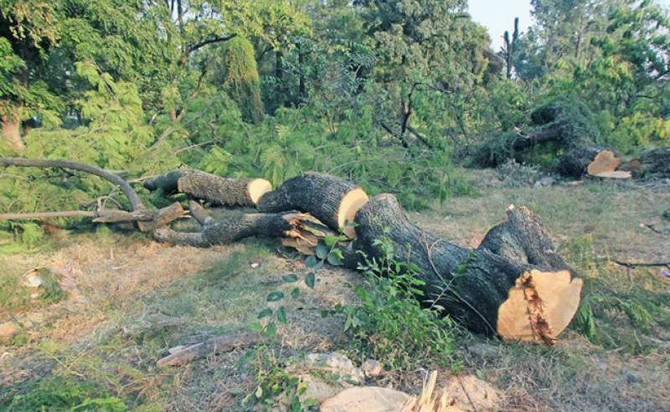
Smog fears as Islamabad’s trees are sacrificed
Latest updates


© 2026 SAUDI RESEARCH & PUBLISHING COMPANY, All Rights Reserved And subject to Terms of Use Agreement.