Iraq will prevent militant Kurdish attacks on Turkey — PM Abadi

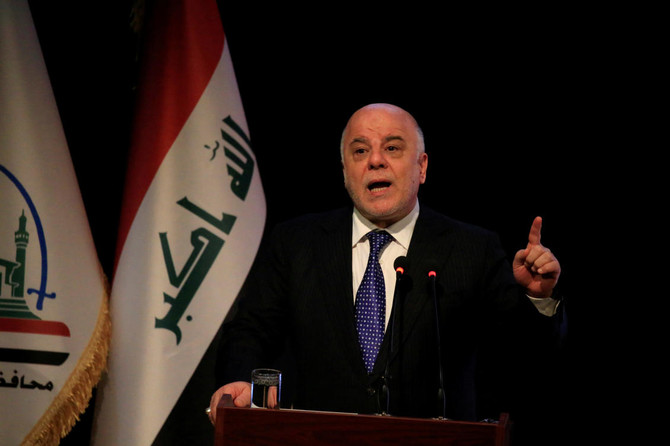
Iraq's Prime Minister Haider al-Abadi speaks during a ceremony in Najaf, Iraq January 7, 2018. (Reuters)
Updated 27 March 2018
Follow

Iraq will prevent militant Kurdish attacks on Turkey — PM Abadi

BAGHDAD: Iraqi armed forces will prevent Kurdish militants based in northern Iraq from staging cross-border attacks against Turkey, Iraqi Prime Minister Haider Al-Abadi said on Tuesday.
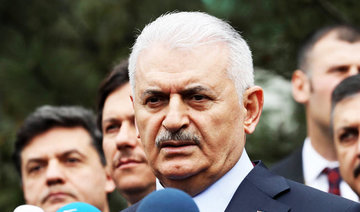
Abadi’s pledge, made during a phone call with Turkish Prime Minister Binali Yildirim, came a day after Ankara threatened to intervene directly if the Iraqi operation against the militants based in the Sinjar region failed.
Turkey has long complained that fighters of the outlawed Kurdistan Workers Party (PKK) are being given free rein to operate out of Sinjar against Turkish targets.
“Iraqi security forces have been instructed not to allow the presence of foreign fighters in the border region,” Abadi’s office quoted him as telling Yildirim in their conversation.
The chief of Iraq’s military General Staff, Lt. Gen. Othman Al-Ghanmi, echoed that message during an inspection tour on Tuesday of troops deployed in Sinjar, the state-run news website Iraqi Media Network reported.
“The Iraqi army is in full control of Sinjar and the border strip with Turkey,” it quoted him as saying.
On Monday Turkish President Tayyip Erdogan said Turkey’s intelligence chief would meet an Iraqi official to discuss the Iraqi military operation in Sinjar.
Erdogan said Turkey would do “what is necessary” if the Iraqi operation failed, raising the prospect of a possible direct Turkish military operation.
Turkish forces are currently waging a full-scale military operation in the Afrin region of northern Syria against the US-allied YPG Kurdish militia that Ankara says has close ties to the PKK.
The PKK, which is classified as a terrorist organization by the United States and the European Union as well as by Turkey, has waged an insurgency against the Turkish state for decades. It has been based in Iraq’s Qandil mountains near the border with Iran for decades.
Sources in northern Iraq said last Friday the PKK would withdraw from Sinjar, where it gained a foothold in 2014 after coming to the aid of the Yazidi minority community, who were under attack by Daesh militants.


EU chief von der Leyen says Europe to do ‘everything it can’ to support Syria

Updated 5 sec ago
Follow

EU chief von der Leyen says Europe to do ‘everything it can’ to support Syria

  • “Europe will do everything it can to support Syria’s recovery and reconstruction,” von der Leyen said
  • A Syrian presidency statement said the two sides discussed cooperation, including on reconstruction

DAMASCUS: European Commission chief Ursula von der Leyen said Europe would do everything possible to assist Syria’s recovery and reconstruction, after meeting President Ahmed Al-Sharaa on Friday in Damascus.
Von der Leyen, the highest-ranking EU official to visit since longtime ruler Bashar Assad was ousted in December 2024, is on a regional tour alongside Antonio Costa, who heads the European Council.
Their visit comes as days of deadly clashes between government forces and Kurdish fighters have rocked the north Syrian city of Aleppo.
“Europe will do everything it can to support Syria’s recovery and reconstruction,” von der Leyen said on X.
A Syrian presidency statement said the two sides discussed cooperation, including on reconstruction, as well as “humanitarian matters and the refugee issue in Europe.”
On Thursday, a joint EU-Jordan statement issued on the eve of the EU leaders’ arrival in Damascus said that “we will continue working together in support of a peaceful and inclusive Syrian-led and Syrian-owned transition.”
Syria is struggling to forge a new path after years of war sparked by a brutal crackdown on pro-democracy protests in 2011.
Sharaa, who is seeking to extend state authority across the whole country, has come under pressure to protect Syria’s many minority communities, including the Kurds.
Several EU officials have visited Syria since Assad’s ouster by Sharaa’s forces more than a year ago, and the EU has removed economic sanctions in place under Assad.
In March, the EU pledged nearly 2.5 billion euros in aid for Syria for 2025 and 2026.
Von der Leyen and Costa were also visiting Lebanon on Friday.