Iraq will prevent militant Kurdish attacks on Turkey — PM Abadi

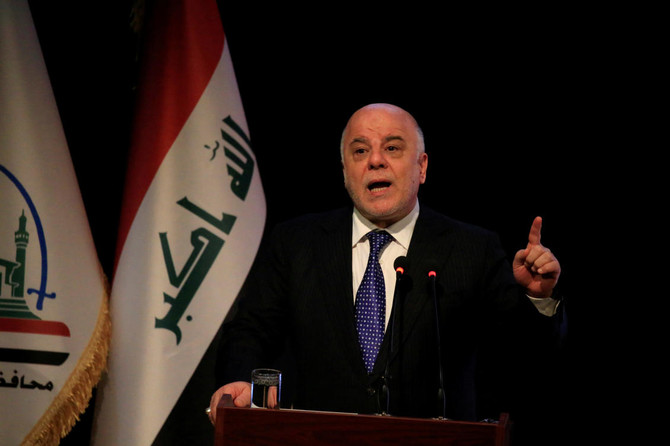
Iraq's Prime Minister Haider al-Abadi speaks during a ceremony in Najaf, Iraq January 7, 2018. (Reuters)
Updated 27 March 2018
Follow

Iraq will prevent militant Kurdish attacks on Turkey — PM Abadi

BAGHDAD: Iraqi armed forces will prevent Kurdish militants based in northern Iraq from staging cross-border attacks against Turkey, Iraqi Prime Minister Haider Al-Abadi said on Tuesday.
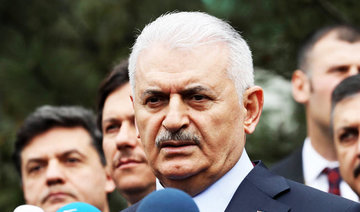
Abadi’s pledge, made during a phone call with Turkish Prime Minister Binali Yildirim, came a day after Ankara threatened to intervene directly if the Iraqi operation against the militants based in the Sinjar region failed.
Turkey has long complained that fighters of the outlawed Kurdistan Workers Party (PKK) are being given free rein to operate out of Sinjar against Turkish targets.
“Iraqi security forces have been instructed not to allow the presence of foreign fighters in the border region,” Abadi’s office quoted him as telling Yildirim in their conversation.
The chief of Iraq’s military General Staff, Lt. Gen. Othman Al-Ghanmi, echoed that message during an inspection tour on Tuesday of troops deployed in Sinjar, the state-run news website Iraqi Media Network reported.
“The Iraqi army is in full control of Sinjar and the border strip with Turkey,” it quoted him as saying.
On Monday Turkish President Tayyip Erdogan said Turkey’s intelligence chief would meet an Iraqi official to discuss the Iraqi military operation in Sinjar.
Erdogan said Turkey would do “what is necessary” if the Iraqi operation failed, raising the prospect of a possible direct Turkish military operation.
Turkish forces are currently waging a full-scale military operation in the Afrin region of northern Syria against the US-allied YPG Kurdish militia that Ankara says has close ties to the PKK.
The PKK, which is classified as a terrorist organization by the United States and the European Union as well as by Turkey, has waged an insurgency against the Turkish state for decades. It has been based in Iraq’s Qandil mountains near the border with Iran for decades.
Sources in northern Iraq said last Friday the PKK would withdraw from Sinjar, where it gained a foothold in 2014 after coming to the aid of the Yazidi minority community, who were under attack by Daesh militants.


Amman ranks among world’s top cities after first Quality of Life Index

Updated 14 sec ago
Follow

Amman ranks among world’s top cities after first Quality of Life Index

  • Jordanian capital second Arab city to be ranked in UN-backed index after Saudi Arabia’s Madinah

AMMAN: Jordan’s capital Amman has completed its first Quality of Life Index, ranking among the world’s leading cities to be assessed under the globally recognized framework, it was reported on Monday.

As a result, the city has become only the second in the Arab world — after Saudi Arabia’s Madinah — to be ranked in the program.

The Greater Amman Municipality said the city placed 10th globally out of 100 participating cities, with its index set to be officially listed on the international Quality of Life platform, the Jordan News Agency reported.

The assessment was developed in collaboration with the Quality of Life Initiative of the UN Human Settlements Programme — known as UN-Habitat — to advance urban well-being and human-centered development.

The Quality of Life Index combines objective data with residents’ perceptions, using global well-being indicators alongside local measures, offering a comprehensive picture of daily life.

The index measures performance across nine key areas: basic services, mobility, culture and recreation, education, environment, economy, governance, health and well-being, and housing and social cohesion.

Yousef Shawarbeh, the mayor of Amman, said the initiative aimed to support the city’s long-term vision of becoming a prosperous, inclusive and sustainable urban center, Petra reported.

He added that the index provided deeper insight into residents’ lived experiences and would help guide policymaking to improve quality of life.

Akram Khraisat, director of the Amman Urban Observatory, said the city’s participation marked a major step toward data-driven urban planning.

He added that the index would enable the municipality to better prioritize services, promote inclusive development, and assess the impact of policies on residents’ well-being, in line with the UN Sustainable Development Goals.

Officials said the initiative complemented a range of ongoing development projects in the capital, including public transport improvements, participatory greening and urban agriculture schemes, climate action planning, digital transformation initiatives and the Greater Amman Municipality Strategic Plan 2022–2026.