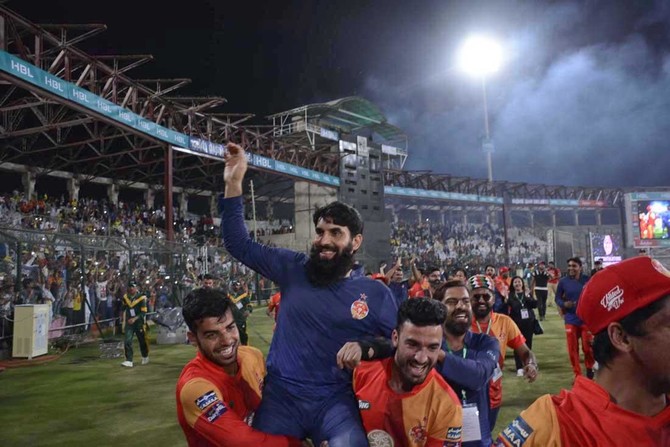
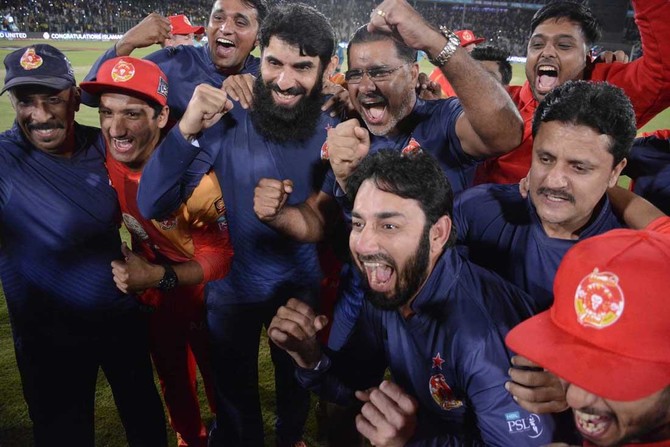
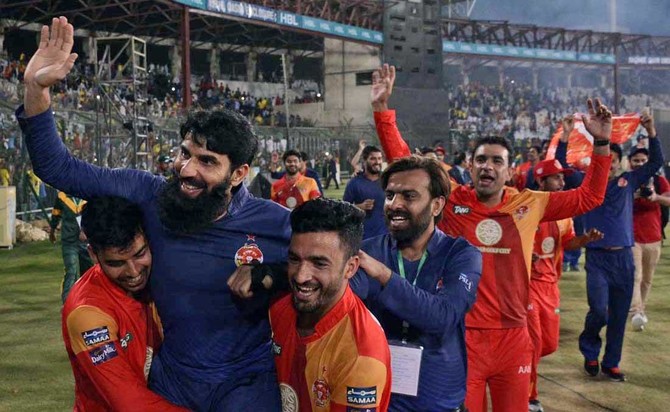
KARACHI: Islamabad United, winners of the inaugural 2016 Pakistan Super League, regained the trophy with a comprehensive victory over defending champions Peshawar Zalmi at the National Stadium on March 25.
The final of the Twenty20 tournament was the first high-profile match featuring leading international cricketers played in the city for nine years, and the stadium was packed for the occasion.
Luke Ronchi, who opened the innings for Islamabad with Sahibzada Farhan, punished the Peshawar bowlers with hard-hitting sixes and fours, scoring 52 off 26 balls. He was caught by Fletcher on Chris Jordan’s delivery, but only after helping his team to reach 96 runs in 8.4 overs, putting the match beyond Zalmi.
Ronchi was declared Man of the Match, and also collected Player of the Tournament award. Kumar Sangakkara of the Multan Sultans won the award for most catches this season, while Faheem Ashraf’s 18 wickets for Islamabad earned him the Best Bowler title.
Zalmi skipper Darren Sammy said he was disappointed his team had struggled to score runs.
“With the ball, we took a while to respond,” he said. “Ronchi made the difference. I said to the guys after the match: ‘Keep working with your heads held high.’”
Peshawar won the toss and elected to bat first. However, the decision backfired as the side struggled to a very difficult start and failed to set a big target. The reached only 149, a run total that was not easy to defend on a good batting track against a team with ruthless hitters, led by Ronchi.
Zalmi’s renowned opener, Kamran Akmal, who played an exceptional knock in the second eliminator against Karachi Kings, faced nine deliveries in the final but could not hit a single boundary. Islamabad’s left-arm spinner, Samit Patel, made an early breakthrough by taking Akmal’s wicket after the Peshawar batsman had managed to score only a single run.
Mohammad Hafeez also failed to impress, and was caught by Patel on his own delivery in the fifth over of the match, having scored only eight runs off six balls.
Andre Fletcher, who opened the inning with Akmal and scored 21 runs at a strike rate of 140, was the third victim of the Islamabad bowlers, losing his wicket to Shadab Khan.
Chris Jordan and Liam Dawson boosted Peshawar’s total to 90 before Hussain Talat dismantled the partnership when Jordan, the highest scorer of the inning with 36 runs, was caught by Islamabad skipper JP Duminy. Saad Nasim was the fifth batsman to fall, after scoring only two runs off three balls.
Skipper Sammy, who had entertained fans throughout the tournament with his big hitting, could not get into a groove either, adding only 6 runs.
Umaid Asif was the seventh out, followed by Dawson, the second-highest run scorer of the inning, who was bowled out for 33 runs by Mohammed Sami. Hasan Ali could add only six runs.
Wahab Riaz, however, gave his side a glimmer of hope by scoring 28 runs off 14 balls, taking Zalmi’s total to 148 for 9 in 20 overs. It kept the final alive as a contest, though the disappointing score proved too low to defend.
Islamabad, in contrast, got off to a flawless start thanks to Ronchi. After his dismissal, Chadwick Walton came out but was bowled out by Umaid Asif. Skipper JP Duminy did not remain on the pitch for long, caught and bowled by Chris Jordan after adding just two runs.
Sahibzada Farhan, who scored 44 off 33 balls at a strike rate of 133.33, was the fourth wicket to fall and after his return to the pavilion, Islamabad started losing wickets in quick succession.
However, just as it seemed the match was headed for a nail-biting conclusion, Asif Ali steadied the ship and brought his team to the brink of victory with three sixes. He remained not out and played a great knock at the incredible strike rate of 433.33, scoring 26 runs off only six balls.
However, it was Faheem Ashraf who hit the winning strike, a six off Wahab Riaz’s delivery, assuring his side a second PSL title in the three-year-history of the event with a total of 154 for seven in 16.5 overs.
Hasan Ali remained a costly bowler for Peshawar, conceding 53 runs in four overs and taking two wickets. Wahab Riaz conceded 28 in four overs, while Chris Jordan took two wickets in three overs and conceded 22 runs.
Before the sporting action began, leading Pakistani musical acts — including Ali Zafar, Strings, Shehzad Roy, Farhan Saeed and Aima Baig — entertained the spectators, who went through strict security checks as they entered the ground.
The gates of the stadium opened at noon but spectators continued to arrive until 7pm. During the prize-giving ceremony, Najam Sethi, the chairman of the Pakistan Cricket Board, thanked law enforcement agencies and the federal and provincial governments for making the final in Karachi possible. He also congratulated the people of the city on the return of top-level international cricket after nine years.
Earlier, hundreds of buses transported spectators to the stadium from five designated parking areas nearby.
Prime Minister Shahid Khaqan Abbasi and several members of his cabinet watched the match as guests of honor. Chief Minister of Sindh, Syed Murad Ali Shah, who earlier inspected the security operation a helicopter, was also in the crowd, along with members of his provincial administration.
At the end of the match, the Pakistan Army tweeted a message from Chief of Army Staff General Qamar Javed Bajwa: “Congrats to Islamabad United ‘the Champions’. Pakistan won today! Best of the day was excited yet very disciplined spectators of Karachi. Nothing can defeat our national passion.”


![]()
![]()
![]()
![]()

Islamabad United regain PSL trophy with comfortable win over Peshawar Zalmi
Islamabad United regain PSL trophy with comfortable win over Peshawar Zalmi

Latest updates





© 2026 SAUDI RESEARCH & PUBLISHING COMPANY, All Rights Reserved And subject to Terms of Use Agreement.