Saudi forces shoot down 7 Houthi missiles; one expat killed in attack

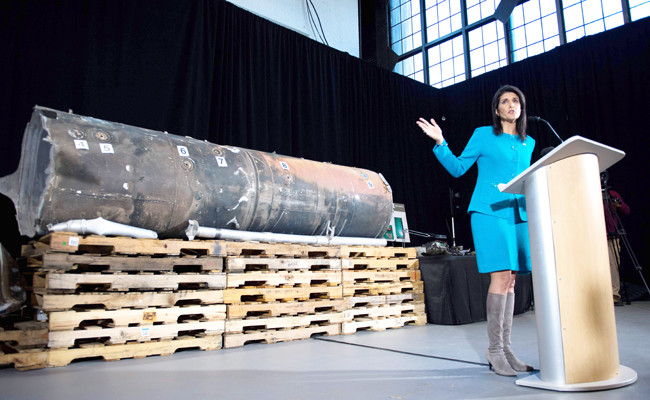
In this file photo, US Ambassador to the United Nations Nikki Haley unveils what remains of a missile fired by Houthi rebels in Yemen toward Riyadh on Nov. 4, 2017. Another missile fired from Yemen was intercepted by Saudi Air Defense Forces on Sunday. (AFP file)
Updated 26 March 2018
Follow

Saudi forces shoot down 7 Houthi missiles; one expat killed in attack

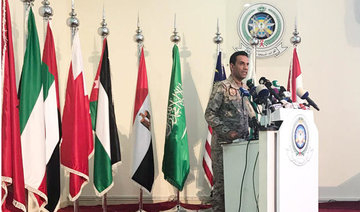
RIYADH: Saudi air defenses intercepted seven ballistic missiles fired by Houthi militia in Yemen toward various targets in Saudi Arabia on Sunday night, the Arab Coalition helping Yemen's legitimate government said.
Three of the missiles were fired toward Riyadh, two toward Jazan, and one each toward Khamis Mushayt and Najran, Saudi state news channel Al Ekhbariya quoted a coalition spokesman as saying.
Missiles were targeted at residential areas and one Egyptian civilian worker was killed and two were injured, said the news channel. It did not mention which place the casualties were based.
Witnesses reported loud explosions and bright flashes in the sky in Riyadh, apparently caused by missiles being shot down.
Since November, Yemen’s Iran-aligned Houthi militias have fired multiple missiles into Saudi Arabia, all of which Saudi forces had successfully intercepted without causing any damages to lives or properties.
The Houthis launched a missile at Riyadh on Nov. 4, targeting King Khalid International Airport. Royal Saudi Air Defense forces intercepted the missile and shot it down, and there was no damage. 
A UN Security Council-appointed panel confirmed the missile was manufactured in Iran, along with three other missiles fired from Yemen toward the Kingdom this year.


Economic growth and resilience at heart of 2nd AlUla Emerging Market Economies Conference

Updated 9 sec ago
Follow

Economic growth and resilience at heart of 2nd AlUla Emerging Market Economies Conference

  • Event on Feb. 8 and 9 will bring together ministers, governors of central banks, policymakers, economic experts and international financial institutions
  • Emerging-market economies a ‘pivotal element’ in global economic system due to effect they have on growth and stability, says Saudi Finance Minister Mohammed Al-Jadaan

RIYADH: The second annual AlUla Conference for Emerging Market Economies, which Saudi Arabia will host next week, offers a platform to exchange views on global developments and discuss policies and reforms that support inclusive growth and strengthen economic resilience, the Kingdom’s finance minister said.

The event on Feb. 8 and 9 will bring together finance ministers, governors of central banks and policymakers, alongside economic experts and representatives of international financial institutions.

Organized by the Saudi Ministry of Finance in partnership with the International Monetary Fund, it takes place as emerging-market economies face mounting challenges amid rapid global economic change.

Finance Minister Mohammed Al-Jadaan said the decision to host the conference reflects Saudi Arabia’s ongoing commitment to efforts that support global financial and economic stability, and highlights the growing influence of emerging economies on worldwide growth.

Emerging-market economies represent a “pivotal element” in the global economic system due to the direct impact they have on economic growth and stability, he added.

“The AlUla Conference for Emerging Market Economies provides a unique platform for exchanging views on global economic developments, and discussing policies and reforms that will support inclusive growth and enhance economic resilience, in light of broader international cooperation that contributes to confronting common challenges,” Al-Jadaan said.

Kristalina Georgieva, managing director of the IMF, said the event would help emerging economies deal with growing uncertainty driven by technological change, demographic shifts and geopolitical tensions.

“The AlUla conference provides a vital platform for emerging economies to discuss how they can navigate the risks and embrace the opportunities ahead,” she said.

“In these times of sweeping transformations in the global economy, policymakers face a more challenging and uncertain environment. Countries should work together to strengthen resilience through sound macroeconomic and financial policies.”