UN urged to act against Iran over Houthi missiles

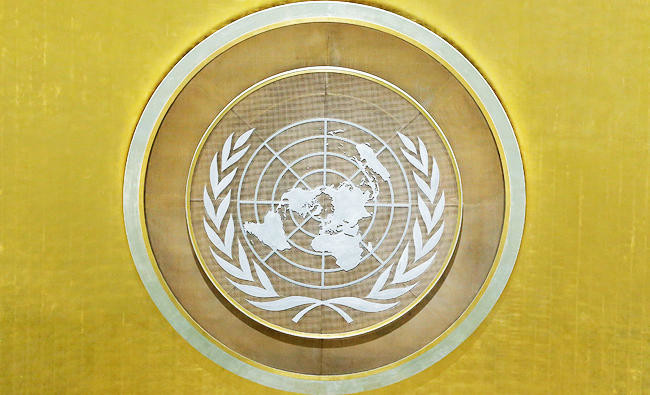
The United Nations emblem is seen in the U.N. General Assembly hall during the 72nd United Nations General Assembly at U.N. headquarters in New York, U.S., in this September 22, 2017 photo. (REUTERS)
Updated 24 December 2017
Follow

UN urged to act against Iran over Houthi missiles

JEDDAH/NEW YORK: The UN was urged on Saturday to take action against Iran for breaking an arms embargo by illegally supplying missiles to Houthi militias in Yemen.
The calls followed a UN Security Council (UNSC) resolution late on Friday that condemned “in the strongest possible terms” last week’s Houthi ballistic missile attack targeting Al-Yamamah Royal Palace in Riyadh.
All 15 council members “expressed alarm at the stated intention of the Houthis to continue these attacks against Saudi Arabia, as well as to launch additional attacks against other states in the region.”
The council urged all UN member states to fully implement the arms embargo against Houthi militias as required by the relevant Security Council resolutions, and expressed its grave concern about continuing violations of the embargo.
It called again for all parties to engage constructively in the peace efforts of Esmail Ould Shaikh Ahmad, the UN secretary-general’s special envoy for Yemen.
The condemnation was fully merited but the Security Council should have gone farther, analysts and experts told Arab News.
“In addition to expressing grave concern, the UN should take action against Iran, the country that has provided the Houthis with the missiles that targeted Riyadh. Iran is the only country that continues to violate the arms embargo imposed by the UNSC Resolution 2216, which was issued under Chapter VII of the UN Charter,” said Abdel Aziz Aluwaisheg, the assistant secretary-general for political and negotiation affairs at the Gulf Cooperation Council.
“Instead of merely expressing generic concern at the continued non‑implementation of previous Security Council resolutions, it should have named the party that has refused so far to come back to the negotiating table. That party is the Iranian-allied Houthi militias.
“The government of Yemen has ‘engaged constructively’ with the UN special envoy, but the Houthis have failed to return to negotiations toward reaching a final and comprehensive agreement to end the conflict.”
The council’s statement “reaffirms the international community’s commitment to finding a political solution to the conflict in Yemen,” Fahad Nazer, a fellow at the National Council on US-Arab Relations, told Arab News.
“It also makes clear that the Houthis have not only alienated their fellow Yemeni citizens by trying to impose their will on the rest of Yemeni society but they have also been widely condemned by the international community.
“Their callous disregard for the safety and security of the people of Yemen and their continuing violations of international resolutions and laws by targeting civilians and infrastructure in Saudi Arabia has made them international pariahs.”

Houthi desperation
“As the Houthis lose territory and the scant support they have left in Yemen, they have attempted to broaden and further complicate the conflict by increasing their attacks against Saudi Arabia and by threatening to attack the UAE. These tactics are indicative of their desperation, as they find themselves isolated at home and abroad.” 
Dr. Hamdan Al-Shehri, a political analyst and international relations scholar in Riyadh, called for serious measures to prevent the Iran-backed militias from threatening regional peace. The Security Council should take action to halt Iranian aggression, which posed a threat to many Arab countries such as Lebanon and Iraq, he said.
The international community should focus on ways of stopping Iran from supporting terrorism, Al-Shehri said. “If they don’t want to punish Iran now, at least stop these militias.”
Experts also urged the UN to ensure that Yemen’s Red Sea port of Hodeidah, which is occupied by the Houthis, was not used as a supply route for Iranian missiles and other arms.
The Saudi-led Arab Coalition in Yemen closed the port last month after a Houthi ballistic missile attack on Riyadh on Nov. 4. It later reopened to receive shipments of humanitarian aid and relief supplies, and remains operational despite last Tuesday’s further missile attack on the Saudi capital, and evidence that both missiles were supplied by Iran.
“While the UN Security Council is no doubt very concerned about the humanitarian situation in Yemen, it should take action by deploying UN staff to supervise the port of Hodeidah to make sure that it is used solely for civilian purposes and not as a conduit for Iranian weapons,” Aluwaisheg told Arab News.

Medical and food aid
Aid delivered through the ports of Hodeidah and Salif is also being misappropriated by the Houthi militias, the Coalition said on Saturday. Its spokesman, Col. Turki Al-Maliki, accused the Houthis of hampering the distribution of vaccines and stealing medical and food aid.
The theft of vaccines is particularly serious, after the International Committee of the Red Cross said there were now one million cases of cholera in Yemen and they expect another serious outbreak next March and April.
The King Salman Center for Relief and Humanitarian Aid has established more than 250 projects in Yemen at a cost of $895 million, its general supervisor, Dr. Abdullah Al-Rabeeah, said on Saturday.
The projects are operated with local partners and specialized UN agencies, and cover health, sanitation and programs for women and children.

Syrian army pushes into Aleppo district after Kurdish groups reject withdrawal

Updated 10 January 2026
Follow

Syrian army pushes into Aleppo district after Kurdish groups reject withdrawal

  • Two Syrian security officials told Reuters the ceasefire efforts had failed and that the army would seize the neighborhood by force

ALEPPO, Syria: The Syrian army said it would push into the last Kurdish-held district of Aleppo ​city on Friday after Kurdish groups there rejected a government demand for their fighters to withdraw under a ceasefire deal.
The violence in Aleppo has brought into focus one of the main faultlines in Syria as the country tries to rebuild after a devastating war, with Kurdish forces resisting efforts by President Ahmed Al-Sharaa’s Islamist-led government to bring their fighters under centralized authority.
At least nine civilians have been killed and more than 140,000 have fled their homes in Aleppo, where Kurdish forces are trying to cling on to several neighborhoods they have run since the early days of the war, which began in 2011.

HIGHLIGHTS

• Standoff pits government against Kurdish forces

• Sharaa says Kurds are ‘fundamental’ part of Syria

• More than 140,000 have fled homes due to unrest

• Turkish, Syrian foreign ministers discuss Aleppo by phone

ِA ceasefire was announced by the defense ministry overnight, demanding the withdrawal of Kurdish forces to the Kurdish-held northeast. That would effectively end Kurdish control over the pockets of Aleppo that Kurdish forces have held.

CEASEFIRE ‘FAILED,’ SECURITY OFFICIALS SAY
But in a statement, Kurdish councils that run Aleppo’s Sheikh Maksoud and Ashrafiyah districts ‌said calls to leave ‌were “a call to surrender” and that Kurdish forces would instead “defend their neighborhoods,” accusing government forces ‌of intensive ⁠shelling.
Hours ​later, the ‌Syrian army said that the deadline for Kurdish fighters to withdraw had expired, and that it would begin a military operation to clear the last Kurdish-held neighborhood of Sheikh Maksoud.
Two Syrian security officials told Reuters the ceasefire efforts had failed and that the army would seize the neighborhood by force.
The Syrian defense ministry had earlier carried out strikes on parts of Sheikh Maksoud that it said were being used by the Kurdish-led Syrian Democratic Forces (SDF) to launch attacks on the “people of Aleppo.” It said on Friday that SDF strikes had killed three army soldiers.
Kurdish security forces in Aleppo said some of the strikes hit a hospital, calling it a war crime. The defense ministry disputed that, saying the structure was a large arms depot and that it had been destroyed in the resumption of strikes on Friday.
It ⁠posted an aerial video that it said showed the location after the strikes, and said secondary explosions were visible, proving it was a weapons cache.
Reuters could not immediately verify the claim.
The SDF is ‌a powerful Kurdish-led security force that controls northeastern Syria. It says it withdrew its fighters from ‍Aleppo last year, leaving Kurdish neighborhoods in the hands of the Kurdish ‍Asayish police.
Under an agreement with Damascus last March the SDF was due to integrate with the defense ministry by the end of 2025, ‍but there has been little progress.

FRANCE, US SEEK DE-ESCALATION
France’s foreign ministry said it was working with the United States to de-escalate.
A ministry statement said President Emmanuel Macron had urged Sharaa on Thursday “to exercise restraint and reiterated France’s commitment to a united Syria where all segments of Syrian society are represented and protected.”
A Western diplomat told Reuters that mediation efforts were focused on calming the situation and producing a deal that would see Kurdish forces leave Aleppo and provide security guarantees for Kurds who remained.
The diplomat ​said US envoy Tom Barrack was en route to Damascus. A spokesperson for Barrack declined to comment. Washington has been closely involved in efforts to promote integration between the SDF — which has long enjoyed US military support — and Damascus, with which the ⁠United States has developed close ties under President Donald Trump.
The ceasefire declared by the government overnight said Kurdish forces should withdraw by 9 a.m. (0600 GMT) on Friday, but no one withdrew overnight, Syrian security sources said.
Barrack had welcomed what he called a “temporary ceasefire” and said Washington was working intensively to extend it beyond the 9 a.m. deadline. “We are hopeful this weekend will bring a more enduring calm and deeper dialogue,” he wrote on X.

TURKISH WARNING
Turkiye views the SDF as a terrorist organization linked to the outlawed Kurdistan Workers’ Party and has warned of military action if it does not honor the integration agreement.
Turkish Foreign Minister Hakan Fidan, speaking on Thursday, expressed hope that the situation in Aleppo would be normalized “through the withdrawal of SDF elements.”
Though Sharaa, a former Al-Qaeda commander who belongs to the Sunni Muslim majority, has repeatedly vowed to protect minorities, bouts of violence in which government-aligned fighters have killed hundreds of Alawites and Druze have spread alarm in minority communities over the last year.
The Kurdish councils in Aleppo said Damascus could not be trusted “with our security and our neighborhoods,” and that attacks on the areas aimed to bring about displacement.
Sharaa, in a phone call with Iraqi Kurdish leader Masoud Barzani on Friday, affirmed that the Kurds were “a fundamental part ‌of the Syrian national fabric,” the Syrian presidency said.
Neither the government nor the Kurdish forces have announced a toll of casualties among their fighters from the recent clashes.