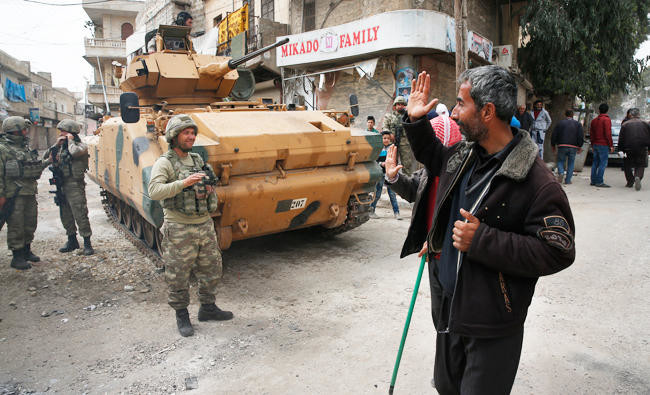
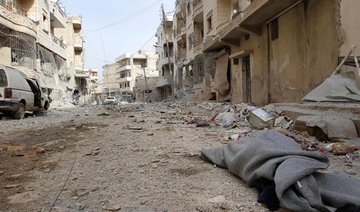
AFRIN: Turkey’s military and its Syrian rebel allies have taken full control of northwest Syria’s Afrin region, a Turkish army source said on Saturday, as aid workers distributed food to people in the area.
Turkish forces and the Syrian fighters swept into the main Afrin town last Sunday after an eight-week campaign to drive out the Kurdish YPG (people’s protection units) militia, which Ankara regards as a terrorist group.
A military source told Reuters the last remaining villages had been seized and control established overnight.
“Control has been completely achieved in the Afrin region and search operations are continuing so that local people can return safely to their houses,” the source said.
State-run Anadolu news agency carried a similar report.
In Afrin, people queued to receive hot food which was being distributed by the Turkish Red Crescent while Turkish soldiers kept security and armored vehicles moved along the streets.
“We are trying to bring back life to normal in the short and medium term here,” said the aid group’s president Kerem Kinik.
“Our mobile kitchens are here, and our crews are in the villages.”
“We want everything to be alright. We want our women and children to come back. They could not come back to their homeland,” said Afrin resident Abdurrahman Nahsen Suleymanoglu.
Turkish President Tayyip Erdogan rejected criticism of the Afrin campaign in a phone call with French President Emmanuel Macron on Friday, according to a Turkish presidential source.
Among Turkey’s Western allies, France has been one of the biggest critics of the Turkish military operation, with its foreign minister saying concerns for its border security did not justify the incursion.
Macron expressed “concern” over the offensive, telling Erdogan it was vital that humanitarian aid be allowed to reach the area.
In a statement released by his office on Saturday, the Elysee said during the phone conversation, the French leader had emphasized the “strategic importance of our partnership with Turkey, particularly in the fight against terrorism and in all other regional crises.”
It was important to pay attention to the security interests of Turkey, “our ally within NATO,” Macron said.
At the same time, he reiterated France’s “very clear expression of concern over the launch of the Turkish military intervention in Afrin and the need to allow full access to humanitarian aid to civilian populations.”
And he said “top priority” should be given to the fight against the Islamic State “which is for France a national security issue.”
The Elysee said that Macron called on “all the actors engaged on the ground to respect without any further delay the cessation of hostilities throughout Syria and to build a durable political solution.”
On that basis, Macron, “in agreement with his Turkish counterpart, wished that in-depth and intensive exchanges will continue in the coming days on Syria, and expressed his will to continue the close dialogue with Turkey on the situation off Cyprus and in the Aegean Sea,” the statement said.
According to a Turkish presidential source, Erdogan insisted to Macron that the aim of the operation in Syria was to “avert threats to Turkish national security” and “ensure peace” in the region.

Turkey takes full control of Afrin
Turkiye again blocks aid convoy for Kurds in Syria: NGO
- Last week, Turkish authorities prevented a convoy carrying humanitarian supplies destined for Kobani
- The convoy had been assembled in Turkiye’s southeastern Kurdish city of Diyarbakir
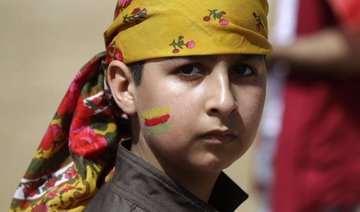
DIYARBAKIR, Turkiye: Turkish authorities have blocked for a second time an aid convoy from reaching the Syrian Kurdish town of Kobani that’s been overwhelmed by people fleeing fighting, a local NGO said on Wednesday.
As the Syrian army and Kurdish forces clash in Syria, Kobani has been inundated by people trying to escape the hostilities.
Last week, Turkish authorities prevented a convoy of 25 trucks carrying humanitarian supplies destined for Kobani from reaching the Turkiye-Syria border.
The convoy, which included water, milk, baby formula and blankets, had been assembled in Turkiye’s southeastern Kurdish city of Diyarbakir by the Diyarbakir Solidarity and Protection Platform, the NGO that organized the aid drive.
After it was blocked last week, it had initially been authorized to travel via Azaz, a city in northern Syria, with its own delegation overseeing the handover.
But “the delegation was again denied permission,” the group said in a statement on Wednesday.
The trucks “were not allowed to cross into Kobani despite all efforts,” it said, adding that “the aid was brought back to Diyarbakir.”
Last week, residents of Kobani said they were running out of food, water and electricity because the city was overwhelmed with people fleeing the advance of the Syrian army.
Kurdish forces accused the Syrian army of imposing a siege on Kobani, also known as Ain Al-Arab in Arabic.
After months of deadlock and fighting, Damascus and the Syrian Kurds announced an agreement on Friday.
The deal “seeks to unify Syrian territory,” including Kurdish areas, while also maintaining an ongoing ceasefire and introducing the “gradual integration” of Kurdish forces and administrative institutions, according to the text of the agreement.
Kurdish forces liberated Kobani from a lengthy siege by the Daesh group in 2015, their first major victory against the jihadists.
Turkiye views Syrian Kurdish fighters as a terror group affiliated with Turkiye’s outlawed Kurdistan Workers’ Party (PKK).
As the Syrian army and Kurdish forces clash in Syria, Kobani has been inundated by people trying to escape the hostilities.
Last week, Turkish authorities prevented a convoy of 25 trucks carrying humanitarian supplies destined for Kobani from reaching the Turkiye-Syria border.
The convoy, which included water, milk, baby formula and blankets, had been assembled in Turkiye’s southeastern Kurdish city of Diyarbakir by the Diyarbakir Solidarity and Protection Platform, the NGO that organized the aid drive.
After it was blocked last week, it had initially been authorized to travel via Azaz, a city in northern Syria, with its own delegation overseeing the handover.
But “the delegation was again denied permission,” the group said in a statement on Wednesday.
The trucks “were not allowed to cross into Kobani despite all efforts,” it said, adding that “the aid was brought back to Diyarbakir.”
Last week, residents of Kobani said they were running out of food, water and electricity because the city was overwhelmed with people fleeing the advance of the Syrian army.
Kurdish forces accused the Syrian army of imposing a siege on Kobani, also known as Ain Al-Arab in Arabic.
After months of deadlock and fighting, Damascus and the Syrian Kurds announced an agreement on Friday.
The deal “seeks to unify Syrian territory,” including Kurdish areas, while also maintaining an ongoing ceasefire and introducing the “gradual integration” of Kurdish forces and administrative institutions, according to the text of the agreement.
Kurdish forces liberated Kobani from a lengthy siege by the Daesh group in 2015, their first major victory against the jihadists.
Turkiye views Syrian Kurdish fighters as a terror group affiliated with Turkiye’s outlawed Kurdistan Workers’ Party (PKK).
© 2026 SAUDI RESEARCH & PUBLISHING COMPANY, All Rights Reserved And subject to Terms of Use Agreement.