BRUSSELS: European countries are set to take further steps as early as Monday to punish Russia over the poisoning of a former spy in England, officials said, as diplomatic pressure builds on Moscow over the nerve agent attack.
Russia, for its part, accused London of trying to force its European allies to take “confrontational steps” and unleashing an “anti-Russian campaign.”
EU leaders meeting in Brussels have agreed to recall the bloc’s ambassador from Moscow over the attack on Sergei Skripal and his daughter Yulia in the English city of Salisbury.
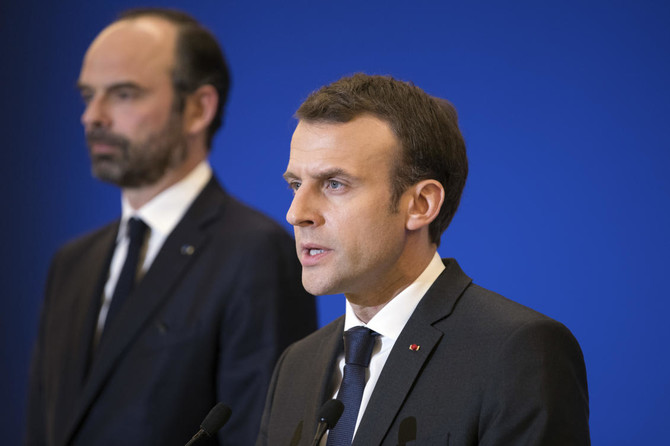
French President Emmanuel Macron said Friday the poisoning with the Soviet-made “Novichok” agent was an “attack on European sovereignty,” after EU leaders unanimously backed London’s assessment that it was “highly likely” Moscow was to blame and that there was no plausible alternative explanation.
A number of member states are considering following Britain’s lead and expelling Russian intelligence agents posing as diplomats, with German Chancellor Angela Merkel saying further coordinated actions were “necessary” to respond to the attack.
The 23 diplomats expelled by Moscow in a tit-for-tat move “have returned to the UK safely,” British Foreign Secretary Boris Johnson said on Twitter late Friday.
The question of whether to expel Russian diplomats will be left to individual member states and EU President Donald Tusk said action was expected as early as Monday.
But divisions remain over how far to go, with Austria already ruling out expelling diplomats, and Tusk, a former Polish prime minister, said it was not clear how many states would join the expulsions.
“More than one but I don’t think that it will be the whole group,” Tusk said.
Macron told a joint news conference with Merkel after the summit in Brussels that the March 4 incident — for which Russia denies responsibility — was “a serious challenge to our security and... an attack on European sovereignty.”
“It calls for a coordinated, determined response from the European Union and its member states,” the French leader said.
British Prime Minister Theresa May briefed other EU leaders on the probe into the attack over a summit dinner on Thursday.
She managed to overcome resistance from countries like Greece and Italy who were reluctant to put their close Kremlin ties in jeopardy to persuade them to back Britain’s conclusion that Moscow was to blame.
Merkel said May had shared “certain findings” which left little doubt Moscow was behind the first offensive use of a nerve agent in Europe since World War II.
“We believe that the analyzes are already very well-founded and this has not been questioned by anyone,” Merkel said.
“We agreed — Germany and France at least — that such reactions are still necessary in addition to recalling the ambassador.”
European Commission chief Jean-Claude Juncker said the recall of the ambassador was an “extraordinary measure” never before taken by the bloc.
The leaders of former Soviet bloc EU states the Czech Republic and Lithuania, as well as Denmark and Ireland, have said they were considering further unilateral steps, including expelling diplomats.
Latvia was the first to commit explicitly to expelling Russians, saying it expected to make an official announcement on Monday.
Moscow denounced the moves by Britain and the EU.
“As for the decision taken, we regret in this context that again such decisions are taken using the wording ‘highly likely’,” President Vladimir Putin’s spokesman Dmitry Peskov said Friday.
“We don’t agree with this and we repeat again that Russia absolutely definitely has nothing to do with the Skripal case.”
Foreign Minister Sergei Lavrov, on a visit to Hanoi, separately accused Britain of “feverishly trying to force allies to take confrontational steps,” suggesting London’s focus was now on making “the crisis with Russia as deep as possible.”
The Russian ambassador to Britain wrote Friday to a policeman exposed to the nerve agent used against the Skripals, insisting on Moscow’s innocence and thanking him for his bravery.
Alexander Yakovenko told Detective Sergeant Nick Bailey, who was released from hospital Thursday following two weeks of treatment, that he hoped the officer and the Skripals “get well soon.”
“I would like to express my sincere gratitude to you for your bravery when reacting to the assault on two Russian nationals,” he wrote.


![]()
Europe steps up pressure on Russia over spy attack
Europe steps up pressure on Russia over spy attack
Latest updates


Recommended


© 2026 SAUDI RESEARCH & PUBLISHING COMPANY, All Rights Reserved And subject to Terms of Use Agreement.