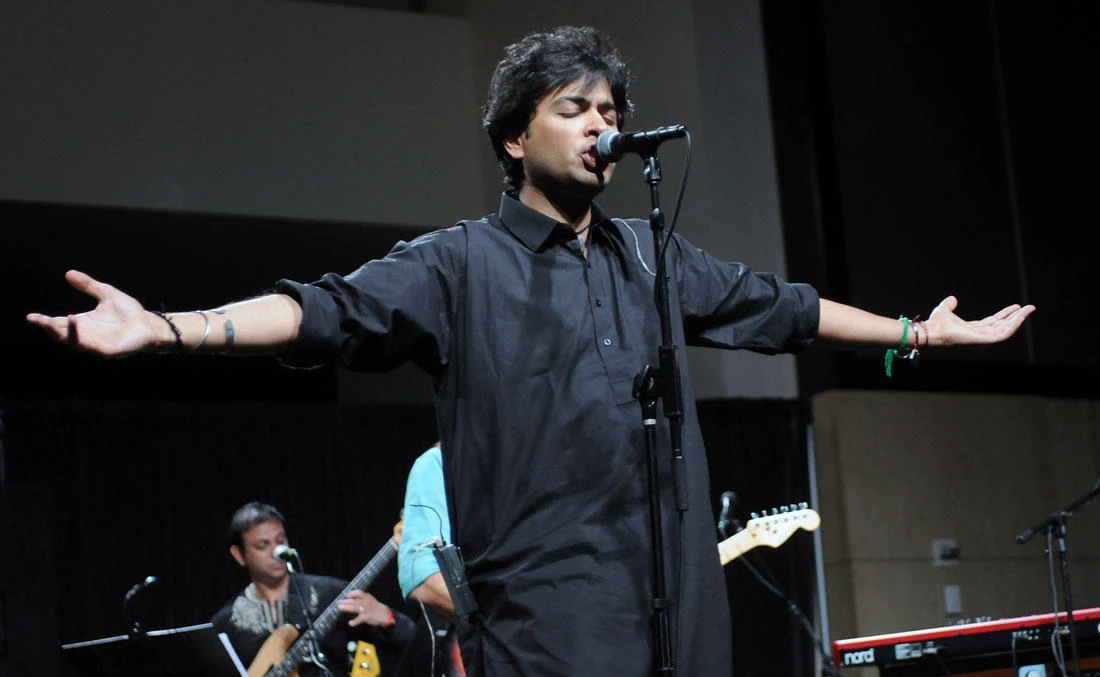
Shehzad Roy to receive second Sitara-E-Imtiaz

In this file photo, Pakistani singer Shehzad Roy attends the Peace Through Music Gala at The Ray Dolby Ballroom at Hollywood & Highland Center on Sept. 15, 2013 in Hollywood, California. (AFP)
Updated 23 March 2018
Follow

Shehzad Roy to receive second Sitara-E-Imtiaz

ISLAMABAD: Humanitarian, philanthropist, activist and rock star Shehzad Roy has announced that he will again be the recipient of Pakistan’s highest civilian honor: the Sitara-e-Imtiaz.
Roy, whose career as a singer began in 1995 with his debut album Zindagi, went on to release six albums, and has used his platform for good. In 2002 he established Zindagi Trust, a non-government, non-profit organization working on providing education for all Pakistanis, particularly those who do not have access to it.
It was his work for the public sector with Zindagi Trust that earned him his first Sitara-e-Imtiaz in 2005. Zindagi Trust aimed high, and was active in public school reform as well as pioneering a program that paid students to go to school rather than drop out to help earn income for their families.
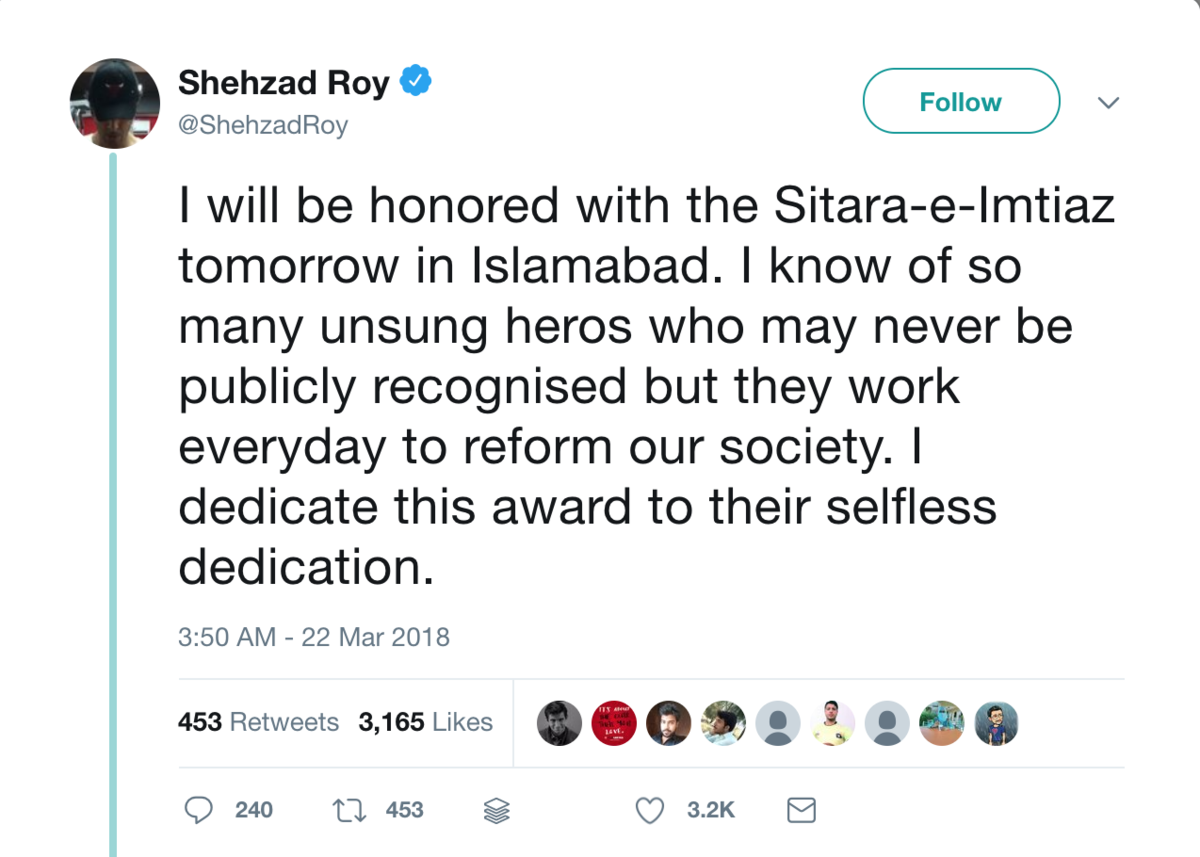
Roy announced the news on his Twitter account, acknowledging and dedicating the award to those who have not received recognition for their tireless work.
“I will be honored with the Sitara-e-Imtiaz tomorrow in Islamabad. I know of so many unsung heros who may never be publicly recognized but they work everyday to reform our society. I dedicate this award to their selfless dedication.”
The Sitara-e-Imtiaz is awarded by Pakistan to civilians whose efforts have contributed to the national interest of Pakistan through their work, philanthropy, cultural celebration, scientific advancements or the pursuit of peace. The recipients of the awards cover a diverse range of backgrounds including writers, sportspeople and those who work in science and entertainment. Fellow singers Reshma and Abida Parveen are previous recipients.
In October last year, Roy represented Pakistan as National Goodwill Ambassador for the UN Office on Drugs and Crime.
T20 World Cup: ICC deputy chief in Lahore for talks after Pakistan boycotts India match

Updated 8 sec ago
Follow

T20 World Cup: ICC deputy chief in Lahore for talks after Pakistan boycotts India match

  • Islamabad’s boycott over Bangladesh’s exclusion has threatened the tournament’s most lucrative game
  • Bangladesh Cricket Board chief has also arrived in Pakistan and is expected to participate in meetings

ISLAMABAD: International Cricket Council (ICC) Deputy Chairman Imran Khwaja arrived in Lahore on Sunday for talks with Pakistan Cricket Board (PCB) officials, the PCB said, as the sport’s governing body strives to save a high-stakes T20 World Cup clash between arch-rivals Pakistan and India.

The development follows Islamabad’s decision to boycott the Feb. 15 Pakistan-India match in Colombo, a move to protest the ICC’s exclusion of Bangladesh from the ongoing T20 World Cup.

The controversy over Pakistan’s participation erupted after the ICC replaced Bangladesh with Scotland, following Bangladesh’s decision to not play matches in India owing to security fears.

The ICC has since requested the Pakistan Cricket Board to reconsider the decision to boycott their match against India in Colombo or they will have to forfeit the marquee game of the tournament.

“ICC Deputy Chairman Imran Khwaja arrived in Lahore,” the PCB said on Sunday, adding that he was received at the airport by the PCB chairman’s adviser, Aamir Mir.

Prior to Khwaja’s arrival in Lahore, where the PCB is headquartered, Pakistan welcomed Bangladesh Cricket Board (BCB) President Aminul Islam, who was received by PCB CEO Salman Naseer.

The two visiting officials are scheduled to meet PCB Chairman Mohsin Naqvi.

“Bangladesh Cricket Board President Aminul Islam will also take part in other meetings,” the PCB said in a statement, hinting that he will be part of the meeting with ICC’s Khwaja.

The dispute stems from the ICC’s decision to replace Bangladesh with Scotland last month after Bangladesh refused to play tournament matches in India. Dhaka’s decision followed the removal of Mustafizur Rahman from the Indian Premier League (IPL). He was bought for $1 million by the IPL’s Kolkata Knight Riders, but on Jan. 3 the Board of Control for Cricket in India (BCCI) ordered Kolkata to release Mustafizur without a public explanation but amid regional tensions.

Pakistan have boycotted the 27th match of the tournament against India, due to take place at R. Premadasa Stadium in Colombo. An India-Pakistan fixture is the sport’s most lucrative asset, generating a massive share of global broadcasting and sponsorship revenue.

The PCB has remained defiant amid reports of potential sanctions. On Saturday, the board rejected claims by Indian media that it had initiated a dialogue with the ICC to find a way out of the standoff.

“I categorically reject the claim by Indian sports journalist Vikrant Gupta that PCB approached the ICC,” PCB’s Mir said in a statement. “As usual, sections of Indian media are busy circulating fiction. A little patience and time will clearly show who actually went knocking and who didn’t.”

The standoff highlights the growing friction within the sport’s governance.

Pakistan has accused India’s cricket board of influencing the ICC’s decisions.

Defense Minister Khawaja Asif this week called for the formation of a new cricket governing body, saying the ICC, currently chaired by Jay Shah, son of India’s Home Minister Amit Shah, was being held “hostage” to “Indian political interests.”

India generates the largest share of cricket’s commercial revenue and hence enjoys considerable influence over the sport. Critics argue that this financial contribution translates into decisive leverage within the ICC.

A large part of that revenue comes from the Indian Premier League (IPL), the sport’s most lucrative T20 cricket competition, which is run by the Board of Control for Cricket in India (BCCI). Between 2024 and 2027, the IPL is projected to earn $1.15 billion, nearly 39 percent of the ICC’s total annual revenue, according to international media reports.

While the Pakistani government cleared the team to participate in the rest of the tournament, Prime Minister Shehbaz Sharif maintained that the boycott of the India game was necessary to protest the “unjust” treatment of Bangladesh.