

Trump signs $1.3 trillion budget after threatening veto

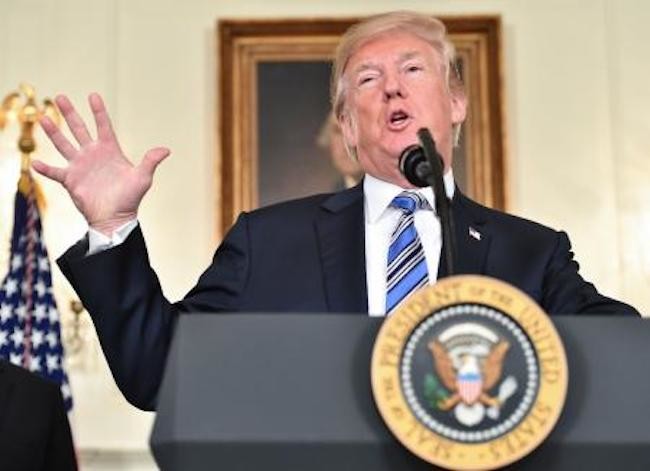
US President Donald Trump speaks about the spending bill during a press conference in the Diplomatic Reception Room at the White House on Mar. 23, 2018. (AFP)
Updated 23 March 2018
Follow

Trump signs $1.3 trillion budget after threatening veto

WASHINGTON: President Donald Trump signed a $1.3 trillion spending measure Friday averting a government shutdown at midnight, acting just hours after saying he was considering a veto.
Trump complained that the legislation does not fully fund his plans for a border wall with Mexico and does not address some 800,000 "Dreamer" immigrants who are now protected from deportation under a program that he has moved to eliminate. He said he signed it in order to provide needed money for the military.
Earlier Friday, Trump cast doubt on whether he would back the massive spending bill, saying he was "considering" a veto. Then, adding to the made-for-TV drama, he scheduled a news conference. Telegraphing the outcome, an internal White House television feed advertised the event this way: "President Trump Participates in a Bill Signing."
With Congress already on recess, Trump had said on Twitter that he was weighing a veto. He said that young immigrants now protected in the US under Barack Obama's Delayed Action for Childhood Arrivals "have been totally abandoned by the Democrats (not even mentioned in Bill) and the BORDER WALL, which is desperately needed for our National Defense, is not fully funded."
Several advisers inside and outside the White House had characterized the tweet as Trump blowing off steam.
Trump's tweet had been at odds with what top members of Trump's administration and House Speaker Paul Ryan said Thursday, and with a formal statement of administration policy, which said Trump was supportive of the measure.

The Senate passage of the bill averted a third federal shutdown this year, an outcome both parties wanted to avoid. But the budget caps-busting deal drew serious conservative opposition. It also failed to resolve the stalemate over shielding young Dreamer immigrants from deportation after Trump's decision to end the Deferred Action for Childhood Arrivals program last year.

The spending package includes $1.6 billion for Trump's long-promised border wall with Mexico. But less than half of the nearly 95 miles (153 kilometers) of border construction that have been approved can be spent on new barriers. The rest can only be used to repair existing segments.
The money was far less than the $25 billion over 10 years Trump had asked for as part of a last-ditch deal that would have included providing a temporary extension of the DACA program. White House budget officials have nonetheless tried to spin the funding as a win.



Vietnam’s ruling Communist Party re-elects To Lam as general secretary

Updated 3 sec ago
Follow

Vietnam’s ruling Communist Party re-elects To Lam as general secretary

HANOI: Vietnam’s leader To Lam was re-elected Friday as the general secretary of its ruling Communist Party, securing a new five-year term in the country’s most powerful position and pledging to rev up economic growth in the export powerhouse.
Lam, 68, was reappointed unanimously by the party’s 180-member Central Committee at the conclusion of the National Party Congress, the country’s most important political conclave.
In a speech, he said he wanted to build a system grounded in “integrity, talent, courage, and competence,” with officials to be judged on merit rather than seniority or rhetoric.
No announcement was made about whether Lam will also become president. If he were to get both positions, he would be the country’s most powerful leader in decades, similar to Chinese leader Xi Jinping.
The Congress was framed by Vietnam’s defining national question: whether the country can transform itself into a high-income economy by 2045. During the meeting, Vietnam set a target of average annual GDP growth of 10 percent or more from 2026 to 2030.
The gathering brought together nearly 1,600 delegates to outline Vietnam’s political and economic direction through 2031. It also confirmed a slate of senior appointments, electing 19 members to the Politburo, the country’s top leadership body.
Beyond settling the question of who will lead Vietnam for the coming years, the Congress will also determine how the country’s single-party system responds to world grown increasingly turbulent as China and the United States wrangle over trade and Washington under President Donald Trump challenges a longstanding global order.
Vietnam’s transformation into a global manufacturing hub for electronics, textiles, and footwear has been striking. Poverty has declined and the middle class is growing quickly.
But challenges loom as the country tries to balance rapid growth with reforms, an aging population, climate risks, weak institutions and US pressure over its trade surplus. At the same time it must balance relations with major powers. Vietnam has overlapping territorial claims with China, its largest trading partner, in the South China Sea.
Lam has overseen Vietnam’s most ambitious bureaucratic and economic reforms since the late 1980s, when it liberalized its economy. Under his leadership, the government has cut tens of thousands of public-sector jobs, redrawn administrative boundaries to speed decision-making, and initiated dozens of major infrastructure projects.
Lam spent decades in the Ministry of Public Security before becoming its minister in 2016. He led an anti-corruption campaign championed by his predecessor, Nguyen Phu Trong. During his rise, Vietnam’s Politburo lost six of its 18 members during an anti-graft campaign, including two former presidents and Vietnam’s parliamentary head.