Two Americans die in Great Barrier Reef chopper crash

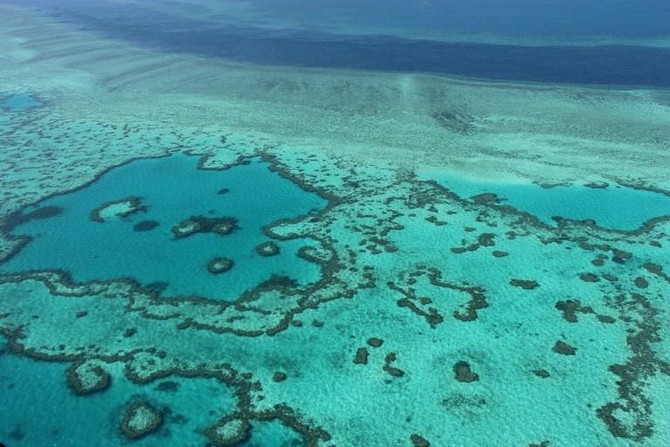
Above, an aerial view of the Great Barrier Reef off the coast of the Whitsunday Islands, along the central coast of Queensland in this 2014 photo. (AFP)
Updated 22 March 2018
Follow

Two Americans die in Great Barrier Reef chopper crash

SYDNEY: Two elderly American tourists have been killed in a helicopter crash at Australia’s Great Barrier Reef, police said Thursday, despite onlookers’ desperate attempts to revive the pair.
The 79-year-old man and 65-year-old women died when the chopper went down near a pontoon on the reef off popular tourist hotspot Airlie Beach late Wednesday. Two other passengers, also from the United States, and the pilot survived with minor injuries.
“As a result of that crash, emergency services have attended and an independent, transparent and robust investigation is currently underway,” local police inspector Ian Haughton said.
There was no indication of what caused the crash but Haughton said the probe would look at the mechanical servicing of the helicopter, what happened at the scene that may have been a contributing factor, and any possibility of error.
Witnesses on a nearby dive platform helped drag the passengers from the water, the Brisbane Courier Mail reported, performing resuscitation under phone instruction from emergency services who were an hour away from the remote site in Queensland’s Whitsunday region.
But the two Americans could not be saved.
“It’s just gut-wrenching. It’s not good. My deepest sympathies goes out to those who lost their lives and those that were injured,” Whitsunday Mayor Andrew Willcox told broadcaster ABC.
“I know most of the tourism operators in the Whitsundays personally and I know they all hold their passenger experience and safety as their number one priority, so it will be a somber day for us in the Whitsundays.”
The company that operated the helicopter, reportedly Whitsunday Air Services, has suspended operations.


UN chief launches first global, independent scientific panel on artificial intelligence

Updated 5 sec ago
Follow

UN chief launches first global, independent scientific panel on artificial intelligence

  • Secretary-General Antonio Guterres nominates 40 experts to serve on body ‘dedicated to helping close the AI knowledge gap and assess the real impacts of AI’
  • It will ‘help the world separate fact from fakes, and science from slop … at a moment when reliable, unbiased understanding of AI has never been more critical,’ he adds

NEW YORK CITY: UN Secretary-General Antonio Guterres on Wednesday formally launched what he described as the only global, independent scientific body focused on artificial intelligence, and submitted his recommendations for the experts to serve on it.

“It will be the first global, fully independent scientific body dedicated to helping close the AI knowledge gap and assess the real impacts of AI across economies and societies,” he told reporters in New York.

“And this could not be more urgent. AI is moving at the speed of light. No country can see the full picture alone.”

The Independent International Scientific Panel on Artificial Intelligence was established by the UN General Assembly through a resolution in August. Guterres said he has now submitted a list of 40 experts from all regions as his proposed candidates for the new body, which was mandated by world leaders under the UN’s Pact for the Future.

The panel is intended to provide authoritative, science-based analysis at a time when AI is developing rapidly and reshaping economies, governance and social life, but regulatory approaches remain fragmented.

Guterres underscored the need for shared understanding among countries to help develop effective safeguards, promote innovation for the common good, and strengthen international cooperation.

The UN said the panel would serve as a global reference point, helping policymakers and the public distinguish between reliable evidence and misinformation, and grounding debates on AI in independent scientific assessment.

The initiative comes amid growing concern over the societal, economic and security risks posed by unchecked technological competition.

“We need shared understandings to build effective guardrails, unlock innovation for the common good, and foster cooperation,” Guterres said.

“The panel will help the world separate fact from fakes, and science from slop. It will provide an authoritative reference point at a moment when reliable, unbiased understanding of AI has never been more critical.”

The proposed members of the panel were selected following an open global call that attracted more than 2,600 applicants, whose expertise spanned fields including machine learning, data governance, public health, cybersecurity, child development and human rights. The chosen candidates are expected to serve in a personal capacity, independent of governments, businesses or other institutions.

The panel will operate on an accelerated timeline, with its first report due in time to inform a Global Dialogue on AI Governance scheduled for July. UN officials said the findings were expected to support international efforts to build common ground on AI governance during a period of heightened geopolitical tensions and technological rivalry.

Guterres framed the initiative as part of a broader push to ensure that AI is shaped collectively, guided by scientific evidence and global solidarity, rather than allowing its development to outpace international cooperation.