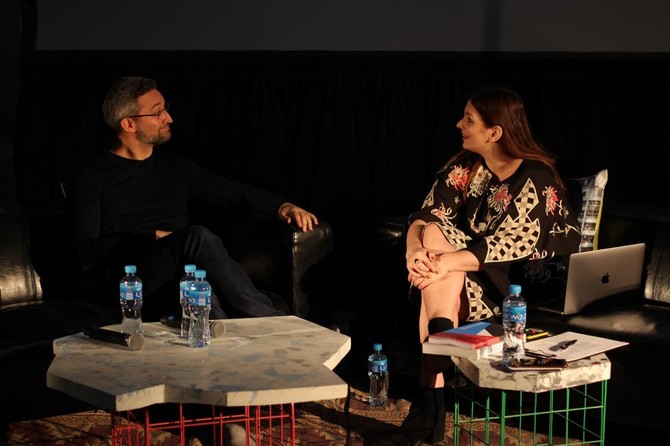
It certainly isn’t the most obvious choice of topic for an art summit. In fact, it’s quite a head-scratcher at first. But this year’s Global Art Forum commissioner — and writer/curator/cultural critic — Shumon Basar defended the theme of artificial intelligence (AI) eloquently, saying: “What Global Art Forum tends to do is take the cultural temperature of the moment, and this is clearly part of the cultural consciousness now.
“We’re able to approach the topic in ways that other platforms can’t — by cutting through different disciplines. People from films, philosophy, literature, political theory… we’re always interested to see how minds from different disciplines think when put next to each other. Often that elicits something new from the speaker.”
The Forum’s program opened at a special evening in Dubai Design District on Feb. 14 2018 and continues during Art Dubai, which ends on March 24.
And there will be some very interesting people from different backgrounds participating. Not least the curatorial team of the show, which, alongside Basar, includes Noah Raford – chief operating officer of the Dubai Future Foundation, and former futures adviser to the Prime Minister’s Office (this is a personal project for Raford, however); and Marlies Worth, leading curator and art historian from Austria, who is, among many other things, part of the curatorial team of the international traveling exhibition “Hello, Robot.”
Even though the approach may seem more like thought leadership than art discourse, the trans-disciplinary summit aims to explore the relationship between art and technology today, particularly dwelling on the themes of power, paranoia, and ethics in an era in which artificial intelligence is becoming increasingly commonplace.
“We’re increasingly living in a present that feels like science-fiction. To really understand any artist, you have to understand social history — the world they existed in,” Basar said. “Some of the earliest adopters of the Internet were artists. Today, more and more artists are bringing robots into their work — there are a number interested in the phenomena of humanoids; some artists looking at the anthropomorphic side of robots; some are looking at networks or codes … Many of the participants in the forum are contemporary artists, but they have a key interest in technology.”
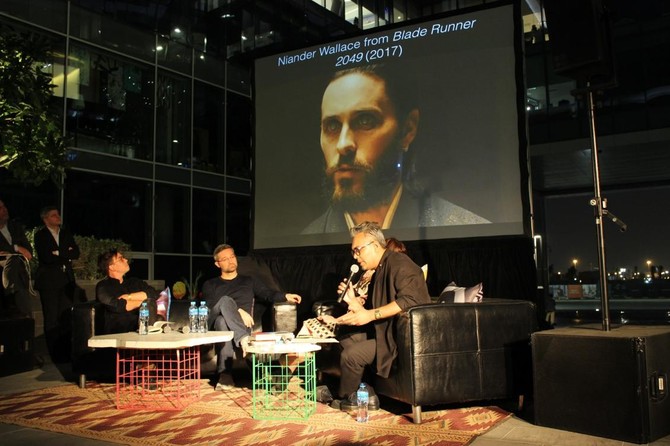
A prime example is James Bridle — a highly lauded British artist, writer, and thought leader on the subject of technology and the future — who expounded on his theories of how AI can affect our culture and politics, at a Global Art Forum 2018 curtain-raiser event held at Dubai Design District in February.
Bridle is just one of several notable participants — such as Emirati writer Mishaal Al Gergawi; Finnish architect and musician Martti Kalliala; London-based Artistic Director of the Serpentine Galleries, Hans-Ulrich Obrist; and Estonian artist Katja Novitskova ¬— who will take on the existential issues mankind faces today, through a diverse range of programs over three days.
Issues such as how algorithms influence societal decisions; whether hyper-intelligent machines can feel the full range of human emotions; how AI can affect jobs and employment; the history of technology and the supernatural (“Many people in the Muslim world relate ghosts to machines,” Basur said); and the related topic of the difference in perceptions of AI and intelligence across cultures, and how this can have an effect on the development of AI — which, so far, has primarily been viewed and discussed through the lens of Western philosophy…
This question appears even more pertinent considering the geographical axis the forum has been built on, focusing on the Middle East and its role at the global frontier of the adaptation of technology.
Basur said: “Dubai is obviously at the forefront in tackling how a city can employ new forms of technology for governance. My co-curator Noah Raford, for example, is actively involved in shaping Dubai’s outlook toward automation.
“Recently Saudi Arabia also made a number of announcements, including giving citizenship to the first female robot, and launching Neom (the futuristic, fully automated megacity that will be run mostly by robots). These countries are thinking about what a smart city in the 21st century should be, and I see it as an exciting time for tech entrepreneurs to step up and tackle all these big questions.
Quite often, real disruptive innovation comes from the least likely sources, and emerging economies such as these have a rich potential in this direction.”
In the hope of spurring on some of that innovation and precipitating discussion, the forum will not only include mind-expanding lectures and presentations, but also feature slightly more light-hearted elements such as a live dance and music performance, “I am/not a robot,” and thought-provoking film screenings curated by Cinema Akil — which include a dystopian-future sci-fi short film by Kenyan director Wanuri Kahiu; Lebanese short film “Last Days of the Man of Tomorrow”; and Austrian film “Free Lunch Society,” which tackles the subject of universal basic income.
“The kind of experience we hope our audience has is to encounter a menu of topics — some of which they might have thought of before, some not — and that they leave somewhat empowered by these things,” Basur concluded. “Because raising important and pressing questions has always been the role of art.”