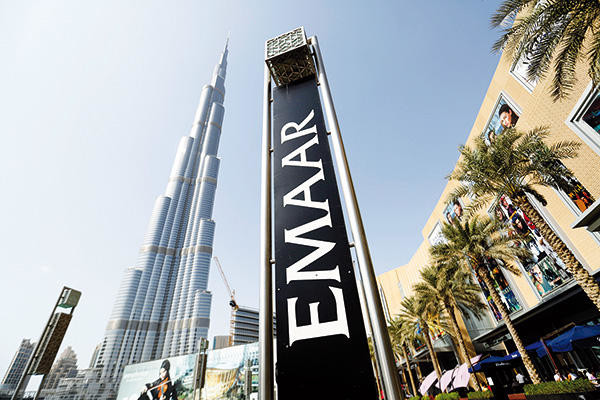
LONDON: The decision by Abu Dhabi’s Aldar and Dubai’s Emaar to forge a strategic alliance has attracted widespread attention in the Gulf.
The pair have plowed lone furrows in the past but are now teaming up in a move that analysts see as a sign of closer commercial ties between the UAE’s two biggest emirates.
It comes as UAE property developers are under increased pressure amid a weak housing market, faltering consumer confidence and expatriate job losses.
“We are in a new economic reality, one that commenced four years ago with the oil rout. I think the best thing for UAE going forward is to consolidate entities, play off each other’s strengths and present a more unified front to the rest of the world,” said Faisal Durrani, who heads research for Cluttons, the property broker.
The deal between the two property companies is for co-operation and pooled resources in selected areas.
But collaboration has the benefit of making a bigger land bank available for exploitation, and potentially, fatter margins. “We are happy to witness the signing of this partnership, which will contribute to our development journey and help enhance the UAE’s position as a tourism destination of choice,” said Mohammed bin Rashid Al-Maktoum, prime minister of the UAE, and ruler of Dubai.
“We want our companies to collaborate to explore creative ideas for strengthening the UAE’s leadership,” he added.
The developers will initially collaborate on two UAE-based projects: Saadiyat Grove in the heart of the cultural district on Abu Dhabi’s Saadiyat Island, and the Emaar Beachfront project, a private island in Dubai located between Jumeirah Beach Residence and Palm Jumeirah.
Emaar and Aldar are both profitable, even though in many segments, the Gulf trading environment is not as lucrative it was — especially in the real estate sector.
So is it possible that economic realities have helped to propel the latest deal? “That could be one key, underlying factor,” said Durrani.
The tie-up between the two big property players in both emirates follows similar collaboration in the aviation sector.
Last October Dubai-based Emirates and Abu Dhabi-based Etihad revealed plans to cooperate in areas that included procurement.
Beyond the business arena, there are also signs of a more joined-up approach in sport, with the Abu Dhabi and Dubai cycle tours scrapped in favor of a single UAE race from 2019.
“That appears to be part of a wider government move to help position the UAE on the global stage,” said Durrani.
Emaar has an excellent track record in developing real estate projects, in multiple asset classes and can produce sparkling numbers even when the economy hits a soft patch.
Equally, Aldar — which operates in the more challenging Abu Dhabi property market, has good experience to pass on in the area of beach front developments.
But the biggest benefit could be the enhanced reputation that would accompany an Emaar-Aldar alliance.
More than that, if we accept that two is better than one, heralding greater profitability, investors may stand to benefit further down the line.

Emaar and Aldar property alliance underscores new economic landscape following oil rout
‘The future is renewables,’ Indian energy minister tells World Economic Forum
- ‘In India, I can very confidently say, affordability (of renewables) is better than fossil fuel energy,’ says Pralhad Venkatesh Joshi during panel discussion
- Renewables are an increasingly important part of the energy mix and the technology is evolving rapidly, another expert says at session titled ‘Unstoppable March of Renewables?’
BEIRUT: “The future is renewables,” India’s minister of new and renewable energy told the World Economic Forum in Davos on Wednesday.
“In India, I can very confidently say, affordability (of renewables) is better than fossil fuel energy,” Pralhad Venkatesh Joshi said during a panel discussion titled “Unstoppable March of Renewables?”
The cost of solar power has has fallen steeply in recent years compared with fossil fuels, Joshi said, adding: “The unstoppable march of renewables is perfectly right, and the future is renewables.”
Indian authorities have launched a major initiative to install rooftop solar panels on 10 million homes, he said. As a result, people are not only saving money on their electricity bills, “they are also selling (electricity) and earning money.”
He said that this represents a “success story” in India in terms of affordability and “that is what we planned.”
He acknowledged that more work needs to be done to improve reliability and consistency of supplies, and plans were being made to address this, including improved storage.
The other panelists in the discussion, which was moderated by Godfrey Mutizwa, the chief editor of CNBC Africa, included Marco Arcelli, CEO of ACWA Power; Catherine MacGregor, CEO of electricity company ENGIE Group; and Pan Jian, co-chair of lithium-ion battery manufacturer Contemporary Amperex Technology.
Asked by the moderator whether she believes “renewables are unstoppable,” MacGregor said: “Yes. I think some of the numbers that we are now facing are just proof points in terms of their magnitude.
“In 2024, I think it was 600 gigawatts that were installed across the globe … in Europe, close to 50 percent of the energy was produced from renewables in 2024. That has tripled since 2004.”
Renewables are an increasingly important and prominent part of the energy mix, she added, and the technology is evolving rapidly.
“It’s not small projects; it’s the magnitude of projects that strikes me the most, the scale-up that we are able to deliver,” MacGregor said.
“We are just starting construction in the UAE, for example. In terms of solar size it’s 1.5 gigawatts, just pure solar technology. So when I see in the Middle East a round-the-clock project with just solar and battery, it’s coming within reach.
“The technology advance, the cost, the competitiveness, the size, the R&D, the technology behind it and the pace is very impressive, which makes me, indeed, really say (renewables) is real. It plays a key role in, obviously, the energy demand that we see growing in most of the countries.
“You know, we talk a lot about energy transition, but for a lot of regions now it is more about energy additions. And renewables are indeed the fastest to come to market, and also in terms of scale are really impressive.”
Mutizwa asked Pan: “Are we there yet, in terms of beginning to declare mission accomplished? Are renewables here to stay?”
“I think we are on the road but (its is) very promising,” Pan replied. There is “great potential for future growth,” he added, and “the technology is ready, despite the fact that there are still a lot of challenges to overcome … it is all engineering questions. And from our perspective, we have been putting in a lot of resources and we are confident all these engineering challenges will be tackled along the way.”
Responding to the same question, Arcelli said: “Yes, I think we are beyond there on power, but on other sectors we are way behind … I would argue today that the technology you install by default is renewables.
“Is it a universal truth nowadays that renewables are the cheapest?” asked Mutizwa.
“It’s the cheapest everywhere,” Arcelli said.