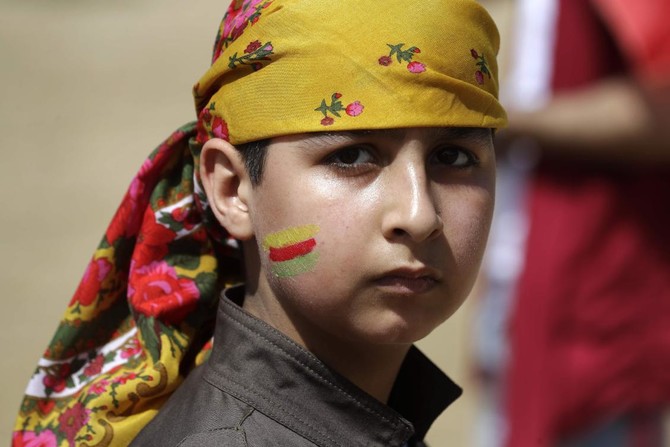
ZIYARA: With tears in her eyes, Rasheeda Ali said she would not celebrate the Kurdish New Year this week after she and her family were forced to flee under fire from Syria’s Afrin.
The annual Nowruz holiday which was being marked on Wednesday had always been a time for Syrian Kurdish families to gather together and mark new beginnings, but this year is different.
Tens of thousands have been left homeless after abandoning their homes and loved ones in the northwestern city of Afrin, now controlled by Turkish troops and allied fighters.
The fall of Afrin on Sunday was a major blow for Syria’s Kurds, who have proudly run autonomous local governments since 2013 — finally speaking Kurdish and marking customs long banned by the Damascus government.
With her hometown overrun, Nowruz this year is nothing but “tragedy and displacement,” Ali said, a mauve scarf wrapped around her hair and her eyes moist with tears.
“Death would have been easier than leaving our home,” said the 40-year-old Arabic language teacher, in an area outside Afrin that is jointly held by Kurds and the Syrian regime.
“I left my home — which looks like a palace — and now I live in this house with 50 other people,” she said, gesturing to the small room in a collective shelter in the Ziyara area.
Children huddled around her as she spoke. A mattress was propped up against a wall behind her and scant belongings were stacked on bare metal shelves.
Around 100,000 civilians streamed out of Afrin, using the only escape route available into government-held zones to the south and east, the UN says.
They hit the road on foot, in cars, on motorbikes and in pickup trucks, with what little belongings they could carry or cram into their vehicles.
Once in regime territory, they sought shelter in mosques, schools and buildings under construction.
Some have nowhere at all to go and have been sleeping in their vehicles, others are still on roadsides sleeping in the open.
For Syria’s Kurds, Nowruz symbolizes the deliverance of Kurdish people from a mythical tyrant — but that was hard to imagine now.
“I’ll never forget fleeing. Looking back and getting a last glimpse of Afrin, feeling helpless and torn,” said 38-year-old Rohan, also displaced.
“Away from Afrin, Nowruz means nothing. Afrin was our paradise,” she told AFP in the nearby Zahraa area.
In Ziyara, Mohammed Zaki, a middle-aged man, recounted how he and his family fled farmland on which they had lived for generations.
“We fled on foot carrying just the clothes we wore,” he said, now living with several other displaced families.
Women and children packed the room, as a small child slept bundled up in a donated blanket behind him.
“We have no money to buy food. We left everything and came here penniless,” Zaki said.
It may be Nowruz but “we wouldn’t dream of celebrating,” he said. “We just dream of ending this tragedy for our children.”
Afrin, an agricultural area famed for its olive trees, was part of territory in northern Syria where the Kurds have been setting up systems of self-rule.
The Kurdish People’s Protection Units (YPG) recaptured eastern areas of the territory from the Daesh group, with backing from a US-led coalition.
The Kurds have otherwise largely stayed out of Syria’s complex seven-year conflict, instead focusing on building their own institutions including in Afrin.
But Turkish-led forces on Jan. 20 launched a deadly assault on Afrin, dragging Kurds into conflict and capturing the city in a major setback for the dream of autonomy.
His boots and a bag of flat bread by his side, 82-year-old Khalil Tamer sat on a blanket atop a layer of straw — thin cushioning for the hard concrete floor underneath.
With his head hung low, he recounted how he and his family escaped fighting in the neighboring province of Aleppo to Afrin.
When Turkey began its assault on the YPG, whom it considers “terrorists,” Tamer and his family were forced to flee a second time.
“We walked out on foot for four days straight,” he said. But in the chaos, he was separated from some of his loved ones and will mark Nowruz without them.
Smoking a cigarette in a holder, he repeated his fate in disbelief.
“We lost the children. I lost them. I lost my children.”

Syria Kurds mark grim Nowruz after fleeing Afrin
US military launches strikes in Syria against Daesh fighters after American deaths
- “This is not the beginning of a war — it is a declaration of vengeance,” Defense Secretary Pete Hegseth says
- President Trump earlier pledged “very serious retaliation” but stressed that Syria was fighting alongside US troops
WASHINGTON: The Trump administration launched military strikes Friday in Syria to “eliminate” Daesh group fighters and weapons sites in retaliation for an ambush attack that killed two US troops and an American interpreter almost a week ago.
A US official described it as “a large-scale” strike that hit 70 targets in areas across central Syria that had Daesh (also known as Islamic State or IS) infrastructure and weapons. Another US official, who also spoke on condition of anonymity to discuss sensitive operations, said more strikes should be expected.
The attack was conducted using F-15 Eagle jets, A-10 Thunderbolt ground attack aircraft and AH-64 Apache helicopters, the officials said. F-16 fighter jets from Jordan and HIMARS rocket artillery also were used, one official said.
“This is not the beginning of a war — it is a declaration of vengeance. The United States of America, under President Trump’s leadership, will never hesitate and never relent to defend our people,” Defense Secretary Pete Hegseth said on social media.
President Donald Trump had pledged “very serious retaliation” after the shooting in the Syrian desert, for which he blamed Daesh. The troops were among hundreds of US troops deployed in eastern Syria as part of a coalition fighting the terrorist group.
Trump in a social media post said the strikes were targeting Daesh “strongholds.” He reiterated his support for Syrian President Ahmad Al-Sharaa, who he said was “fully in support” of the US effort to target the militant group.
Trump also offered an all-caps threat, warning the group against attacking US personnel again.
“All terrorists who are evil enough to attack Americans are hereby warned — YOU WILL BE HIT HARDER THAN YOU HAVE EVER BEEN HIT BEFORE IF YOU, IN ANY WAY, ATTACK OR THREATEN THE USA.,” the president added.
The attack was a major test for the warming ties between the United States and Syria since the ouster of autocratic leader Bashar Assad a year ago. Trump has stressed that Syria was fighting alongside US troops and said Al-Sharaa was “extremely angry and disturbed by this attack,” which came as the US military is expanding its cooperation with Syrian security forces.
Syria’s foreign ministry in a statement on X following the launch of US strikes said that last week’s attack “underscores the urgent necessity of strengthening international cooperation to combat terrorism in all its forms” and that Syria is committed “to fighting Daesh and ensuring that it has no safe havens on Syrian territory and will continue to intensify military operations against it wherever it poses a threat.”
Daesh has not claimed responsibility for the attack on the US service members, but the group has claimed responsibility for two attacks on Syrian security forces since, one of which killed four Syrian soldiers in Idlib province. The group in its statements described Al-Sharaa’s government and army as “apostates.” While Al-Sharaa once led a group affiliated with Al-Qaeda, he has had a long-running enmity with Daesh.
Syrian state television reported that the US strikes hit targets in rural areas of Deir ez-Zor and Raqqa provinces and in the Jabal Al-Amour area near Palmyra. It said they targeted “weapons storage sites and headquarters used by Daesh as launching points for its operations in the region.”
Trump this week met privately with the families of the slain Americans at Dover Air Force Base in Delaware before he joined top military officials and other dignitaries on the tarmac for the dignified transfer, a solemn and largely silent ritual honoring US service members killed in action.
The guardsmen killed in Syria last Saturday were Sgt. Edgar Brian Torres-Tovar, 25, of Des Moines, and Sgt. William Nathaniel Howard, 29, of Marshalltown, according to the US Army. Ayad Mansoor Sakat, of Macomb, Michigan, a US civilian working as an interpreter, was also killed.
The shooting nearly a week ago near the historic city of Palmyra also wounded three other US troops as well as members of Syria’s security forces, and the gunman was killed. The assailant had joined Syria’s internal security forces as a base security guard two months ago and recently was reassigned because of suspicions that he might be affiliated with Daesh, Interior Ministry spokesperson Nour Al-Din Al-Baba has said.
The man stormed a meeting between US and Syrian security officials who were having lunch together and opened fire after clashing with Syrian guards.
When asked for further information, the Pentagon referred AP to Hegseth’s social media post.