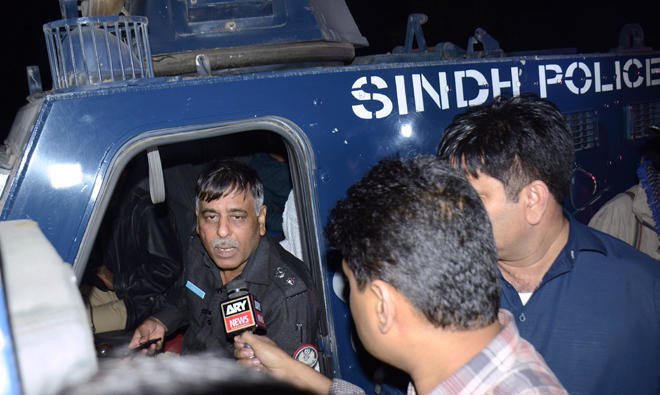
KARACHI: Rao Anwar, the absconding police officer who was arrested outside the apex court on Wednesday morning, was shifted here to Karachi, where he will be questioned by a joint interrogation team (JIT) and tried in an anti-terrorism court.
Anwar arrived in Karachi on a Shaheen Air flight from Islamabad, along with Additional IG Sindh, Aftab Pathan.
“Getting justice in Pakistan seems to be happening. I hope I will get justice, and also those who have faced similar injustice at the hands of people like Rao Anwar,” said Hajji Muhammad Khan, father of the young Pashtun Naqeebullah Mehsud, who was killed in a police raid in Karachi.
“My expectations of the supreme court seem about to be fulfilled,” Mehsud’s father told.
“We strived to get justice within the limits of the law. It has been proved that justice may be delayed but can’t be permanently denied,” said Saif Ur Rehman, leader of the Pashtun Jirga, whose protest forced authorities to register the case against Anwar.
“Today’s proceedings have raised our hopes of getting justice. We say thanks to our institutions, who delayed but eventually sided with the oppressed against injustice,” Mehsud told Arab News.
“Anwar hasn’t only defaced Pakistan but also caused damage to the image of the peaceful Pashtun community by posing them as Taliban militants,” Mehsud maintained.
Meanwhile, a JIT headed by Additional Inspector General of Sindh Police Aftab Pathan and comprising DIG Zulfiqar Larak, DIG Azad Khan, DIG Waliullah Dal and SSP Dr. Rizwan, was formed.
Earlier the court rejected Anwar’s request to form a JIT from intelligence agencies.
Anwar, former Senior Superintendent Police (SSP) of Malir, Karachi, is accused of killing the aspiring model Naqeebullah Mehsud in a fake encounter.
Anwar had claimed Naqeebullah was an active member of the PakistanTaliban, but subsequently evidence began to pile up against the police team involved in his killing.
After the incident, a formal inquiry was launched against Anwar. As pressure mounted on him, he went underground and even made a botched attempt to fly out of Pakistan.
He also wrote a few letters to the Supreme Court after it began the suo motu hearing on Naqeebullah’s murder, telling the judges that the system was heavily stacked against him and he was not hoping to get any justice in the case.
In response, the country’s top court granted him some relief, asking him to surrender and let the law take its course.
The court was also willing to reconstitute the JIT looking into Naqeebullah’s killing since the absconding police officer had voiced concern over its composition.
Despite these steps, Anwar did not make an appearance before the court, forcing judges to take action against him by asking the relevant authorities to freeze his accounts.
In a surprise move on Wednesday, however, the absconding police officer came to the court in a white car. He was clad in a black dress and wore a medical mask to cover his face.
Anwar’s lawyer told the chief justice that his client had “surrendered” himself and wanted protective bail.
However, the Supreme Court turned down the request and ordered law enforcement authorities to lock up the former SSP.
The country’s top judge expressed his displeasure, saying that Anwar had continued to run away from legal procedures even when the court had guaranteed that he would get a fair hearing and justice would be dispensed in the case.

Rao Anwar shifted to Karachi for further interrogation
Pakistan says it is targeting militant infrastructure in Afghanistan as Kabul threatens to hit Islamabad
- Ata Tarar says Pakistan is carrying out ‘precise intelligence-based operations’ to avoid civilian casualties
- Afghan defense minister says the underlying dispute between the two sides is over the ‘Durand Line’ border
ISLAMABAD: Pakistan said on Saturday it was conducting intelligence-based operations against militant infrastructure inside Afghanistan while attempting to avoid civilian casualties, as a senior Afghan Taliban official warned Kabul could retaliate by targeting Islamabad if Pakistani forces struck the Afghan capital.
The escalating rhetoric comes as cross-border fighting between the two neighbors intensifies following clashes that began last month when Afghan forces launched attacks on Pakistani military installations along the frontier. Kabul said the assault was retaliation for Pakistani airstrikes targeting what Islamabad called militant camps inside Afghanistan.
Pakistan’s defense minister Khawaja Muhammad Asif said last week the situation had effectively become “open war” between the two countries.
“Pakistan is only targeting terrorist infrastructures and support system with precise intelligence based operations ensuring no collateral damage takes place,” Pakistan’s Information Minister Ataullah Tarar said in a statement.
He challenged the recent claims made by an Afghan defense ministry spokesperson earlier this week who said his country was making significant battlefield gains against Pakistan including the killing of 109 soldiers and the capture or destruction of 14 military posts in large scale attacks.
“These so called attacks by Afghan Taliban in coordination with FAK [Fitna Al Khawarij] Terrorists once again confirm the nexus of Afghan Taliban regime and multiple terrorist organizations operating from within their territory,” Tarar continued. “All such attempts are responded to, immediately and effectively with severe retributive punishment that is swift, precise and effective.”
“The imaginary numbers being floated by Afghan Taliban regime are however not worth any serious comment,” he added.
Tarar said Pakistan’s military campaign — described as Operation Ghazb Lil Haq — had inflicted heavy losses on Afghan Taliban forces.
According to figures shared by the minister, 527 Taliban fighters had been killed and more than 755 injured since the clashes began, while 237 check posts were destroyed and 38 captured and destroyed. He said 205 tanks, armored vehicles and artillery guns were destroyed and 62 locations across Afghanistan had been targeted by air strikes.
Arab News could not independently verify the claims made by either side.
CIVILIAN CASUALTIES
Earlier this week, the United Nations raised concern over the toll of the escalating conflict on civilians.
UN human rights chief Volker Turk said on Friday that 56 Afghan civilians — nearly half of them children — had been killed since hostilities between Pakistan and Afghanistan intensified.
However, Tarar questioned the UN findings, saying its assertions appeared to rely heavily on information provided by Taliban authorities and did not adequately reflect independently verified intelligence.
“Pakistan categorically reiterates that all counter-terrorism operations conducted by its security forces are carried out with the highest degree of precision, professionalism, and responsibility,” he said.
Islamabad has long accused the Taliban government of allowing militant groups, including the Tehreek-e-Taliban Pakistan (TTP), to operate from Afghan soil, a charge Kabul denies.
“Operations are meticulously planned so that civilian areas remain completely safe,” the minister said. “The locations targeted are remote terrorist hideouts and facilities far removed from populated zones, including sensitive areas such as Kabul’s Green Zone.”
AFGHAN WARNING
Meanwhile, Afghanistan’s Defense Minister Mullah Yaqoob issued a warning to Pakistan in remarks circulated by Afghan broadcaster TOLOnews.
“If Kabul lacks peace, there will be no peace in Islamabad. If Kabul is attacked, Islamabad will be attacked,” Yaqoob said in a promotional clip of an interview shared on social media.
Yaqoob rejected Pakistan’s justification that the presence of the TTP in Afghanistan warranted military action and suggested the underlying dispute was over the contested “Durand Line” border between the two countries.
So far, there has been no official response from Pakistan to Yaqoob’s remarks.