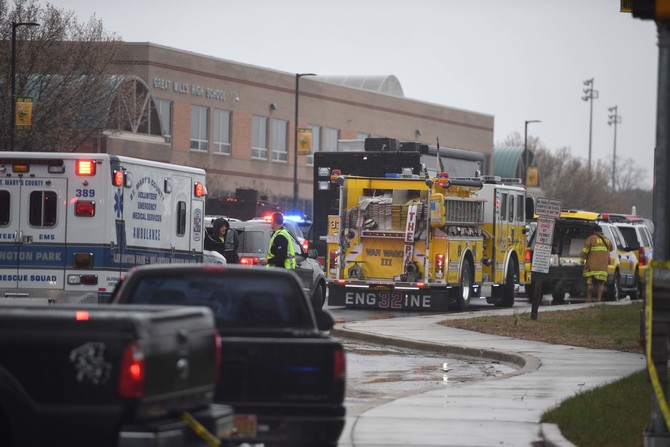
GREAT MILLS, United States: A student armed with a handgun wounded two classmates at a Maryland high school on Tuesday, officials said, in an outburst of campus violence just days before a student-organized nationwide march for gun control.
The shooter, who was not identified, has died following the incident at Great Mills High School, St. Mary’s County Sheriff Tim Cameron told reporters.
Cameron said the “school resource officer” responsible for security engaged the shooter after hearing gunfire at around 7:45 am (1145 GMT), shortly before classes were due to begin for the day.
“A male student produced a handgun and fired... wounding a female student and another male student in a hallway,” Cameron said. The female student was in critical condition while the male student was in stable condition, he said.
“When the shooting took place, our school resource officer, who was stationed inside the school, was alerted to the event and the shots being fired,” he said.
“He pursued the shooter, engaged the shooter — during that engagement, he fired a round at the shooter,” Cameron said. “Simultaneously the shooter fired a round as well.”
“In the hours to come, in the days to come, through detailed investigation, we will be able to determine if our school resource officer’s round struck the shooter,” the sheriff said, suggesting the assailant may have instead taken his own life.
Following the shooting in Great Mills, located about a 90-minute drive southeast of the US capital Washington, students were evacuated to a nearby school where they were reunited with their parents, Cameron said.
“It happened really quickly, right after school started,” Jonathan Freese, a Great Mills student, told CNN.
“The police came and responded really quickly,” Freese said. “They had a lot of officers respond.”
Mollie Davis, who identified herself on Twitter as a student at Great Mills, posted a series of tweets about the shooting.
“Now my school is the target,” she said. “WHY DO WE LET THIS KEEP HAPPENING??? I’m so tired, I’m so tired.”
“You never think it’ll be your school and then it is,” Davis said. “Great Mills is a wonderful school and somewhere I am proud to go. Why us?“
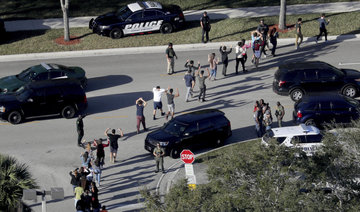
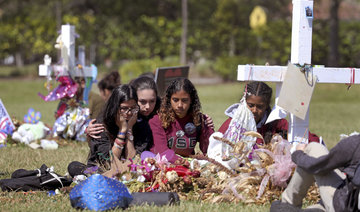
The Great Mills incident comes about five weeks after a shooting at a Florida high school left 14 students and three adult staff members dead.
Students at Marjory Stoneman Douglas High School launched a grassroots campaign for gun control following the shooting.
They have organized an event on Saturday called “March For Our Lives,” which is expected to turn out large crowds in US cities, with the main event in Washington.
Emma Gonzalez, a Stoneman Douglas student, tweeted her support Tuesday for her peers at Great Mills.
“We are Here for you, students of Great Mills,” Gonzalez said. “Together we can stop this from ever happening again.”
Under the banner #ENOUGH, tens of thousands of US high school students walked out of classrooms around the country on March 14 to protest gun violence.
Maryland Governor Larry Hogan pledged to provide assistance.
“Our prayers are with students, school personnel and first responders,” Hogan said in a tweet.