De Mistura: Dividing Syria is catastrophic to the entire region

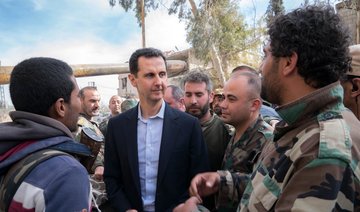
Syrian pro-government forces enter the main square of Kfar Batna, southeastern Ghouta, on the outskirts of the capital Damascus, on March 19, 2018. (AFP)
Updated 20 March 2018
Follow

De Mistura: Dividing Syria is catastrophic to the entire region

DUBAI: United Nations’ special envoy to Syria, Staffan de Mistura, said Syria was heading toward a catastrophic division and could see the return of Daesh if a peaceful settlement was not found, Saudi state-news channel Al-Ekhbariya reported.
Speaking to an audience at the Institute of Graduate Studies in Geneva, De Mistura said: “The fact is that Syria’s long-term division, which we are witnessing at the moment in different areas of control, will be catastrophic, not only for Syria, but for the region as a whole.”
He explained that without a political solution that does not exclude anyone, Daesh will return to the sphere.
“This is division, this is in fact a country with areas under the influence of other countries ... this cannot continue,” said de Mistura, holding a map of Syria with different colors representing the areas of control of the land, adding that “I think that ultimately Syria must remain united.”
He said neither the European Union nor the World Bank would fund the $352 billion reconstruction of Syria unless a political process involving a new UN-sponsored constitution was found.
He added that without this, any military victory would come at an irreplaceable cost.
De Mistura said there was no country that wanted to divide Syria, and that Russia and the United States shared a common interest in defeating Daesh and were in constant communication.


Lebanon ex-central bank chief's corruption case being sent to top court, officials say

Updated 10 sec ago
Follow

Lebanon ex-central bank chief's corruption case being sent to top court, officials say

BEIRUT: The corruption case of Lebanon's former central bank governor, who is widely blamed for the country’s economic meltdown, has been transferred to the country's highest court, judicial officials told The Associated Press on Tuesday.
Riad Salameh was released on $14 million bail in September after a year in prison while awaiting trial in Lebanon on corruption charges, including embezzlement and illicit enrichment.
The trial of Salameh, 75, and his two legal associates, Marwan Khoury and Michel Toueini, will now be heard at the Court of Cassation, according to a copy of the notice obtained by the AP. Salameh and the others will be issued with arrest warrants if they don't show up for trial at the court.
No trial date has been set yet. Salameh denies the charges. The court’s final ruling can't be appealed, according to the four officials who spoke on condition of anonymity, because they weren't authorized to speak with the media.
In September 2024, he was charged with the embezzlement of $42 million, with the court later adding charges of illicit enrichment over an apartment rented in France, supposedly to be a substitute office for the central bank if needed. Officials have said that Salameh had rented from his former romantic partner for about $500,000 annually.
He was once celebrated for steering Lebanon’s economic recovery, after a 15-year civil war, upon starting his long tenure in 1993 and keeping the fragile economy afloat during long spells of political gridlock and turmoil.
But in 2023, he left his post after three decades with several European countries investigating allegations of financial crimes. Meanwhile, much of the Lebanese blame his policies for sparking a fiscal crisis in late 2019 where depositors lost their savings, and the value of the local currency collapsed.
On top of the inquiry in Lebanon, he is being investigated by a handful of European countries over various corruption charges. In August 2023, the United States, United Kingdom and Canada imposed sanctions on Salameh.
Salameh has repeatedly denied allegations of corruption, embezzlement and illicit enrichment. He insists that his wealth comes from inherited properties, investments and his previous job as an investment banker at Merrill Lynch.
Lebanon’s current central bank governor, Karim Souaid, announced last week that he's filing legal complaints against a former central bank governor and former banking official who diverted funds from the bank to what he said were four shell companies in the Cayman Islands. He didn't name either individual.
But Souaid said that Lebanon's central bank would become a plaintiff in the country's investigation into Forry Associates. The U.S. Treasury, upon sanctioning Salameh and his associates, described Forry Associates as “a shell company owned by Raja (Salameh’s brother) in the British Virgin Islands” used to divert about $330 million in transactions related to the central bank.
Several European countries, among them France, Germany, and Luxembourg, have been investigating the matter, freezing bank accounts and assets related to Salameh and his associates, with little to no cooperation from the central bank and Lebanese authorities.
Souaid said that he will travel later this month to Paris to exchange “highly sensitive” information as France continues its inquiries.