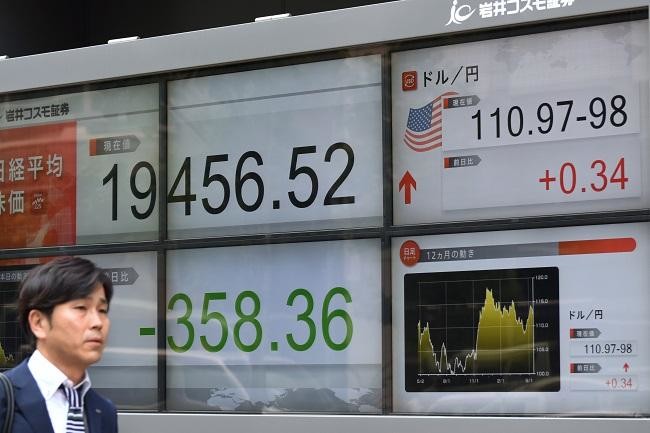
HONG KONG: Asian markets sank on Tuesday following sharp losses in New York as a massive data breach at Facebook fueled fears of a regulatory crackdown on the technology sector.
The scandal at the social media giant come as investors fret over a possible increase in the rate of US interest rate hikes and Donald Trump steps up his protectionist rhetoric that has sparked talk of a global trade war.
Reports said Cambridge Analytica, the analysis firm hired by Donald Trump’s 2016 presidential campaign, stole data from 50 million Facebook user profiles to help design software to predict and influence voters’ choices.
Stephen Innes, head of Asia-Pacific trading at OANDA, warned: “This security breach could end up being a significant turning point for the social media and network portal.”
The news hammered tech giants with Facebook plunging 6.8 percent, while other household names were also hit — including Apple, Google-parent Alphabet and Netflix — by regulatory concerns.
“The adults are starting to realize that the altruistic kids who started some of these tech behemoths are either unwilling or unable to deal with the fact that the companies they wrought and thought were a force for good can be manipulated by those who seek to do ill,” said Greg McKenna, chief market strategist at AxiTrader.
The US losses filtered through to Asia, with Hong Kong-listed Internet giant Tencent and AAC Technologies sharply lower. Samsung retreated in Seoul, while Sony was one percent lower in Tokyo.
On broader markets Japan’s Nikkei went into the break more than one percent lower, while Hong Kong shed 0.6 percent and Sydney was off 0.5 percent.
Shanghai dropped 0.3 percent, Singapore gave up 0.2 percent and Seoul retreated 0.4 percent, with Wellington, Manila, Taipei and Jakarta all sharply down.
Investors are keeping a close watch on the Federal Reserve’s policy meeting this week looking for clues about its timetable for tightening monetary policy. Opinion is split on the number of rate hikes it will likely announce this year, with some forecasting three and others saying four.
Market-watchers warn a G20 meeting of finance ministers in Argentina could also revive tensions on international trade after Trump unveiled his controversial tariffs this month.
On currency markets the pound extended gains against the dollar after Britain and European Union leaders agreed a post-Brexit transition deal that will buy businesses and citizens time to adjust to life after the divorce.

Asian markets tumble with Wall St. as Facebook breach hits tech

Crude oil prices surpass $100 a barrel as the Iran war impedes production and shipping
- 15m barrels of crude oil — about 20 percent of the world’s oil — typically are shipped every day through the Strait of Hormuz
- Iraq, Kuwait and the UAE have cut their oil production as storage tanks fill due to the reduced ability to export crude
CHICAGO: Oil prices have eclipsed $100 per barrel for the first time in more than three and a half years as the Iran war hinders production and shipping in the Middle East.
The price for a barrel of Brent crude, the international standard, was at $101.19 shortly after trading resumed on the Chicago Mercantile Exchange, up 9.2 percent from its settlement price of $92.69 Friday.
West Texas Intermediate, the light, sweet crude oil produced in the United States, was selling for about $107.06 a barrel. That’s 16.2 percent higher than its Friday settlement price of $90.90.
Both could rise or fall as market trading continues.
The increases followed US crude prices jumping by 36 percent and Brent crude prices rising 28 percent last week. Oil prices have surged as the war, now in its second week, ensnared countries and places that are critical to the production and movement of oil and gas from the Arabian Gulf.
Roughly 15 million barrels of crude oil — about 20 percent of the world’s oil — typically are shipped every day through the Strait of Hormuz, according to independent research firm Rystad Energy. The threat of Iranian missile and drone attacks has all but stopped tankers from traveling through the strait, which is bordered in the north by Iran, carry oil and gas from Saudi Arabia, Kuwait, Iraq, Qatar, Bahrain, the United Arab Emirates and Iran.
Iraq, Kuwait and the UAE have cut their oil production as storage tanks fill due to the reduced ability to export crude. Iran, Israel and the United States also have attacked oil and gas facilities since the war started, exacerbating supply concerns.
The last time US crude futures traded above $100 per barrel was June 30, 2022, when the price reached $105.76. For Brent, it was July 29, 2022, when the price hit $104 per barrel.
The global surge in oil prices since Israel and the US attacked Iran on March 1 has rattled financial markets, sparking worries that higher energy costs will fuel inflation and lead to less spending by US consumers, the main engine of the economy.
In the US, a gallon of regular gasoline rose to $3.45 on Sunday, about 47 cents more than a week earlier, according to AAA motor club. Diesel was selling for about $4.60 a gallon, a weekly increase of about 83 cents.
The price of natural gas has also climbed, though not as much as oil. It rose about 11 percent last week and ended Friday at $3.19 per 1,000 cubic feet.
If oil prices stay above $100 per barrel, some analysts and investors say it could be too much for the global economy to withstand.
Over the weekend, Israel’s military struck oil depots in Tehran and four oil storage tankers and a petroleum transfer terminal.
Mohammad Bagher Qalibaf, the speaker of Iran’s parliament, said the war’s impact on the oil industry would spiral, warning it soon could become harder to produce and sell oil.
Iran exports roughly 1.6 million barrels of oil a day, mostly to China, which may need to look elsewhere for supply if Iran’s exports are disrupted, another factor that could increase energy prices.