Chinese stock regulators slap record $870 million fine in share-price manipulation scandal

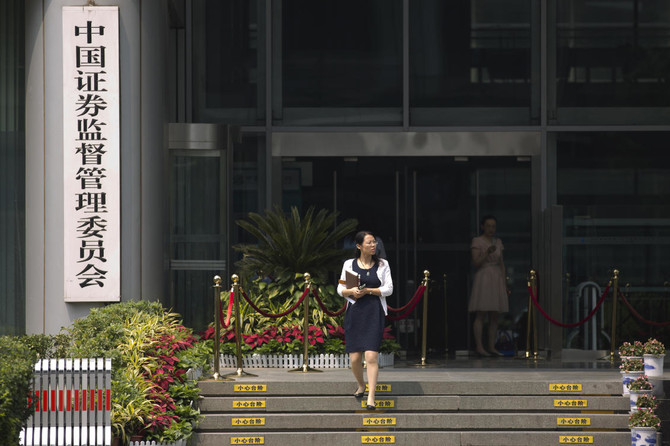
Xiamen Beibadao Group made a 945 million yuan ($150 million) profit by using 300 trading accounts to manipulate share prices of two banks and an aluminum maker, the China Securities Regulatory Commission, above, said. (AP)
Updated 14 March 2018
Follow

Chinese stock regulators slap record $870 million fine in share-price manipulation scandal

BEIJING: China’s securities regulator said Wednesday it fined a company a record 5.5 billion yuan ($870 million) for manipulating share prices in the latest scandal to roil the country’s turbulent markets.
Xiamen Beibadao Group made a 945 million yuan ($150 million) profit by using 300 trading accounts to manipulate share prices of two banks and an aluminum maker, the China Securities Regulatory Commission said. It gave no details of possible criminal charges against employees. Phone calls to the CSRC weren’t answered.
China’s securities industry has been battered by scandals since a 2015 stock market crash that prompted a multibillion-dollar government intervention to prop up prices.
A prominent trader was sentenced last year to 5½ years in prison for share-price manipulation and the general manager of the country’s biggest brokerage was arrested in 2016. Other brokerages disclosed they were under investigation.
Beibadao Group is China’s largest privately-owned operator of railway cargo cars, according to news reports.
Its traders took advantage of a reduction in the number of shares available for trading following the 2015 crash due to government-ordered buying by big investors, according to business news website Tencent Finance. It said that allowed Beibadao to boost prices while buying fewer shares.
The government announced plans Tuesday to combine China’s banking and insurance regulators in an effort to improve supervision of those industries amid a campaign by the ruling Communist Party to control financial risks and surging debt levels. There was no mention of possible changes to the CSRC, the third financial regulator.


UAE non-oil business growth at 1-year high in February: PMI report

Updated 6 sec ago
Follow

UAE non-oil business growth at 1-year high in February: PMI report

RIYADH: The growth of the non-oil private sector in the UAE ticked up to a 12-month high in February, driven by rapid increases in business activity and new work orders, an economic tracker showed.

In its latest Purchasing Managers’ Index report, S&P Global revealed that the UAE’s PMI rose to 55 in February from 54.9 in January.

Any PMI reading above 50 indicates expansion, while a reading below 50 reflects contraction.

The upturn of the non-oil private sector in the UAE aligns with the broader trend observed in the Gulf Cooperation Council region, where countries, including Saudi Arabia, are pursuing economic diversification efforts to reduce reliance on crude revenues.

In January, the Kingdom’s PMI stood at 56.3, the highest in the region, while Kuwait recorded a reading of 54.5.

“The UAE PMI signalled the strongest growth in non-oil business conditions for a year in February, with output increasing rapidly in response to strong inflows of new work. So far, the data points to an encouraging picture for the domestic economy in the first quarter of this year,” said David Owen, senior economist at S&P Global Market Intelligence.

According to the report, stronger output among non-oil sectors was driven by higher demand, successful contract wins, and growth in key sectors including construction, real estate, logistics, and technology.

Additional factors that contributed to this growth include rising tourist arrivals, the expansion of e-commerce channels, and growing demand for AI-related products.

While international orders also contributed to the expansion of the non-oil sector, the increase in export sales remained modest, suggesting that sales growth was mainly driven by domestic demand.

The analysis highlighted that employment numbers rose modestly in February, marking the largest uplift since last November.

UAE non-oil businesses successfully increased their inventories of purchased inputs for the second month running, supported by another rapid improvement in supplier delivery times.

Regarding the future outlook, non-oil firms in the UAE expressed optimism, although the level of confidence declined from the recent high in January.

“The outlook is positive, as demand has continued to pressure business capacity, suggesting additional expansions in output and employment may be necessary,” added Owen.

In the same report, S&P Global revealed that Dubai’s PMI slipped to 54.6 in February from 55.9 observed in January.

Rates of output and new order growth lost momentum, but remained sharp overall, with firms highlighting increased opportunities and new projects.

The release highlighted that demand was also lifted by various factors, including marketing activities, AI adoption, population growth and increased tourism.