Iran wants to form another Hezbollah in Yemen, says Saudi ambassador to US

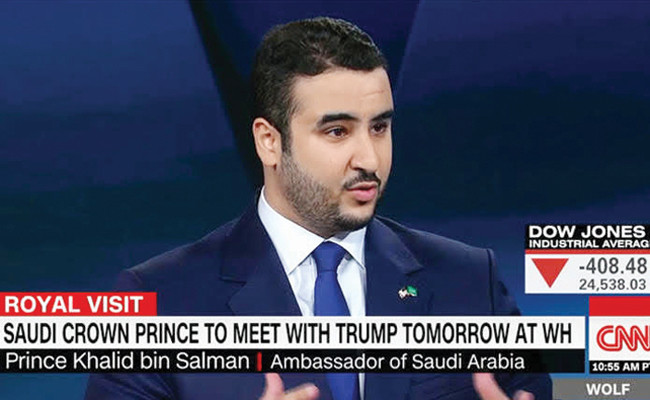
Saudi Ambassador to the US Prince Khalid bin Salman gives CNN’s Wolf Blitzer his first televised interview.
Updated 20 March 2018
Follow

Iran wants to form another Hezbollah in Yemen, says Saudi ambassador to US

WASHINGTON: Prince Khalid bin Salman, the Saudi ambassador to the US, said on Monday that Iran wants to form another Hezbollah in Yemen through its support of Houthi militia.
He told CNN that Iran wants to destabilize Saudi Arabia, and that it poses a threat to the entire region and international security.
“Here’s what happening in Yemen: (Iran is trying to create) another Hezbollah in Yemen, which will not just threaten our security and Yemeni security, but also regional security.”
“We’ve been focusing on the weapon of mass destruction, the WMD. What we should really be focusing on is the MD, the mass destruction that Iran is committing in the region.”
He stressed to CNN that Tehran was stirring unrest, and said the so-called “nuclear deal” between Iran and Western powers needs “to be fixed.” 
In the interview, the ambassador was asked about the changes going on in Saudi Arabia and he pointed to Saudi Vision 2030, a long-term strategy toward "fascinating change and transformation."

"We want to reform our economy, we want to modernize our society, we want to empower our youth, including women," he said.
"On the women issues, currently in Saudi Arabia, we have more percentage of women in the Shoura Council, equivalent to Congress. In municipal elections, women are allowed to run and vote, and they have run, they have voted and won seats. Women are allowed to drive, and the biggest stock market in the Middle East and Africa, the Saudi stock market, is headed by women," he said.

The ambassador was speaking as Saudi Arabia’s Crown Prince Mohammed bin Salman begins a multi-city trip to the US, where he is due to meet President Donald Trump on Tuesday.
Crown Prince Mohammed is also due to meet with Vice President Mike Pence, administration officials and religious leaders in the US.
He will meet financiers and think tank chiefs in New York, entertainment executives and technology entrepreneurs in San Francisco and Los Angeles, and key figures of the energy industry in Houston.

Saudi Arabia targets 50 wildlife breeding programs within 5 years

Updated 12 February 2026
Follow

Saudi Arabia targets 50 wildlife breeding programs within 5 years

  • Strategy follows surging interest in protecting prized native species

RIYADH: Saudi Arabia’s top wildlife protection body has launched a plan to operate 50 breeding programs by 2030 and improve environmental balance, its CEO has said.

Mohammed Ali Qurban, head of the National Center for Wildlife, said the number of programs has already surged from seven to 21 in recent years, amid renewed interest in the protection of valued native species.

The breeding programs are based on precise scientific principles, starting with the selection of suitable species at research centers, followed by veterinary care and specialized nutrition programs, he added.

At the final stage, protected species are rehabilitated for release and monitored using the latest tracking and data analysis technologies.

The relocation of more than 10,000 animals in Saudi Arabia is “an important step in restoring ecosystems and enhancing environmental balance in the Kingdom,” Qurban said.

Veterinary scientists at work at the National Center for Wildlife's laboratory. (Supplied)

“Releasing wildlife into the wild contributes to forming new populations capable of self-reproduction; these releases support the genetic diversity of wild populations and enhance their ability to resist disease and adapt to environmental changes,” he added.

Releases have so far included more than 80 priority species, most notably reem antelopes, Arabian oryx, idmi gazelles, mountain ibex, houbara bustards, ostriches and sandgrouses. The animals were released within their historical and ecological ranges.

Qurban said that the plans take into account the carrying capacity of natural habitats and the importance of safe ecological corridors that connect protected areas to facilitate species movement and population sustainability.

Release sites are spread across more than 60 diverse environmental locations, including natural reserves, royal reserves and national parks, as well as strategic sites within the Kingdom’s giga-projects, ensuring the dispersal of animals across their targeted geographical ranges.

The efforts are part of a national integrated framework to support the goals of the Saudi Green Initiative, Vision 2030 and the National Environment Strategy, aiming to achieve thriving and sustainable wildlife and ecosystems, Qurban said.