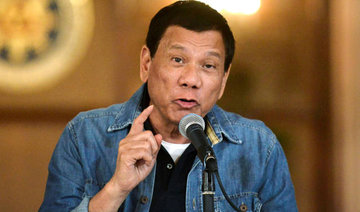
MANILA: Philippine President Rodrigo Duterte urged other governments on Sunday to abandon the International Criminal Court, saying the world tribunal — where he’s facing a possible complaint for the thousands of killings of drug suspects under his crackdown — is “rude.”
Although the Philippine Senate has ratified the Rome Statute that established the ICC, Duterte said in a speech that the treaty was never enforced in the country because it was not published in the government journal as required by law.
As a result, Duterte said the international court can never have jurisdiction over him, “not in a million years.”
Last month, an ICC prosecutor, Fatou Bensouda, announced that she was opening a preliminary examination into a complaint by a Filipino lawyer of suspected extrajudicial killings under Duterte’s anti-drug campaign, which could amount to crimes against humanity.
The move angered Duterte, who announced Wednesday that he was withdrawing the Philippine ratification of the Rome Statute “effective immediately,” citing “a concerted effort” by Bensouda and UN human rights officials “to paint me as a ruthless and heartless violator of human rights.”
“You know, if it’s not published, there is no law,” Duterte said Sunday in a speech before the annual graduation of cadets at the Philippine Military Academy in northern Baguio city.
There was no reason to withdraw from “something which is not existing,” Duterte said, adding that he announced the withdrawal from the ICC treaty to draw the world’s attention to the issue he had with the international court.
“I will convince everybody now who are under the treaty at ICC: ‘Get out, get out, it’s rude,’” the brash-talking president said.
Duterte’s action came under fire from human rights groups, who said the president was trying to evade accountability by backing out of the ICC. Critics say Duterte can’t withdraw from the court by himself and may need the approval of the Senate, which ratified the Rome Statute in 2011.
Commission on Human Rights chief Chito Gascon said that the Philippines has historically been at the forefront of the fight for international justice, but that Duterte’s decision “constitutes a reversal that will be viewed as encouraging impunity to continue.”
More than 120 countries have ratified the treaty that established the court in 2002 in The Hague. The court can intervene only when a state is unable or unwilling to carry out an investigation and prosecute perpetrators of heinous crimes like crimes against humanity, genocide, aggression and war atrocities.
More than 4,000 mostly poor drug suspects have been killed under Duterte’s drug crackdown, according to the national police, although human rights groups have reported larger death tolls. Duterte argued Wednesday that the killings do not amount to crimes against humanity, genocide or similar atrocities.


![]()


Philippine leader Duterte urges nations to exit international court
Philippine leader Duterte urges nations to exit international court


Peru Congress to debate impeachment of interim president
LIMA: Peru’s Congress is set to consider Tuesday whether to impeach interim president Jose Jeri, the country’s seventh head of state in 10 years, accused of the irregular hiring of several women in his government.
A motion to oust Jeri, 39, received the backing of dozens of lawmakers on claims of influence peddling, the latest of a series of impeachment bids against him.
The session, set for 10:00 am local time (1500 GMT), is expected to last several hours.
Jeri, in office since October, took over from unpopular leader Dina Boluarte who was ousted by lawmakers amid protests against corruption and a wave of violence linked to organized crime.
Prosecutors said Friday they were opening an investigation into “whether the head of state exercised undue influence” in the government appointments of nine women on his watch.
On Sunday, Jeri told Peruvian TV: “I have not committed any crime.”
Jeri, a onetime leader of Congress himself, was appointed to serve out the remainder of Boluarte’s term, which runs until July, when a new president will take over following elections on April 12.
He is constitutionally barred from seeking election in April.
The alleged improper appointments were revealed by investigative TV program Cuarto Poder, which said five women were given jobs in the president’s office and the environment ministry after visiting with Jeri.
Prosecutors spoke of a total of nine women.
Jeri is also under investigation for alleged “illegal sponsorship of interests” following a secret meeting with a Chinese businessman with commercial ties with the government.
- Institutional crisis -
The speed with which the censure process is being handled has been attributed by some political observers as linked to the upcoming presidential election, which has over 30 candidates tossing their hat into the ring, a record.
The candidate from the right-wing Popular Renewal party, Rafael Lopez Aliaga, who currently leads in polls, has been among the most vocal for Jeri’s ouster.
If successfully impeached, Jeri would cease to exercise his functions and be replaced by the head of parliament as interim president.
But first a new parliamentary president would have to be elected, as the incumbent is acting in an interim capacity.
“It will be difficult to find a replacement with political legitimacy in the current Congress, with evidence of mediocrity and strong suspicion of widespread corruption,” political analyst Augusto Alvarez told AFP.
Peru is experiencing a prolonged political crisis, which has seen it burn through six presidents since 2016, several of them impeached or under investigation for wrongdoing.
It is also gripped by a wave of extortion that has claimed dozens of lives, particularly of bus drivers — some shot at the wheel if their companies refuse to pay protection money.
In two years, the number of extortion cases reported in Peru jumped more than tenfold — from 2,396 to over 25,000 in 2025.
A motion to oust Jeri, 39, received the backing of dozens of lawmakers on claims of influence peddling, the latest of a series of impeachment bids against him.
The session, set for 10:00 am local time (1500 GMT), is expected to last several hours.
Jeri, in office since October, took over from unpopular leader Dina Boluarte who was ousted by lawmakers amid protests against corruption and a wave of violence linked to organized crime.
Prosecutors said Friday they were opening an investigation into “whether the head of state exercised undue influence” in the government appointments of nine women on his watch.
On Sunday, Jeri told Peruvian TV: “I have not committed any crime.”
Jeri, a onetime leader of Congress himself, was appointed to serve out the remainder of Boluarte’s term, which runs until July, when a new president will take over following elections on April 12.
He is constitutionally barred from seeking election in April.
The alleged improper appointments were revealed by investigative TV program Cuarto Poder, which said five women were given jobs in the president’s office and the environment ministry after visiting with Jeri.
Prosecutors spoke of a total of nine women.
Jeri is also under investigation for alleged “illegal sponsorship of interests” following a secret meeting with a Chinese businessman with commercial ties with the government.
- Institutional crisis -
The speed with which the censure process is being handled has been attributed by some political observers as linked to the upcoming presidential election, which has over 30 candidates tossing their hat into the ring, a record.
The candidate from the right-wing Popular Renewal party, Rafael Lopez Aliaga, who currently leads in polls, has been among the most vocal for Jeri’s ouster.
If successfully impeached, Jeri would cease to exercise his functions and be replaced by the head of parliament as interim president.
But first a new parliamentary president would have to be elected, as the incumbent is acting in an interim capacity.
“It will be difficult to find a replacement with political legitimacy in the current Congress, with evidence of mediocrity and strong suspicion of widespread corruption,” political analyst Augusto Alvarez told AFP.
Peru is experiencing a prolonged political crisis, which has seen it burn through six presidents since 2016, several of them impeached or under investigation for wrongdoing.
It is also gripped by a wave of extortion that has claimed dozens of lives, particularly of bus drivers — some shot at the wheel if their companies refuse to pay protection money.
In two years, the number of extortion cases reported in Peru jumped more than tenfold — from 2,396 to over 25,000 in 2025.
Latest updates




Recommended



© 2026 SAUDI RESEARCH & PUBLISHING COMPANY, All Rights Reserved And subject to Terms of Use Agreement.