NATO chief says spy attack must have ‘consequences’ for Russia

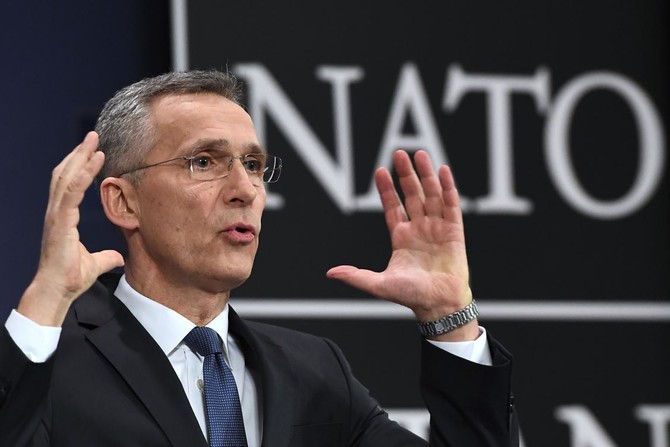
NATO Secretary-General Jens Stoltenberg said: ‘The attack in Salisbury has taken place against a backdrop of reckless behavior by Russia over many years.’ (AFP)
Updated 15 March 2018
Follow

NATO chief says spy attack must have ‘consequences’ for Russia

BRUSSELS: NATO Secretary General Jens Stoltenberg on Thursday backed a “proportionate” British response to a nerve agent attack on a former Russian spy, saying the incident must have “consequences.”
Stoltenberg said the poisoning of Sergei Skripal and his daughter, which he called the first offensive use of a nerve agent on the alliance’s territory since its foundation, came against the “backdrop of a pattern of reckless behavior” by Russia.
He said he would hold special talks with British Foreign Secretary Boris Johnson in Brussels on Monday over the attack in the city of Salisbury, but added that Britain had not invoked the alliance’s Article 5 mutual defense clause.
British Prime Minister Theresa May ordered the expulsion of 23 Russian diplomats and suspended some high-level contacts with the Kremlin after saying Moscow was “culpable” for the attempted murder of Skripal.
“Britain is not alone,” Stoltenberg told a news conference as he launched NATO’s annual reports.
“I am absolutely certain that the UK will respond and is responding in a proportionate and measured way. But at the same time, I fully support that there is a need for a response, because it has to have consequences when we see actions like we have seen in Salisbury.”
The former Norwegian premier said NATO itself was not taking any direct steps beyond offering political support, although it would offer “practical support” with the investigation if Britain wanted.
He said NATO was already responding strongly to years of Russian aggression including the annexation of Crimea, the conflict in eastern Ukraine, and meddling in western elections.
“The attack in Salisbury has taken place against a backdrop of reckless behavior by Russia over many years,” he said.
Stoltenberg said Britain had not asked for the triggering of NATO’s fundamental collective defense clause — which the United States used after the September 11, 2001 attacks.
“There has been no request for article 5 and it is for nations to ask for that,” he said.


Bangladesh police say student leader’s killers fled to India

Updated 17 sec ago
Follow

Bangladesh police say student leader’s killers fled to India

DHAKA: Bangladesh police on Sunday said the alleged killers of popular student leader Sharif Osman Hadi had fled to India, in comments likely to further strain relations with its neighbor.
Hadi, a vocal India critic who took part in last year’s mass uprising, was shot by masked assailants in Dhaka earlier this month and later succumbed to his injuries at a hospital in Singapore.
His death set off violent protests with angry mobs torching several buildings, including two major newspapers deemed to favor India as well as a prominent cultural institution.
With protests being held across the country almost daily, pressure has been growing on Bangladesh’s interim government to arrest the killers of Hadi, who was set to contest general elections in February next year.
“The killing was premeditated. Those behind it have been identified,” SN Nazrul Islam, a senior Dhaka Metropolitan Police officer, said at a news conference.
Suspects Faisal Karim Masud and Alamgir Sheikh left Bangladesh through the Haluaghat border with India shortly after attacking Hadi on December 12, Islam said.
They were received at the border by two Indian citizens, who escorted them into the northeastern state of Meghalaya before handing them over to two accomplices.
Bangladeshi investigators were in contact with their Indian counterparts who had arrested the two suspected accomplices, Islam said.
“We are communicating with Meghalaya police, who have confirmed the arrest of two Indian nationals,” he added.
Two senior Meghalaya police officers however did not comment when contacted by AFP.
The Indian foreign ministry had earlier said it rejects “false narratives” about New Delhi’s involvement in Hadi’s killing.
Ties between the neighbors have deteriorated since ousted prime minister Sheikh Hasina fled the pro-democracy uprising and sought refuge in India.
India says it is still considering Dhaka’s requests to extradite Hasina, who was sentenced to death in absentia for orchestrating a deadly crackdown on the uprising.
The lynching of a Hindu garment worker by a mob on December 18 has also hit ties.
Amid the deteriorating security situation in the Muslim-majority country, Khuda Baksh Chowdhury, special assistant to interim leader Muhammad Yunus overseeing the home department, stepped down on Wednesday.