HELSINKI: If cold weather and a lack of sunlight in winter are enough to get you down, chances are you’re not Finnish.
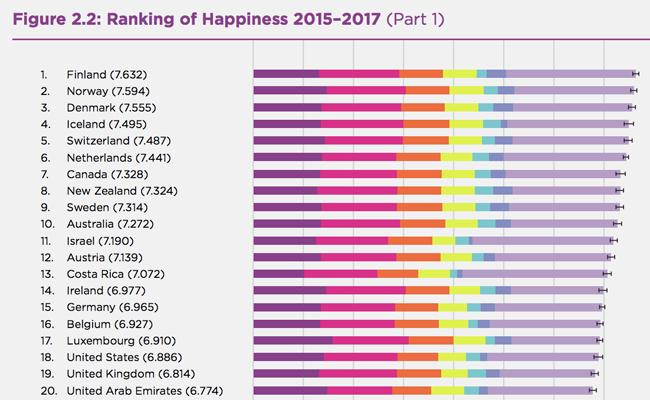
The World Happiness Report published Wednesday put Finland at the top among 156 countries ranked by happiness levels, based on factors such as life expectancy, social support and corruption.
Finland has emerged as the happiest place to live even though little sun and low temperatures are often blamed for high rates of depression.
“Well, our politics and our economics. I think the basics are quite good in Finland,” said Sofia Holm, 24-year-old resident of Helsinki, the Nordic country’s capital. “So, yes, we have the perfect circumstances to have a happy life here in Finland.”
And that’s not forgetting other plentiful attractions like skiing and saunas and, for children of all ages, Santa Claus.
“It’s a great thing to live in the happiest country although it’s snowing and we are walking in this wet snow,” said Helsinki resident Inari Lepisto, 28. “Yes, we have many things that make me happy.”
This year, the annual report published by the UN Sustainable Development Solutions Network also evaluated 117 countries by the happiness and well-being of their immigrants.
In 2015, more than a million migrants entered Europe, and a few thousand made it to Finland, a relatively homogenous country with about 300,000 foreigners and residents with foreign roots, out of its 5.5 million people.
Finland’s largest immigrant groups come from other European nations, but there also are communities from Afghanistan, China, Iraq and Somalia.
John Helliwell, a co-editor of the World Happiness Report and professor emeritus of economics at the University of British Columbia, noted that all the countries in the Top 10 scored highest both in overall happiness and regarding the happiness of immigrants. He said a society’s happiness seems contagious.
“The most striking finding of the report is the remarkable consistency between the happiness of immigrants and the locally born,” Helliwell said. “Those who move to happier countries gain, while those who move to less happy countries lose.”
Europe’s Nordic nations, none particularly diverse, have dominated the index since it first was produced in 2012. In reaching No. 1, Finland nudged neighboring Norway into second place.
Rounding out the Top 10 are Denmark, Iceland, Switzerland, the Netherlands, Canada, New Zealand, Sweden and Australia. The United States fell to 18th place from 14th last year.
Meik Wiking, CEO of the Copenhagen-based Happiness Research Institute, said the five Nordic countries that reliably rank high in the index “are doing something right in terms of creating good conditions for good lives,” something newcomers have noticed.
He said the happiness revealed in the survey derives from healthy amounts of both personal freedoms and social security that outweigh residents having to pay “some of the highest taxes in the world.”
“Briefly put, (Nordic countries) are good at converting wealth into well-being,” Wiking said. The finding on the happiness of immigrants “shows the conditions that we live under matter greatly to our quality of life, that happiness is not only a matter of choice.”
The United States was 11th in the first index and has never been in the Top 10. The report cited several factors to explain its falling ranking.
“The US is in the midst of a complex and worsening public health crisis, involving epidemics of obesity, opioid addiction, and major depressive disorder that are all remarkable by global standards,” the report said.
It added that the “sociopolitical system” in the United States produces more income inequality — a major contributing factor to unhappiness — than other countries with comparatively high incomes.
The US also has seen declining “trust, generosity and social support, and those are some of the factors that explain why some countries are happier than others,” Wiking said.
One of the world’s northernmost countries stretching some 1,160 kilometers (720 miles) from north to south, the sun does not set for 73 consecutive days during summer at Finland’s northernmost point. During the winter months, the sun doesn’t rise at all for 51 days in Lapland, northern Finland.
___
Jan M. Olsen in Copenhagen, Denmark, contributed to this report.


![]()
Despite cold, dark, Finland tops 2018 global happiness index
Despite cold, dark, Finland tops 2018 global happiness index



Latest updates


Recommended


© 2026 SAUDI RESEARCH & PUBLISHING COMPANY, All Rights Reserved And subject to Terms of Use Agreement.