Theresa May says UK to expel 23 Russian diplomats, Kremlin to retaliate

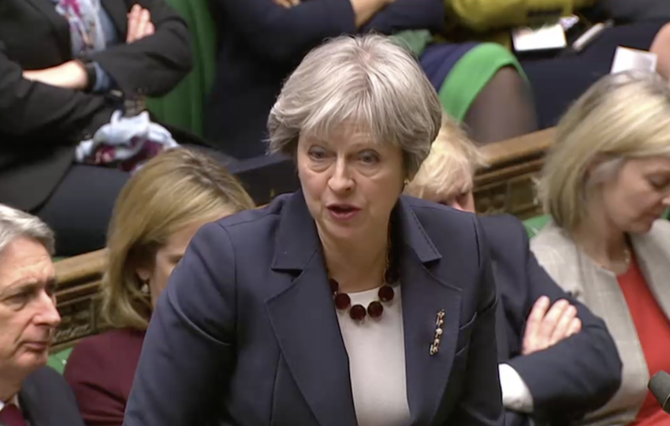
British Prime Minister Theresa May said on Wednesday she had come to the conclusion that Russia was culpable for the attempted murder of Sergei Skripal. (Screenshot)
Updated 14 March 2018
Follow

Theresa May says UK to expel 23 Russian diplomats, Kremlin to retaliate

LONDON: British Prime Minister Theresa May said on Wednesday she had come to the conclusion that Russia was culpable for the attempted murder of Sergei Skripal and his daughter.
In a speech in the British Parliament soon after Yakovenko's statement, Prime Minister Theresa May said Britain would expel 23 Russian diplomats, describing it as the single biggest expulsion in over 30 years.
Skripal, 66, and his daughter Yulia, 33, were found slumped unconscious on a bench outside a shopping centre in the genteel southern English city of Salisbury on March 4.
They have been in a critical condition in hospital ever since.
"There is no alternative conclusion, other than that the Russian state was culpable for the attempted murder of Mr Skripal and his daughter, and for threatening the lives of other British citizens in Salisbury,” May said.
“This represents an unlawful use of force by the Russian state against the United Kingdom," she said. “Under the Vienna Convention, the United Kingdom will now expel 23 Russian diplomats who have been identified as undeclared intelligence officers," May told parliament. “They have just one week to leave.”

May said the biggest expulsions from London in 30 years would degrade Russian intelligence capabilities in Britain for years to come.
“We will freeze Russian state assets wherever we have the evidence that they may be used to threaten the life or property of UK nationals or residents,” May said.
Russia's Ambassador to Britain Alexander Yakovenko warned London on Wednesday of reciprocal measures if Britain expelled Russian diplomats. The Russian embassy to the UK said all responsibility for the deterioration of the Russia-UK relationship lies with the current political leadership of Britain.
Moscow refused to comply with Britain's demands that it explain how Novichok — a form of nerve agent developed by the Soviet Union during the Cold War — came to be used in Britain. Russia said the U.K. must first provide samples of the poison collected by investigators.
Putin spokesman Dmitry Peskov told reporters on Wednesday that Britain has offered "baseless accusations which are not backed up by any evidence." He said Russia would cooperate with the investigation but does not see Britain's willingness to reciprocate.
"We hope reason will prevail and other countries will think hard how serious the evidence against Russia is," he said.
Russia has claimed that the nerve agent could have come from another former Soviet country, pointing to Moscow's foe, Ukraine.
Lawmaker Vladimir Gutenev, a member of the state commission for chemical disarmament, said Russia had scrapped its stockpile of Novichok.
"It is hard to say what may be happening in neighboring countries," he was quoted as saying by the Interfax news agency.
Meanwhile, the UK foreign office has told Britons travelling to Russia to be aware of the possibility of anti-British sentiment or harassment. It also advised Britons in the country to avoid commenting on politics publicly.
May also told parliament that British ministers and the royal family will not be attending the World Cup in Russia later this year after spy attack.


Arrivederci Milan Cortina. Italian organizers contemplating Rome bid for 2040 Summer Olympics

Updated 4 sec ago
Follow

Arrivederci Milan Cortina. Italian organizers contemplating Rome bid for 2040 Summer Olympics

  • The entire idea of the Milan Cortina Games was born out of the rejection of Rome’s bid for the 2024 Olympics by then-Mayor Virginia Raggi a decade ago
CORTINA D’AMPEZZO: Goodbye Milan Cortina. See you in Rome in 2040?
Now that the just-concluded Winter Olympics have been hailed for setting “a new, very high standard” by IOC President Kirsty Coventry, Italian organizers are contemplating a bid for the 2040 Summer Games.
“I think our country deserves another Summer Olympics,” Italian Olympic Committee (CONI) president Luciano Buonfiglio said over the weekend. “But let’s take it step by step. A candidacy has to be agreed on and shared with the government.”
The idea of the Milan Cortina Games was born out of the rejection of Rome’s bid for the 2024 Olympics by then-Mayor Virginia Raggi a decade ago. That came four years after then-Premier Mario Monti scrapped the city’s candidacy for the 2020 Games because of financial concerns; and after a Rome bid was narrowly defeated by Athens in the final round of voting for 2004.
“Scars help you remember” the defeats, said Giovanni Malagò, the head of the Milan Cortina organizing committee and former CONI president.
But Malagò, who is also an IOC member, suggested that Rome has a couple of key advantages in Olympic circles: its “unique” history of failed bids and the centerpiece venue for any Summer candidacy.
“Rome has a 70,000-seat stadium with an athletics track — which is huge in terms of sustainability,” Malagò said.
The existing Stadio Olimpico and surrounding Foro Italico complex would be a natural setting for athletics and swimming — the two biggest sports at the Summer Games.
Rome Mayor Roberto Gualtieri said during the Milan Cortina Games that he believes his city has “the conditions” for another bid — especially after welcoming more than 33 million people to the capital and Vatican for the 2025 Holy Year.
“If it’s considered a realistic goal, I’m open to collaborating with the IOC, government and CONI in order to create the most competitive bid possible,” Gualtieri said. “A capital like Rome should not be afraid of big challenges. The Jubilee showed off our organizational capacity for big events.”
With the 2028 Games coming up in Los Angeles and 2032 in Brisbane, Australia; and India and Qatar bidding for 2036; the 2040 Summer Games seem destined to return to Europe.
“Now is not the time to discuss this. It’s premature, wrong and even counterproductive,” Malagò said. “We need to understand the geopolitical landscape for post-2032.”
Malagò wouldn’t elaborate on speculation that he will run for Rome mayor after he finishes off his Milan Cortina duties, saying he would discuss “ideas that I have in mind” after next month’s Paralympics.
Andrea Abodi, Italy’s Minister for Sport and Youth, added: “It doesn’t necessarily require an announcement to build a winning bid.”