Attack on Al-Hamdallah aimed at derailing reconciliation talks

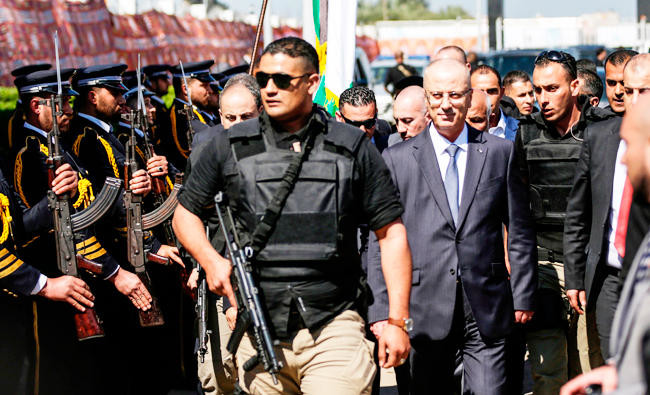
Palestinian Prime Minister Rami Hamdallah (2nd-R), escorted by his bodyguards, is greeted by police forces of the Islamist Hamas movement (L) upon his arrival in Gaza City, in this March 13, 2018 photo. (AFP)
Updated 14 March 2018
Follow

Attack on Al-Hamdallah aimed at derailing reconciliation talks

AMMAN: The failed assassination attempt against the Palestinian prime minister on Tuesday had one target — internal Palestinian reconciliation.
The small explosive and the shots fired at the convoy, that also included the head of the Palestinian intelligence, Majed Farraj, has sent political shock waves throughout the Palestinian political map. It was a crude reminder of an attempt against President Abbas in 2007. At the time the president’s security officers uncovered four large explosive devices that were intended to kill Abbas.
Omar Kullab, a political analyst in Jordan of Gazan origin, told Arab News that the best response to the attempt on the prime minister's life, is to move ahead with reconciliation talks.
“We don’t know who is behind it. It might be the Israelis or ISIS (Daesh), but I doubt it is Hamas. Nevertheless, I think that the attitude of Prime Minister (Rami) Hamdallah is the correct one, namely to move even faster ahead with the reconciliation efforts.”
But the attack puts Hamas under the spotlight at a time when the territory they rule is suffering one of the worst economic and humanitarian periods since the Israeli blockade began.
Nahed Abo Tueima, a lecturer on gender issues at Bir Zeit University, near Ramallah, believes that Hamas, as the party in charge of security in Gaza, is responsbile for what happened under its watch.
“Hamas claims that it has a strong security force in Gaza and therefore it is fully responsible for what happens.” Tueima, who was born in Gaza, told Arab News. “It needs to allow for joint investigation in order to uncover who exactly is behind what happened.”
Annes Sweidan, head of the external department in the Palestine Liberation Organization, also feels Hamas has to be held responsible. “They can’t shake off their responsibility even if they didn’t do it. The reconciliation will certainly be negatively affected by the attack,” Sweidan told Arab News.
But regardless of the motive or who is behind the attack, there is no doubt that the situation in Gaza is very volatile and needs close attention. Kullab, the Jordanian-Palestinian analyst, believes that the timing of the attack is not coincidental. “It happened on the same day that a meeting is due to take place in the White House to talk about the situation in Gaza.
The timing of the attack is not innocent, but is meant to send some kind of message to Ramallah and Washington,’ Kullab told Arab News.
Hamadeh Faraneh, a member of the Palestinian National Council, told Arab News that Palestinian leaders should not deviate from their goal. “The reconciliation is of utmost importance for the national interest of the Palestinian people and it must be pursued no matter what happened.”
But despite all the brave talk, the attack on the convoy of Palestinian leaders from Ramallah, deep in the Gaza Strip, will leave its scars for a long time to come.
The attack is sure to delay the visit by President Abbas to Gaza further. The president had promised to come once the reconciliation is totally in effect and the security situation is stable.


How succession works in Iran and who will be the country’s next supreme leader?

Updated 58 min 38 sec ago
Follow

How succession works in Iran and who will be the country’s next supreme leader?

  • An 88-member panel called the Assembly of Experts “must, as soon as possible” pick a new supreme leader under Iranian law

DUBAI: The death of Iran’s Supreme Leader Ayatollah Ali Khamenei after almost 37 years in power raises paramount questions about the country’s future. The contours of a complex succession process began to take shape the morning after Khamenei’s assassination.
Here is what to know:
A temporary leadership council assumes duties
As outlined in its constitution, Iran on Sunday formed a council to assume leadership duties and govern the country.
The council is made up of Iran’s sitting president, the head of the country’s judiciary and a member of the Guardian Council chosen by Iran’s Expediency Council, which advises the supreme leader and settles disputes with parliament.
Iran’s reformist President Masoud Pezeshkian and hard-line judiciary chief Gholamhossein Mohseni Ejei are its members who will step in and “temporarily assume all the duties of leadership.”
A panel of clerics selects a new supreme leader
Though the leadership council will govern in the interim, an 88-member panel called the Assembly of Experts “must, as soon as possible” pick a new supreme leader under Iranian law.
The panel consists entirely of Shiite clerics who are popularly elected every eight years and whose candidacies are approved by the Guardian Council, Iran’s constitutional watchdog. That body is known for disqualifying candidates in various elections in Iran and the Assembly of Experts is no different. The Guardian Council barred former Iranian President Hassan Rouhani, a relative moderate whose administration struck the 2015 nuclear deal with world powers, from election for the Assembly of Experts in March 2024.
Khamenei’s son could be a possible contender
Clerical deliberations about succession and machinations over it take place far from the public eye, making it hard to gauge who may be a top contender.
Previously, it was thought Khamenei’s protégé, hard-line President Ebrahim Raisi, may try to take the mantle. However, he was killed in a May 2024 helicopter crash. That has left one of Khamenei’s sons, Mojtaba, a 56-year-old Shiite cleric, as a potential candidate, though he has never held government office. But a father-to-son transfer in the case of a supreme leader could spark anger, not only among Iranians already critical of clerical rule, but also among supporters of the system. Some may see it as un-Islamic and in line with creating a new, religious dynasty after the 1979 collapse of the US-backed Shah Mohammad Reza Pahlavi’s government.
A transition like this has happened only once before
There has been only one other transfer of power in the office of supreme leader of Iran, the paramount decision-maker since the country’s 1979 Islamic Revolution.
In 1989, Grand Ayatollah Ruhollah Khomeini died at age 86 after being the figurehead of the revolution and leading Iran through its bloody eight-year war with Iraq. This transition now comes after Israel launched a 12-day war against Iran in June 2025 as well.
The vast powers of a supreme leader
The supreme leader is at the heart of Iran’s complex power-sharing Shiite theocracy and has final say over all matters of state.
He also serves as the commander-in-chief of the country’s military and the powerful Revolutionary Guard, a paramilitary force that the United States designated a terrorist organization in 2019 and which Khamenei empowered during his rule. The Guard, which has led the self-described “Axis of Resistance,” a series of militant groups and allies across the Middle East meant to counter the US and Israel, also has extensive wealth and holdings in Iran.