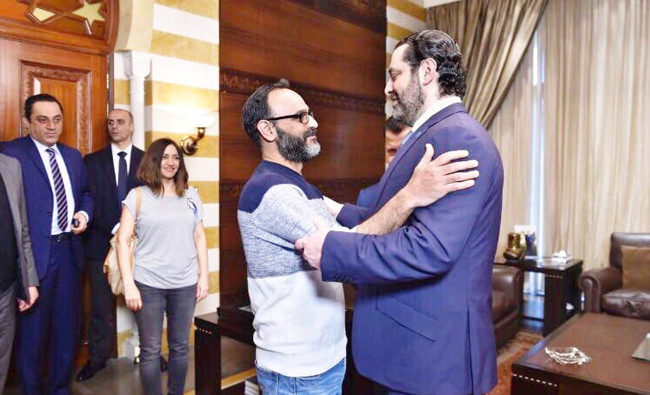
BEIRUT: Actor Ziad Itani has been released by the Lebanese military judiciary without bail after being confined for 110 days on a charge of spying for Israel.
His arrest shocked the Lebanese public, and there was further upset when an Internal Security Forces officer and a hacker were arrested for fabricating the case against Itani.
Itani was first held by Lebanese State Security and then by the Information Department of the ISF.
As soon as he was released from prison, a tearful Itani said: “The guys at the Information Department are heroes — thorough investigations were conducted with precision, and they saved the era from a big scandal.”
He also thanked President Michel Aoun, Prime Minister Saad Hariri, and Interior Minister Nouhad Machnouk and said: “They knew that such a case won’t go unsolved.
“I am a stage actor who works for the people’s theater and was accused of the gravest crime. We don’t wish to go back to the outdated systems,” he added.
When asked if he had been tortured, he replied: “Yes.”
Less than two hours following the release order, Itani’s Twitter account was activated and, as he waited in prison for his attorney to finish the release proceedings, he tweeted: “What are you waiting for? Meet me in Tariq El Jdideh and bring sweets and juice with you. I’ve missed you.”
Itani’s lawyer Rami Itani, said after the prosecutor issued the release order: “A huge reception will await Ziad near his house in Tariq El Jdideh.”
Itani’s mother, who waited for him at her house in Tariq El Jdideh, said: “My son is innocent.
“I will never forgive those who were behind Ziad’s arrest, and I won’t forgive his acquaintances who believed the charge against him,” she added.
The Lebanese flag and Future Movement banners were raised on balconies In Tariq El Jdideh to welcome Itani.
Military Investigative Judge Riad Abu Ghaida issued two arrest warrants against the security officer, Lt. Col. Suzan Hajj (Hobeiche), who was interrogated on Tuesday in the presence of her defense lawyer, former minister Rashid Derbas, and the hacker, Elie Ghabash, who was questioned on Monday.
During her three-hour investigation, conducted by Judge Abu Ghaida, Hajj was brought face-to-face with Ghabash, and both stuck to their statements.
According to judicial sources, Hajj insisted on denying the charge and Ghabash’s confessions.
For his part, Ghabash confirmed that Hajj had requested that he hack Ziad Itani’s online account in revenge.
While being interrogated by Judge Abu Ghaida, Ghabash had confirmed the confessions he made to the Information Department, where he said that “the case had been fabricated against Itani at the request of Hajj.”
Gabash had recorded all phone calls received from Hajj when she asked him to frame Itani for collaborating with a Mossad spy, Colette, who was later found to be fictitious.
Hajj wanted revenge on Itani for exposing a ‘like’ she had placed on a social media post by TV director Charbel Khalil, in which he mocked the Saudi decision to lift the driving ban on women.
Even though she quickly withdrew the ‘like’, she lost her job as head of the ISF anti-cybercrime unit as a result of the tweet.
Judge Abu Ghaida is to close the investigation and refer the case to the Military Tribunal for review it before he hands down his indictment, under which he refers the two detainees, Hajj and Ghabash, to the Military Court. The criminal charges they face carry a maximum sentence of 10 years.


![]()
![]()
Lebanese actor accused of spying for Israel freed

Lebanese actor accused of spying for Israel freed

Latest updates


© 2026 SAUDI RESEARCH & PUBLISHING COMPANY, All Rights Reserved And subject to Terms of Use Agreement.