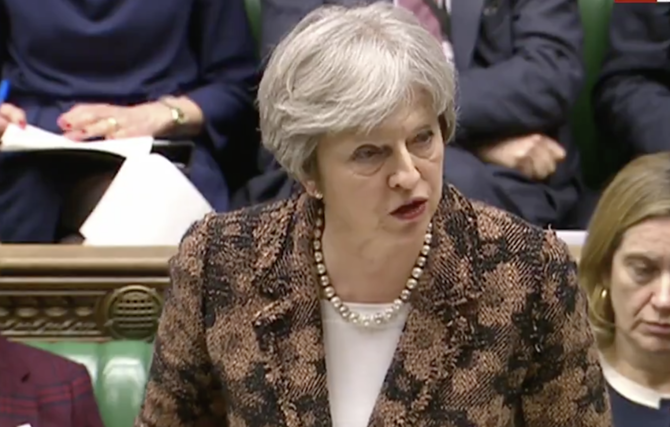
LONDON: Britain's prime minister said Monday that it was "highly likely" that Russia was responsible for poisoning ex-spy Sergei Skripal with a military-grade nerve agent in southwestern England last week.
Theresa May said that should Russian state involvement be proven, it would be considered an "unlawful use of force by the Russian state against the United Kingdom," and gave the Russian ambassador until the end of Tuesday to respond.
May said that Skripal and his daughter were poisoned with a form of nerve agent known as Novichock, and there were two possible explanations: the attack was an act of the Russian state, or Russia has lost control of a deadly banned substance.
She said that Britain expects the Russian ambassador to explain which version is true.
May spoke in the House of Commons after chaired a National Security Council meeting to hear the latest evidence in the case. She has been under mounting pressure to hit Russia with sanctions, diplomatic expulsions and other measures in response to the poisoning, the latest in a string of mysterious mishaps to befall Russians in Britain in recent years.
May said Britain would consider tough action if the Russian explanation is inadequate, though she didn't give details.
"There can be no question of business as usual with Russia," she said.
Skripal, 66, and his 33-year-old daughter, Yulia, remain in critical condition following the March 4 nerve agent attack. A police detective who came in contact with them is in serious but stable condition.
The case has similarities to the killing of former Russian spy Alexander Litvinenko, who was poisoned with radioactive tea in London in 2006. A British inquiry concluded that his death was the work of the Russian state and had probably been authorized by Russian President Vladimir Putin.
The Kremlin has rejected suggestions that it's behind the poisoning.
Putin spokesman Dmitry Peskov told reporters that Sergei Skripal worked for British intelligence and was poisoned on British soil, and therefore the incident "has nothing to do with Russia, let alone the Russian leadership." Peskov also said the Kremlin hasn't heard any official statements of Russian involvement.
Skripal was a Russian military intelligence officer when he was recruited to spy for Britain in the 1990s. He was jailed in Russia in 2006 for revealing state secrets before being freed in a spy swap in 2010. He had settled in the cathedral city of Salisbury, 90 miles (140 kilometers) southwest of London.
He and his daughter were found comatose on a bench near the city center after visiting an Italian restaurant and a pub.
Almost 200 troops, including soldiers trained in chemical warfare and decontamination, have been deployed to Salisbury to assist the police investigation into where the nerve agent came from and how it was delivered.
British officials have said the risk to the public is low, but urged people who visited the Zizzi restaurant or the Mill pub to wash their clothes and take other precautions. Some have questioned why it took health authorities a week to issue the advice.
Putin brushed off a question about the affair while visiting a grain centre in Krasnodar, southern Russia, saying British authorities should first “get to the bottom of things,” the BBC’s Moscow correspondent wrote on Twitter.
The Russian foreign ministry responded by saying the comments by May were a "circus show."

UK PM Theresa May: 'Highly likely' Russia responsible for spy poisoning
New Zealand mosque shooter seeks to discard his guilty pleas, saying prison made him irrational
WELLINGTON: The man who killed 51 Muslim worshipers at two mosques in New Zealand’s deadliest mass shooting told an appeals court Monday that he felt forced to admit to the crimes because of “irrationality” due to harsh prison conditions, as he sought to have his guilty pleas discarded.
A panel of three judges at the Court of Appeal in Wellington will hear five days of evidence about Brenton Tarrant’s claim that he was not fit to plead to the terrorism, murder and attempted murder charges he faced after the 2019 attack in the city of Christchurch. If his bid is successful, his case would return to court for a trial, which was averted in March 2020 when he admitted to the hate-fueled shooting.
He is also seeking to appeal his sentence of life without the chance of parole, which had never been imposed in New Zealand before. Tarrant’s evidence Monday about his mental state when he pleaded guilty was the first time he had spoken substantively in a public setting since he livestreamed the 2019 massacre on Facebook.
Shooter says he suffered “nervous exhaustion”
The Australian man, a self-declared white supremacist, migrated to New Zealand with a view to committing the massacre, which he planned in detail. He amassed a cache of semiautomatic weapons, took steps to avoid detection and wrote a lengthy manifesto before he drove from Dunedin to Christchurch in March 2019 and opened fire at two mosques.
Along with 51 people killed, the youngest a 3-year-old boy, dozens of others were severely wounded. The attack was considered one of New Zealand’s darkest days and institutions have sought to curb the spread of Tarrant’s message through legal orders and a ban on possession of his manifesto or video of the attack.
Monday’s hearing took place under tight security constraints that severely limited who could view Tarrant’s evidence, which included some reporters and those hurt or bereaved in the massacre. Tarrant, who wore a white button-down shirt and black-rimmed glasses and had a shaved head, spoke on video from a white-walled room at Auckland Prison.
Answering questions from a Crown lawyer and from lawyers representing him, Tarrant, 35, said his mental health had deteriorated due to conditions in prison, where he was held in solitary confinement with limited reading material or contact with other prisoners.
By the time he pleaded guilty, Tarrant said he was suffering from “nervous exhaustion” and uncertainty about his identity and beliefs. He had admitted to the crimes a few months before his trial was due to begin because there was “little else I could do,” he told the court.
Crown lawyers say no evidence of serious mental illness
Crown lawyer Barnaby Hawes suggested to Tarrant during questioning that the Australian man had other options. He could have requested a delay in his trial date on mental health grounds or could have proceeded to trial and defended himself, Hawes said.
Hawes also put to Tarrant that there was little evidence in the documentation of his behavior by mental health experts and prison staff that he was in any kind of serious mental crisis. Tarrant suggested that signs of mental illness he displayed hadn’t been recorded and that at times he had sought to mask them.
“I was definitely doing everything possible to come across as confident, assured, mentally well,” he told the court. Tarrant’s behavior “reflected the political movement I’m a part of,” he added. “So I always wanted to put on the best front possible.”
He agreed that he had had access to legal advice throughout the court process. Tarrant’s current lawyers have been granted name suppression because they feared representing him would make them unsafe.
The appeal outcome is due later
Bids to appeal convictions or sentences in New Zealand must be made within 20 working days. Tarrant was about two years late in seeking an appeal, filing documents with the court in September 2022.
He told the court Monday that his bid had been late because he hadn’t had access to the information required to make it.
The hearing is due to run for the rest of the week but the judges are expected to release their decision at a later date. If they reject Tarrant’s attempt to have his guilty pleas discarded, a later hearing will focus on his bid to appeal his sentence.
A panel of three judges at the Court of Appeal in Wellington will hear five days of evidence about Brenton Tarrant’s claim that he was not fit to plead to the terrorism, murder and attempted murder charges he faced after the 2019 attack in the city of Christchurch. If his bid is successful, his case would return to court for a trial, which was averted in March 2020 when he admitted to the hate-fueled shooting.
He is also seeking to appeal his sentence of life without the chance of parole, which had never been imposed in New Zealand before. Tarrant’s evidence Monday about his mental state when he pleaded guilty was the first time he had spoken substantively in a public setting since he livestreamed the 2019 massacre on Facebook.
Shooter says he suffered “nervous exhaustion”
The Australian man, a self-declared white supremacist, migrated to New Zealand with a view to committing the massacre, which he planned in detail. He amassed a cache of semiautomatic weapons, took steps to avoid detection and wrote a lengthy manifesto before he drove from Dunedin to Christchurch in March 2019 and opened fire at two mosques.
Along with 51 people killed, the youngest a 3-year-old boy, dozens of others were severely wounded. The attack was considered one of New Zealand’s darkest days and institutions have sought to curb the spread of Tarrant’s message through legal orders and a ban on possession of his manifesto or video of the attack.
Monday’s hearing took place under tight security constraints that severely limited who could view Tarrant’s evidence, which included some reporters and those hurt or bereaved in the massacre. Tarrant, who wore a white button-down shirt and black-rimmed glasses and had a shaved head, spoke on video from a white-walled room at Auckland Prison.
Answering questions from a Crown lawyer and from lawyers representing him, Tarrant, 35, said his mental health had deteriorated due to conditions in prison, where he was held in solitary confinement with limited reading material or contact with other prisoners.
By the time he pleaded guilty, Tarrant said he was suffering from “nervous exhaustion” and uncertainty about his identity and beliefs. He had admitted to the crimes a few months before his trial was due to begin because there was “little else I could do,” he told the court.
Crown lawyers say no evidence of serious mental illness
Crown lawyer Barnaby Hawes suggested to Tarrant during questioning that the Australian man had other options. He could have requested a delay in his trial date on mental health grounds or could have proceeded to trial and defended himself, Hawes said.
Hawes also put to Tarrant that there was little evidence in the documentation of his behavior by mental health experts and prison staff that he was in any kind of serious mental crisis. Tarrant suggested that signs of mental illness he displayed hadn’t been recorded and that at times he had sought to mask them.
“I was definitely doing everything possible to come across as confident, assured, mentally well,” he told the court. Tarrant’s behavior “reflected the political movement I’m a part of,” he added. “So I always wanted to put on the best front possible.”
He agreed that he had had access to legal advice throughout the court process. Tarrant’s current lawyers have been granted name suppression because they feared representing him would make them unsafe.
The appeal outcome is due later
Bids to appeal convictions or sentences in New Zealand must be made within 20 working days. Tarrant was about two years late in seeking an appeal, filing documents with the court in September 2022.
He told the court Monday that his bid had been late because he hadn’t had access to the information required to make it.
The hearing is due to run for the rest of the week but the judges are expected to release their decision at a later date. If they reject Tarrant’s attempt to have his guilty pleas discarded, a later hearing will focus on his bid to appeal his sentence.
© 2026 SAUDI RESEARCH & PUBLISHING COMPANY, All Rights Reserved And subject to Terms of Use Agreement.