BEIRUT: Jaish Al-Islam, one of the main rebel groups in Syria’s eastern Ghouta, said on Monday it had reached an agreement with the government’s ally Russia to evacuate wounded people from the besieged enclave near Damascus.
It communicated with Russia through the United Nations to reach the agreement, it said, as the government presses a major offensive against the enclave with Russian military help.
Meanwhile Syrian TV says another group of civilians has left the rebel-held enclave of Eastern Ghouta outside Damascus through a corridor established by the Syrian army
The state-run TV broadcast footage showing a small group of men, women and children it says left the town of Madyara on Monday. The town was captured by Syrian troops on Sunday.
Earlier on Monday, new airstrikes and barrel bombs pounded Eastern Ghouta as regime forces pressed a three-week advance that splintered the opposition enclave and trapped dozens under collapsed buildings.
Defying global calls for a cease-fire, Syria’s regime has pursued a ferocious Russian-backed air campaign and ground offensive to capture the region, the last rebel bastion on the capital’s doorstep.
In three weeks of fighting, it has overrun more than half the area and split the remainder into three pockets, isolating the urban hub of Douma from the rest of the enclave.
On Sunday, regime troops battered the edges of each pocket with air raids, barrel bombs, and rockets, said the Britain-based Syrian Observatory for Human Rights.
After fighting all morning, they captured the town of Medeira, which lies at the heart of the three zones, Observatory head Rami Abdel Rahman said.
State news agency SANA had reported troops were focusing on the town in order to cut the opposition’s access routes in Ghouta.
Bombing runs across several towns in Ghouta killed a dozen civilians on Sunday, bringing the total toll from the offensive to at least 1,111 civilians, the Observatory said.
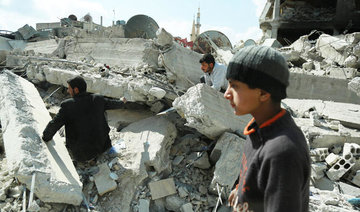
They include dozens of decomposing bodies still trapped under pulverized residential blocks in the towns of Hammuriyeh, Saqba, and Misraba.
In Hammuriyeh, AFP’s correspondent saw a young man scrambling frantically over the rubble of a collapsed building in search of his loved ones.
His father, mother, and three siblings were killed in an air raid, but rescue workers have been unable to pull them out.
Hassaan, a 30-year-old rescue worker, said there were around 20 more families under the rubble.
“We need heavy machinery to get them out, but we can’t bring the machines out into the streets because the regime may bomb them,” he said.
In the main town of Douma, bodies piled up in the morgue as bombardment prevented families from reaching the cemetery, AFP’s correspondent there said.
Families grew desperate for news of loved ones who had fled to other areas that were now inaccessible.
On Saturday, Syrian troops and allied militia cut off the main road leading out of Douma in a major blow to opposition fighters attempting to defend their enclave.
Regime forces also captured the town of Misraba.
Some residents fled from the advancing troops, but dozens stayed as soldiers recaptured their neighborhoods.
SANA reported on Sunday that troops transported “dozens of civilians, including women and children,” from Misraba to temporary shelters in regime-held zones.
The Observatory told AFP that Misraba was left abandoned after 75 to 100 people were moved out of the town by regime forces.
On Sunday, four people were killed and six wounded in rebel rocket fire on a regime-controlled district in eastern Damascus, state television reported.
It broadcast live footage from the battered skyline of Medeira, saying Sunday’s gains linked Syrian soldiers advancing from the east with troops based on the western edges of Ghouta.
In recent years, regime forces have recaptured several areas around Damascus and other parts of war-ravaged Syria from opposition fighters by pursuing fierce military offensives culminating in evacuation deals.


![]()

Syrian rebel group says agreed evacuation of wounded from Ghouta
Syrian rebel group says agreed evacuation of wounded from Ghouta

Latest updates




© 2026 SAUDI RESEARCH & PUBLISHING COMPANY, All Rights Reserved And subject to Terms of Use Agreement.