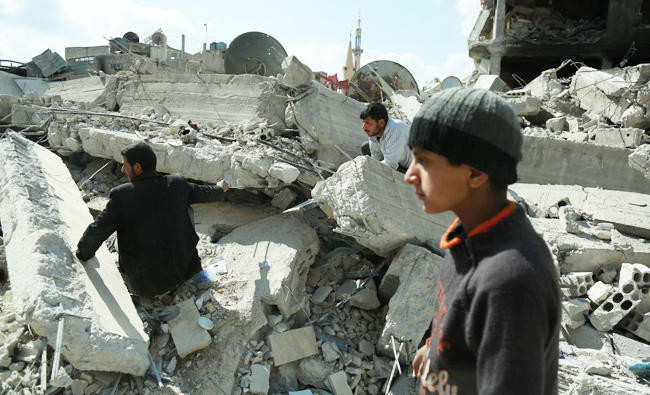
BEIRUT: Amid the unrelenting airstrikes on Eastern Ghouta, a 15-year-old Syrian boy braves the bombing to film what is left of the battered opposition enclave.
Speaking into a camera as smoke rises in the distance behind him, Mohammed Najem looks like a young war correspondent, but is just a teenager taking a video in selfie mode in one of the hottest spots of Syria’s civil war.
As well as videos showing the destruction of last remaining opposition holdout near Damascus, Najem interviews other young locals trapped by the conflict.
In one he posted on Wednesday, Najem is joined by Saleem, a younger boy, who tells how he raced inside his house to avoid an air strike.
“My sister and I started playing and immediately a missile came in,” Saleem says into Najem’s phone on a street covered in rubble and dust.
“Later I woke up and saw myself at a medical center and later they told me that my sister passed away. My house and the whole neighborhood are all gone.”
After several years besieging the area, over the last two weeks and more, the Syrian regime’s military has bombarded it almost around the clock, killing more than 1,000 people, according to medical charity Medecins Sans Frontieres.
The army onslaught has captured about half of Eastern Ghouta, leaving insurgents in control over a dense sprawl of towns where civilians are left cowering in underground shelters awaiting aid trucks.
“Every day Ghouta is bombed without mercy,” Najem told Reuters in social media messages this week.
The teenager, who is draped in the Syrian flag in social media profile pictures, was wary of releasing details about his life before the war or where exactly he was currently located, for his own safety.
In his social media posts, Najem has criticized Syrian President Bashar Assad and Russian intervention in the war.
In one post, he accuses Assad and Russian President Vladimir Putin of stealing the childhoods of Ghouta’s young, as explosions are heard overhead.
Damascus and Moscow say the assault is needed to stop rebels shelling Damascus and to end the rule of insurgents over civilians in the area. They say they try to avoid civilian casualties and accuse the fighters of stopping civilians fleeing, which the insurgents deny.
For the civilians, there is a constant dilemma — whether to seek supplies or stay inside.
“Civilians in Ghouta are living in shelters underground and they are not well equipped in terms of health and services because of the airstrikes,” a girl wearing a headscarf says in a video standing alongside Najem.
The video ends with shots of Najem filming seven different children each saying: “Save Ghouta!”