PORT ELIZABETH: Sunil Gavaskar, a terrific raconteur, loves telling the story of an India-Pakistan Test match from 1979, with the suave Dilip Doshi bowling to Javed Miandad, cricket’s ultimate streetfighter. Miandad spoke with a lisp, and he drove the mild-mannered Doshi to the brink of apoplexy by repeatedly asking him: “What’s your room number?”
When the increasingly agitated Doshi finally took the bait and asked him why he wanted to know, Miandad quipped: “I want to know so I can hit the ball as far as your hotel room.” Even the Indian fielders laughed.
But sledging, or “mental disintegration” as Steve Waugh preferred to call it, has seldom been a funny affair. For every droll Miandad, you will find dozens of others who did nothing more than abuse their fellow professionals, often in the vilest terms. Slurs based on race, religion, sexuality and much else were not acted upon, and mainly because there were no stump microphones back then to capture these exchanges.
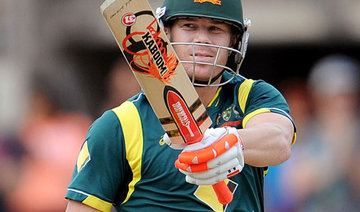
The recent first Test between South Africa and Australia in Durban saw another sledging controversy, with David Warner in the thick of it. During the course of Quinton de Kock’s battling second-innings knock of 83, the South African camp alleged that he was called a “bushpig,” and that his mother and sister were brought into the conversation as well. De Kock apparently responded with jibes about Warner’s wife, Candice, and alluded to a tryst she had with Sonny Bill Williams, the All Blacks rugby player, a decade ago.
Tim Paine, the Australian wicketkeeper, was vehement in his assertion that his team had not got personal with the exchanges. “We were trying to make it an uncomfortable place for Quinton to bat, no doubt, but we didn’t cross the line. We spoke about cricket stuff and a few little things with his fitness. Our stuff is the way we’ve always played our cricket.
“Certainly it’s hard, and we like to make them feel uncomfortable out there. But we don’t cross the line and bring people’s wives and family into the cricket game. And we’ll continue to do that for as long as we play.”
But that is the thing. Who decides what this mythical line in the sand is? A jibe about weight could be as hurtful to some as a comment about their partner. The minute you abuse someone, and there is little doubt that de Kock has copped more than his fair share of fruity language, you lose the right to complain when they respond as they see fit.
What has not helped the toxic atmosphere around some high-profile matches is the utterly reprehensible behavior of cricket boards and officials who should know so much better. At the end of the Ashes series last January, the backdrop for the presentation had an Australian hand with four raised fingers (to symbolize four Test wins) and an English one with a clenched fist, denoting zero. Apparently, Cricket Australia’s marketing team had prepared an Aussie hand with three outstretched fingers as well, in case the scoreline was 3-0.
Crass and pathetic does not even begin to describe it. The same words could be used to describe the behavior of two Cricket South Africa officials, who thought it was fine to pose for a picture next to fans sporting Sonny Bill Williams masks. And this was at a game that Candice Warner was attending with her two small daughters.
Back in 2014, India’s tour of England went south largely because of MS Dhoni’s preoccupation with the James Anderson-Ravindra Jadeja off-field altercation at Trent Bridge. Without actionable proof, Anderson could not be punished, but many Indian players supported their captain’s hard-line stance because they were so sick of the relentless barrage of abuse from Anderson. There were no humorous asides; it was just one foul-mouthed quip after another.
But things were not much better 20 or 30 years ago — one only has to cast their mind back to Craig McDermott against the West Indies, or the Glenn McGrath-Ramnaresh Sarwan saga. And stump microphones and social media these days put such behavior center stage. And if players cannot agree on where the line between banter and abuse lies, the best option is to simply shut it down, and start issuing cards as in football each time a Warner or de Kock gets too mouthy.
“We invented sledging,” wrote Peter Fitzsimons, the Australian journalist. “It turned into a toxic boomerang. It started 50 years ago. It shames our national name and we have to stop it.
“What also needs to happen is Steve Smith, the Australian captain and James Sutherland, the CEO of Cricket Australia, have to say, ‘Listen to me. Hear me and hear me well, we are done, we are finished, no more sledging — finished.’”
We are not holding our breath though.


![]()

Behavior of South Africa and Australia should herald the end of the ‘dark art’ of sledging
Behavior of South Africa and Australia should herald the end of the ‘dark art’ of sledging


Latest updates


© 2026 SAUDI RESEARCH & PUBLISHING COMPANY, All Rights Reserved And subject to Terms of Use Agreement.